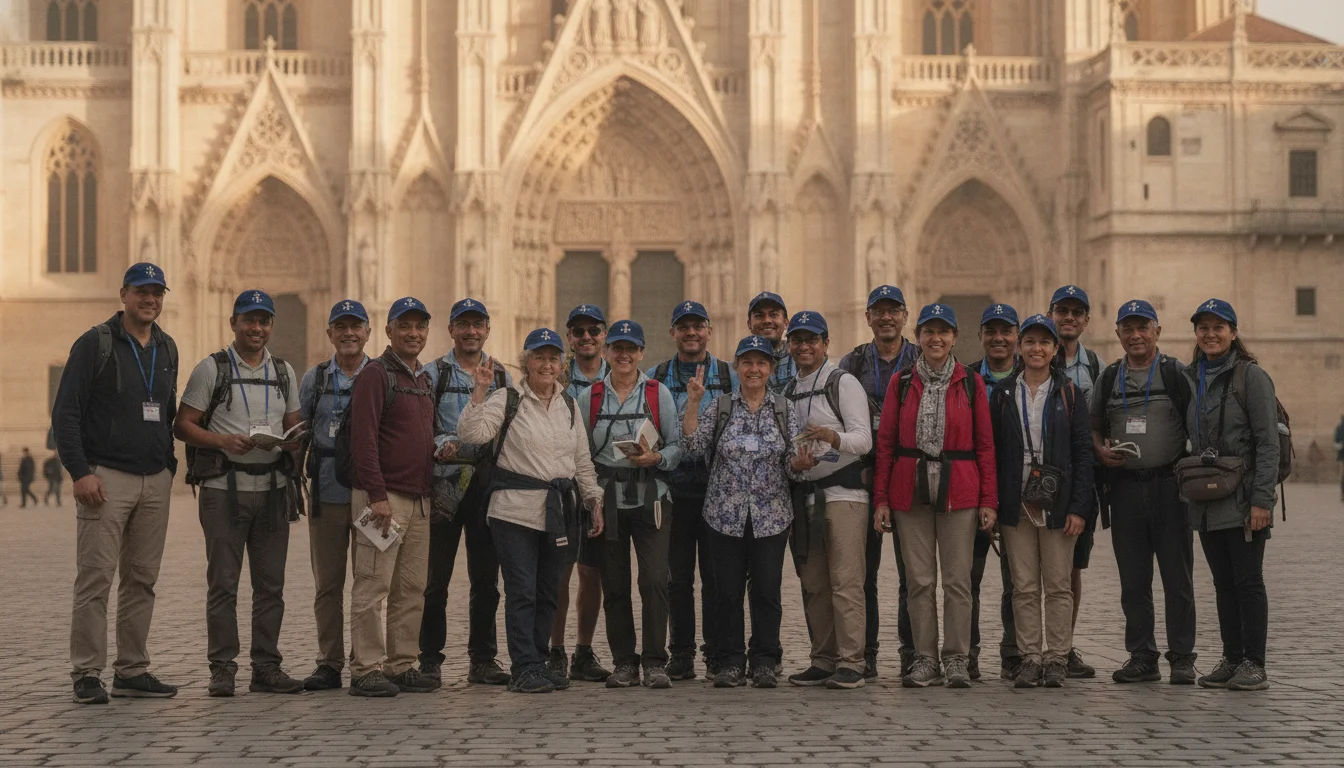
Most pastors I meet have already taken their people to Israel, or they are planning to. That trip is the anchor. It is where the Gospels happen, where the group walks the Galilee and stands in Jerusalem, and it changes people. But somewhere on the flight home, a leader starts asking the next question. Where do we go after Israel? What comes next for a group that has already tasted what heritage travel does to a congregation?
The answer, almost always, is Europe. Not because Europe is a consolation prize, but because the story keeps moving there. After the resurrection, the church pushed west out of Jerusalem. Paul carried it across Greece and on to Rome. Europe is where you can still walk through that history with your own feet. I have built heritage journeys for more than forty years, and Europe is where I send groups who want their second chapter.
This is a map, not a single itinerary. Below I walk through the main pilgrimage routes in Europe, what each one offers a church group, and where to read more when one of them catches your eye. Think of this page as the fork in the road. Each path leads somewhere specific, and I will point you down the right one.
Why Europe Is the Natural Next Pilgrimage After Israel
Israel is the land of the Gospels. Europe is the land of the church that grew out of them. That is the simplest way I know to put it.
When your people finish an Israel trip, they have stood where Jesus taught. What they often have not seen is where the faith went next: the cities where Paul preached and was jailed, the roads the Gospel traveled, the places where the church was tested and reformed and carried forward for two thousand years. Europe holds all of that, and it holds it densely. A single week in Greece or Italy can put a group in front of more early-church history than they expected to see in a lifetime.
There is a practical reason too. Europe is reachable, the infrastructure is strong, and a well-built trip moves your group through it without friction. You get depth without the logistics becoming the story. For a congregation that already trusts you as a leader, the second trip is often easier to fill than the first, because your people have seen what these journeys do.
Paul’s Greece
Greece is where most groups start their European chapter, and for good reason. This is where Acts stops being a map and becomes a place you can stand in. Paul crossed into Europe at Philippi, preached in Thessalonica and Berea, reasoned in Athens on Mars Hill, and spent eighteen months in Corinth. A group can follow that route in a week and read the letters aloud in the cities they were written to and about.
Greece works for a church group because it combines the biblical spine with real beauty and manageable travel. The sites are moving, the guides know how to open them up, and the country carries a group well. If your people have read Acts and the epistles and want to walk them, this is the trip. Start with our guide to church group tours to Greece, and if you want the route site by site, follow a footsteps of Paul itinerary to see how the days connect from Philippi down to Corinth.
Rome and Early-Church Italy
Rome is where Paul’s road ends and where the early church steps out of the New Testament and into history. This is the city Paul was brought to in chains, where Peter and Paul are traditionally held to have died, and where the church went from a persecuted minority to something that reshaped the Western world.
For a group, Italy offers a different weight than Greece. In Greece you walk the missionary journeys. In Rome you stand at the hinge point, the catacombs where believers buried their dead and worshiped in hiding, the sites tied to the apostles, the layers of a city where empire and church met head on. It suits a congregation that wants to see what happened to the movement after Acts closes, how the faith survived and spread. If Rome is pulling at your group, our guide to church group tours to Italy lays out how the itinerary comes together and what a week there gives your people.
Reformation Germany
For Protestant congregations, Germany is a pilgrimage of a different kind. This is not the first century. This is the sixteenth, and it is the story of how the church you belong to came to be. Wittenberg, where Luther is said to have posted the Ninety-Five Theses on the castle church door. The Wartburg, where he hid and translated the New Testament into German. Erfurt, Eisleben, the towns where the Reformation was lived out.
A Reformation trip lands hardest with Lutheran, Reformed, and broadly Protestant groups who want to trace their own roots. It is less about the biblical text and more about the recovery of it, the moment the Scriptures were put back into the hands of ordinary believers. For many congregations that is deeply personal history, not distant history. If your church tells its story through the Reformation, look at how we build Reformation group tours of Germany and what a week on Luther’s ground offers a group.
The Camino in Spain
The Camino de Santiago is the oldest continuous pilgrimage route in Europe, and it asks something different from your group. The others are tours: you ride, you stop, you see, you reflect. The Camino is a walk. Pilgrims have crossed northern Spain on foot for over a thousand years to reach the shrine of Saint James at Santiago de Compostela, and a church group can walk a section of it together.
This is the trip for a congregation that wants the journey to be physical, shared, and slow. There is something specific that happens when a group walks day after day, carries a little, talks on the road, and arrives together. It builds a kind of fellowship that a coach cannot. It is not for every group, and it takes a certain readiness, but for the right community it is unforgettable. If a walking pilgrimage speaks to your people, read how we organize Camino pilgrimage groups and what to expect on the road.
Malta and Paul’s Shipwreck
Malta is small, and it is often overlooked, which is a mistake. Acts 27 and 28 tell the story of Paul’s shipwreck on the way to Rome, three months on the island, the viper that did him no harm, the healing of the father of Publius. Malta is where that chapter happened, and the island has kept the memory of it close for two thousand years.
For a group, Malta works best as a focused add-on or a shorter journey rather than a full week on its own. It pairs naturally with an Italy trip, since it sits on the sea road Paul traveled toward Rome. If your people have ever wondered what it was like to be shipwrecked and stranded and still carried by God’s providence, Malta puts that story in front of them. It is a strong second leg, and I will note below how to combine it with a larger trip.
Biblical Turkey, On the Edge of Europe
Turkey straddles the line between Europe and Asia, and biblically it carries more weight than most leaders realize. The seven churches of Revelation are here: Ephesus, Smyrna, Pergamum, and the rest. So is much of Paul’s earlier missionary work, the churches of Galatia, Antioch of Pisidia, and Ephesus, where he spent years and where Acts records the riot in the theater.
Turkey suits a group that wants to go deep into the New Testament world beyond Greece and Rome. Ephesus alone is one of the most complete ancient cities a group can walk, and standing in the theater where the crowd shouted for two hours is a different way to read Acts 19. It combines well with Greece, since the two together trace nearly the whole arc of Paul’s work. Start with our guide to church group tours to Turkey to see how the seven churches and the Pauline sites fit into a week.
How to Choose Between Them
Six routes, one group, one set of dates. Here is how I help leaders narrow it down.
Start with your people, not the map. What is your congregation studying, preaching through, drawn to? A church walking through Acts wants Greece or Turkey. A Reformation-minded congregation wants Germany. A group that loves to walk and wants shared physical experience wants the Camino. A church that wants to stand where the early church survived empire wants Rome. Let the trip grow out of what your community already cares about, and it will fill more easily.
Then weigh the kind of experience. Most of these are touring pilgrimages: you cover ground by coach, stop at sites, teach, and reflect. The Camino is the exception, a walking pilgrimage that asks for stamina and time. Malta is the smallest and works best as part of something larger. Everything else can carry a full week on its own.
If you are still deciding, our complete guide for group leaders walks through the whole planning arc, from first interest to departure, and it applies to any of these destinations.
How Many Days You Need
For most of these routes, seven to ten days is the working range. A week gives you the core of Greece, Italy, Germany, or Turkey without rushing. Ten days lets a group breathe, add a site or two, and build in more time for reflection rather than only transit.
The Camino is its own math. How many days depends on how much of the route you walk. A group can do a meaningful final stretch into Santiago in about a week, or take longer for more of the road. Malta on its own is a short trip, three to five days, which is exactly why it pairs so well with something bigger.
My honest advice: do not try to see everything in one trip. A focused week that your people actually absorb beats a rushed twelve days they only half remember. Depth is what makes these journeys stay with a congregation.
Combining Two Countries
Some of these routes were made to travel together, and combining two can give a group a fuller arc without a second trip.
Greece and Turkey is the natural pairing. Together they cover almost the whole span of Paul’s missionary work and the seven churches, and the two sit close on the map. Italy and Malta is the other obvious combination, since Malta lies on the sea road Paul sailed toward Rome. Both pairings turn two separate stories into one continuous journey.
A combined trip usually wants more days, ten to fourteen, and a bit more lead time to plan well. But for a group that has already traveled with you and wants to go deeper, it is often the right call. When you reach out, tell me which two are pulling at you and I will show you how they connect.
The Free-Leader Model
One thing holds true across every one of these destinations. With fifteen or more paying participants, the group leader travels free. The leader’s full trip cost, flights, hotels, ground transportation, and included site entries, is covered by the economics of the group booking.
This is not a Greece-only benefit or an Italy-only benefit. It is how we structure group heritage travel wherever the trip goes. For a pastor or congregation leader, it takes the hardest question off the table. You are not asking your church to fund an expensive trip for you. You are organizing a journey your people pay into, and your seat is part of how it is built. That frees you to do your real job on the trip, which is to shepherd your people through it, not to act as its accountant. You can see how the group experience works on our group heritage tours page.
FAQ: Christian Pilgrimage Tours in Europe
Which European pilgrimage is best for a first trip after Israel?
For most groups, Greece. It picks up the story right where Israel leaves off, following Paul’s crossing into Europe through Philippi, Thessalonica, Athens, and Corinth. It combines strong biblical content with manageable travel, which makes it a natural second chapter for a congregation.
Can we combine two countries in one pilgrimage?
Yes, and two pairings work especially well. Greece and Turkey together cover most of Paul’s missionary journeys and the seven churches of Revelation. Italy and Malta follow Paul’s sea road toward Rome. A combined trip usually wants ten to fourteen days and a little more planning time.
How many days should a European pilgrimage be?
Seven to ten days is the working range for Greece, Italy, Germany, or Turkey. A week covers the core without rushing, and ten days gives your group more room to reflect. The Camino varies with how much of the route you walk, and Malta on its own is a shorter three-to-five-day trip.
Do these trips include the free group-leader benefit?
Yes. With fifteen or more paying participants, the group leader travels free on every European destination we run, not just one. The leader’s flights, hotels, ground transportation, and included site entries are covered by the group booking.
Which pilgrimage fits a Protestant or Reformation-minded congregation?
Germany. The Reformation route traces Luther’s ground through Wittenberg, the Wartburg, Erfurt, and Eisleben, and it lands hardest with Lutheran, Reformed, and broadly Protestant groups who want to walk their own roots. Our guide to Reformation group tours of Germany lays out how a week there comes together.
If your people are asking where to go after Israel, one of these six routes is almost certainly the answer. The hard part is not whether Europe is worth it. It is choosing which chapter to walk first, and how to build a group that fills.
Contact us and tell me what your congregation is drawn to. I will help you pick the right route, size the trip, and run the numbers for your dates.