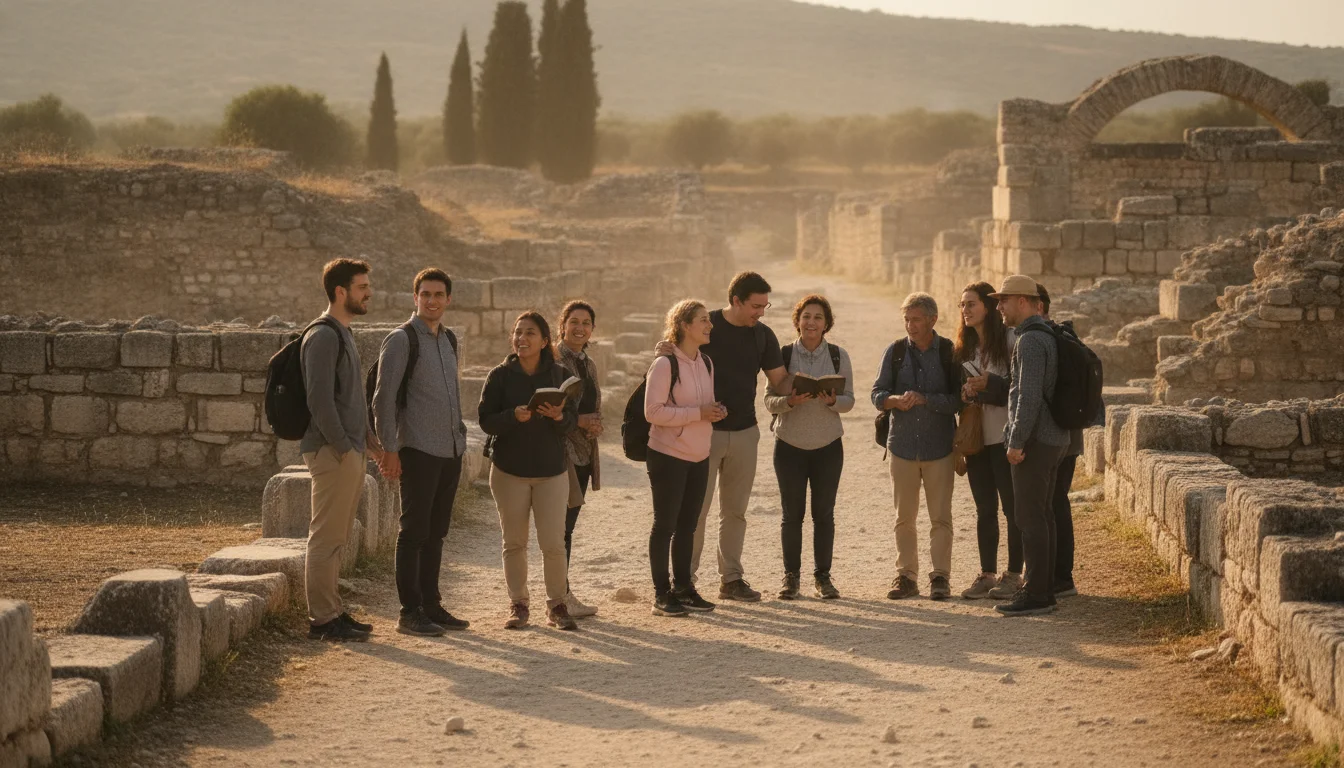
Most pastors who call me about a Footsteps of Paul trip already know the destination. What they do not have yet is a day-by-day plan they can hand to their board, print in a bulletin, and use to answer the questions their people will ask. That is the gap I want to close here. I have built heritage journeys for more than forty years, and I have walked Paul’s route across Greece with groups of every size and stage of faith. Below is a real itinerary, day by day, arrival through departure, with the sites, why each one matters, a Scripture reading tied to it, and honest pacing notes.
Think of this as a working draft you can adapt, not a fixed package. Some groups want the classic Greece route. Others extend into Turkey to stand in Ephesus. I will cover both, and I will tell you where the days get long so you can plan for the energy of your group, not just the map.
Before You Read the Days: The Shape of the Trip
Paul’s second missionary journey brought the gospel into Europe for the first time. He crossed from Asia Minor into Macedonia after a vision, landed near Philippi, and moved south through Thessaloniki, Berea, Athens, and Corinth. Acts 16 through 18 is the narrative spine of the whole trip. If your group reads nothing else beforehand, have them read those three chapters. The route below follows that same path in the same order Paul traveled it, which means your people experience the book of Acts as a journey rather than a list of stops.
The core Greece itinerary runs eight days. Adding Ephesus in Turkey pushes it to eleven or twelve, either by a short flight from Athens or by folding it into the front of the trip. I will mark the Turkey extension clearly so you can decide.
Day 1: Arrival in Thessaloniki
Your group flies into Thessaloniki, in the north, and this is deliberate. Starting in the north lets you follow Paul’s actual direction of travel, from Philippi southward, rather than backtracking.
Day one is a travel day. People arrive tired, jet-lagged, and a little disoriented. Do not schedule a site visit. Get everyone to the hotel, gather for a relaxed group dinner, and read the opening of the story together.
Reading: Acts 16:6-10, the Macedonian vision. This is the moment the whole trip hinges on. Reading it the first night frames why you are all standing on this soil.
Pacing note: Keep the evening short. A warm meal, brief introductions, and an early night do more for the week than an ambitious first day ever could.
Day 2: Philippi and Kavala (Ancient Neapolis)
This is the day the trip becomes real. You drive out to Philippi, the first place in Europe where Paul preached and where the first European convert, Lydia, was baptized.
At Philippi you walk the ancient forum, the ruins of the basilicas, and the traditional site of Paul and Silas’s imprisonment. Nearby runs the river where Lydia and the women gathered to pray. Many groups hold a baptism or a renewal of baptismal vows at the river. It is one of the most moving moments of the whole journey, and I encourage you to plan for it rather than improvise it.
On the way back, stop in Kavala, ancient Neapolis, the port where Paul first stepped onto European ground.
Readings: Acts 16:11-15 at Lydia’s river. Acts 16:25-34, Paul and Silas singing in prison, at the prison site.
Pacing note: This is a full day with real walking on uneven ancient stone. Comfortable shoes, water, and a mid-day rest matter. Emotionally it is a high point, so leave room in the evening for people to talk about what they felt.
Day 3: Thessaloniki City and Berea
Today stays closer to base. You explore Thessaloniki itself, where Paul preached in the synagogue for three Sabbaths and where his letters to the Thessalonians later went. Walk the old city, see the Roman forum, the Arch of Galerius, and the churches that carry the early Christian memory of the city.
In the afternoon, drive to Berea (modern Veria), where the Jewish community “examined the Scriptures daily” to test what Paul taught. There is a bema, a monument marking where Paul is remembered to have preached. Berea is a quieter stop, and that quiet is part of its character. It rewards a slower visit.
Readings: Acts 17:1-9 in Thessaloniki. Acts 17:10-15 at the Berea bema, with its picture of a community that checked the message against Scripture, a good moment to talk with your group about how they read.
Pacing note: Lighter than day two. Good day to let people shop, rest, or wander a little on their own in the evening.
Day 4: Meteora on the Way South
Paul did not stop at Meteora, so I will be honest with you: this is not a Pauline site. It is an early-church and monastic site, the dramatic monasteries built on top of towering rock pillars, and it sits naturally on the drive from the north down toward central Greece. Most groups include it, and most are glad they did.
Meteora connects your group to the wider story of how the early church took root and endured in Greece across the centuries. It also breaks up a long driving day with something unforgettable.
Reading: This is a fitting day for a broader reflection. Try Hebrews 11 or Philippians 1:3-11, Paul writing back to the very church you stood in two days ago.
Pacing note: The monasteries involve stairs and climbing. Have a plan for anyone in your group who cannot manage steep steps, since some monasteries are more accessible than others. Overnight near Kalambaka.
Day 5: Delphi and On to Athens
Delphi is another non-Pauline stop that most groups include, and for good reason. It was the religious center of the ancient Greek world, the home of the famous oracle. Standing there, your group understands the spiritual landscape Paul walked into, a world thick with temples, gods, and altars. It sets up Athens perfectly.
In the afternoon you continue to Athens, the intellectual heart of the ancient world and the setting for one of Paul’s most remarkable sermons.
Reading: Save the Athens reading for tomorrow, on site. Today, read Acts 17:16, “he was greatly distressed to see that the city was full of idols,” and let Delphi make that verse concrete.
Pacing note: A driving-heavy day with one major site. Arrive in Athens in time for a calm dinner. Tomorrow is demanding.
Day 6: Athens and the Areopagus
This is the intellectual peak of the trip. You climb to the Acropolis and stand beneath the Parthenon. Then you walk down to the Areopagus, Mars Hill, the rocky outcrop where Paul addressed the philosophers of Athens.
Reading Paul’s Areopagus sermon while standing on the very rock is one of the reasons people take this trip. He met the Athenians on their own ground, quoted their own poets, and pointed them from the “unknown god” to the risen Christ. Your group will not forget it.
Below the Acropolis lies the ancient Agora, where Paul debated daily, and the reconstructed Stoa. Give it time.
Readings: Acts 17:16-34 on the Areopagus itself. This is the centerpiece reading of the whole journey, so plan who reads it and where everyone stands.
Pacing note: The Acropolis is a steep climb on marble that gets slippery when polished by centuries of feet. Go early to beat the heat and the crowds. This is the most physically demanding day after Philippi.
Day 7: Corinth
A day trip from Athens brings you to ancient Corinth, where Paul stayed for a year and a half, longer than almost anywhere else. Here he worked as a tentmaker alongside Aquila and Priscilla, preached, and later wrote back to this community in the two Corinthian letters.
At Corinth you see the ruins of the ancient city, the Temple of Apollo, and the bema, the judgment seat where Paul stood before the proconsul Gallio. That bema is one of the few places on the trip you can date precisely, which makes it a strong anchor for talking about Acts as real history.
On the way, stop at the Corinth Canal, a striking cut through solid rock.
Readings: Acts 18:1-17 at Corinth, especially the scene at the bema. If time allows, read 1 Corinthians 13 in the city it was written to.
Pacing note: Moderate. The site is open and sunny with little shade, so time your visit for morning or late afternoon and carry water.
Day 8: Departure, or Bridge to Turkey
For the eight-day Greece itinerary, this is your departure day from Athens. Build in a slow morning and, if the flight allows, a final group breakfast to close the circle. Ask each person to name one moment that stayed with them. It turns a trip into a shared memory.
If you are extending to Ephesus, today becomes a travel day. A short flight carries you from Athens to Izmir in Turkey, the gateway to Ephesus, and the trip continues below.
The Turkey Extension: Days 8 to 11
Ephesus is where Paul spent roughly three years, the longest stay of his ministry, and it is one of the best-preserved ancient cities anywhere. If your group has the days and the budget, it is worth the extension.
Day 9: Ephesus
You walk the marble main street, the terraced houses, the great theater where the silversmiths rioted against Paul, and the ruins of what was once the Temple of Artemis, one of the seven wonders of the ancient world. Standing in the theater and reading the riot account is unforgettable, because you can see exactly how a crowd of thousands filled that space.
Nearby is the traditional site associated with the Apostle John and, by tradition, the house of Mary.
Readings: Acts 19 in the theater, the account of Paul’s years in Ephesus and the riot. Ephesians 1 as a closing reflection.
Pacing note: A full walking day on ancient stone, largely uncovered. Early start, sun protection, water.
Day 10: Reflection and Nearby Sites
Depending on your group’s interest, this day can visit the House of the Virgin Mary, the Basilica of St. John, or the Ephesus museum, or simply slow down after a demanding week. Older groups especially appreciate one gentler day near the end.
Reading: Revelation 2:1-7, the letter to the church in Ephesus, spoken to the very community whose streets you just walked.
Day 11: Departure
Fly home from Izmir, or connect back through Istanbul. Close the trip the same way, with a shared breakfast and a moment to name what mattered.
Best Time of Year to Travel
For most church groups, the two windows I recommend are late April through early June, and mid-September through mid-October.
Spring gives you green hills, wildflowers across the ruins, and mild walking weather before the summer heat arrives. It is my usual first choice. Fall gives you warm days, cooler evenings, and thinner crowds after the summer rush has cleared. Both keep your group off the July and August heat, which at sites like Corinth and Ephesus, open and shadeless, can wear people down fast.
If you want to travel around a season in the church calendar, Orthodox Easter shapes the mood and the crowds across Greece, so plan early and expect fuller sites if you go then. For a fuller look at timing and route options, see a church trip in the footsteps of Paul and our overview of church group tours to Greece.
A Note on Reading the Trip as the Book of Acts
The reason this itinerary moves the way it does is that it lets your people live inside the narrative of Acts rather than read about it from a distance. Paul crossed into Europe at Philippi. He argued in Thessaloniki, was tested in Berea, preached to philosophers in Athens, and settled in for the long work at Corinth. Standing in each place in that order turns the early history of the church from a chapter heading into ground under your feet.
That is the heart of a heritage journey. The sites do the teaching. Your job as the leader is to be present, to read the Word aloud in the place it happened, and to let your community feel the weight of standing where the church in Europe began. For the full planning framework, from group size to budgeting to recruiting your travelers, see the complete leader’s guide.
FAQ: The Footsteps of Paul Itinerary
How many days do I need for a Footsteps of Paul trip?
Eight days covers the core Greece route from Thessaloniki and Philippi in the north down through Athens and Corinth. Adding Ephesus in Turkey brings it to eleven or twelve. Fewer than eight days forces you to cut either the north or the south, and both are central to the story, so I do not recommend it.
Should we include Turkey, or stay in Greece?
It depends on your days and your budget. Greece alone gives your group the full arc of Acts 16 to 18, which is a complete and satisfying trip. Ephesus adds Acts 19 and the longest chapter of Paul’s ministry, and it is one of the best-preserved ancient cities in the world. If your group can give the extra three days, it is worth it. If not, the Greece route stands on its own, which is why most of our Apostle Paul tours in Greece are built to feel complete without the Turkey extension.
What is the most physically demanding part?
The Acropolis in Athens and the ancient site of Philippi involve the most climbing and walking on uneven, polished stone. Corinth and Ephesus are flatter but open and sunny with little shade. Comfortable shoes, water, sun protection, and a realistic pace matter more than any other single preparation.
When is the best time of year to go?
Late April through early June, or mid-September through mid-October. Both give you mild walking weather and thinner crowds than midsummer. Avoid July and August if you can, since the open sites get hot.
How far ahead should we start planning?
Six to nine months for a group of fifteen to thirty, and nine to twelve months for larger groups or trips timed around a holiday season. Early planning is as much about recruiting your travelers and setting real dates as it is about booking, because concrete dates and a real itinerary are what move people from interested to committed.
If you want help turning this outline into a trip your group can actually take, with dates, sites, and a plan that fits your congregation, that is exactly what we do. Look at the full route on our Greece heritage tours page, and when you are ready, contact us and we will build the itinerary around your people and your dates.