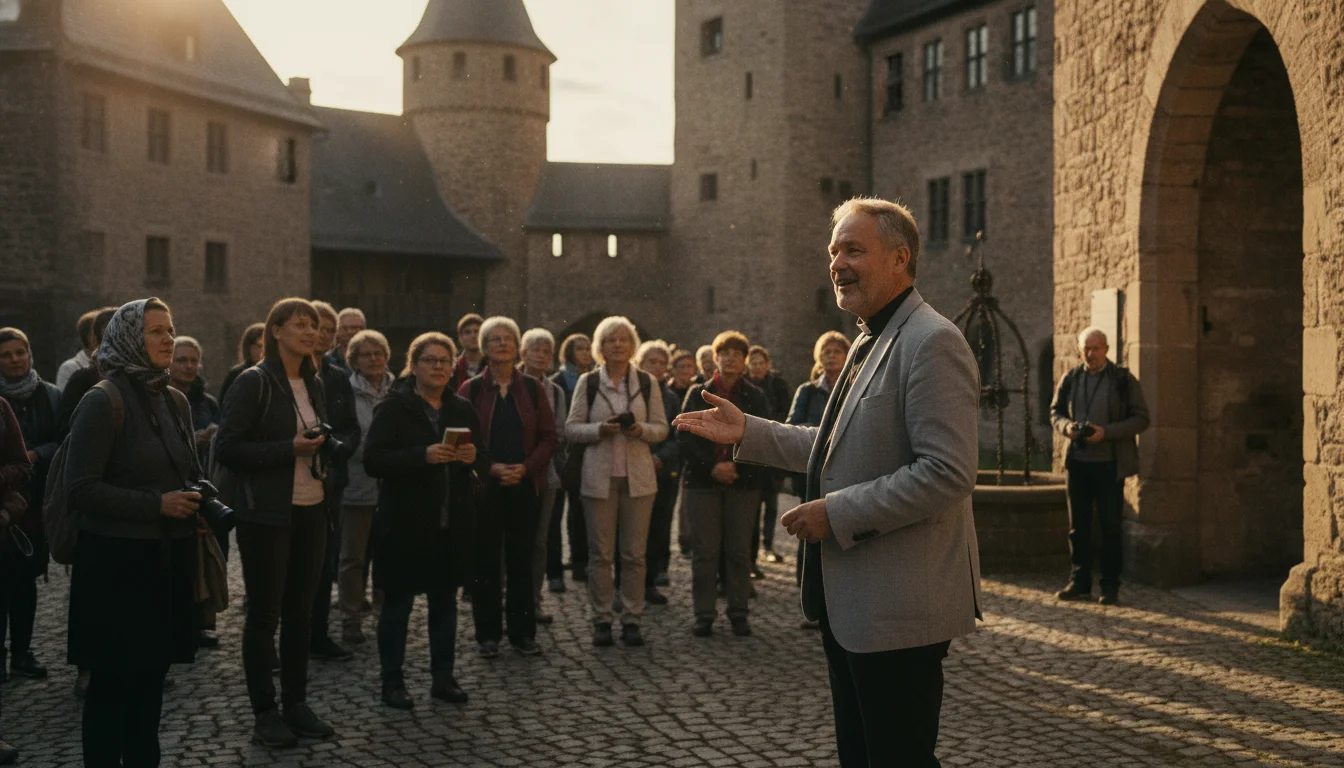
Most pastors who call me about Germany start the same way. They have been preaching through Romans or Galatians, or they just marked another Reformation Sunday, and someone in the congregation asked the question out loud: could we actually go see where this happened? By the time that question reaches the pastor, it has usually turned into a private worry about cost, logistics, and whether he is the right person to lead thirty people across a country he has never visited. I want to take that worry apart, because a church group trip to Germany built around the Reformation sites is one of the most manageable heritage journeys a first-time leader can run.
I have built heritage journeys for more than forty years, and Germany has a quiet advantage most leaders do not expect. The Luther route is compact, the roads are excellent, and the sites are close enough together that you are not burning days in transit. This guide is written for you, the organizer, the person deciding whether to lead this trip, how to pay for it, and how to fill it. Not the individual traveler. The leader.
Why Germany Works So Well for a First Group Trip
The Reformation happened in a fairly small corner of central Germany. That geography does most of the work for you.
Wittenberg, where Luther posted the Ninety-Five Theses on the Castle Church door in 1517, sits about an hour and a half from Berlin. Eisleben, where he was born and died, and Erfurt, where he became a monk, are a short coach ride away. Eisenach and the Wartburg Castle, where he hid under the name Junker Jörg and translated the New Testament into German, are a little further south. Add Worms, where he stood before the emperor and refused to recant, and Augsburg, where the Augsburg Confession was presented in 1530, and you have a complete Reformation arc that fits inside eight to ten days without anyone feeling rushed.
For a leader, that compactness matters more than the individual traveler realizes. Shorter drives mean less coordination, fewer things that can go wrong, and more time standing in the actual places while you read the actual texts aloud. It also means the trip is easier to explain when you are recruiting. “We will stand at the Castle Church door, sit in the room where Luther translated the Bible, and see where he faced the emperor” is a sentence your congregation can picture.
What a Lutheran Group Tour of the Reformation Sites Includes
When leaders ask what a Lutheran group tour of the Reformation sites actually covers, they are really asking whether the trip will feel like tourism or like something their people will carry home. The best reformation tours for churches are built so the theology and the travel reinforce each other rather than compete, and the answer depends on how the itinerary is built, so here is what a serious route looks like.
A well-built Reformation itinerary moves in Luther’s own footsteps rather than hopping between unrelated stops. You begin where his story begins, in Eisleben and Erfurt, walk through the monastery where he wrestled with grace, then travel to Wittenberg for the heart of the trip: the Castle Church, the Luther House (once the Augustinian monastery, later his family home), St. Mary’s Town Church where he preached, and Philipp Melanchthon’s house next door. From there the route runs to the Wartburg above Eisenach, then west to Worms and often south to Augsburg, closing the theological arc where the Confession was made.
Around those sites, the trip carries the things that turn a tour into a pilgrimage: local guides who know the Reformation history in depth, time built in for your own devotionals and reflection at each stop, and evenings where your group can process what they saw together. For many Lutheran and broader Protestant congregations, we also build in a worship or communion moment at one of the historic churches, subject to arrangement with the parish. That is the kind of thing you raise early, and I cover how to vet an operator on those details in our guide to choosing a faith tour operator.
The Money Question: How the Leader Travels Free
Here is the part that decides whether most trips happen. When you organize a group of fifteen or more paying travelers, your seat as the group leader is covered. Not discounted. Covered.
That means your flights, hotel accommodation, ground transportation, site entries, and the group meals built into the itinerary are all included at no personal cost to you. The reason is straightforward. A group of fifteen paying participants generates enough margin inside the trip’s costing to absorb one additional traveler, and that traveler is you, because you are the reason the group exists. I explain the full logic of this in our piece on whether the pastor travels free, and the exact headcount thresholds in how many people you need for a free leader.
This changes the shape of your decision completely. You are no longer asking your church to send the pastor on an expensive trip he cannot justify. You are organizing a journey your congregation pays into, and your own participation is built into how the numbers work. If your board has ever hesitated on a leader’s travel line item, this is the answer to bring them. It is also, in my experience, the single fact that moves a Germany trip from “someday” to a date on the calendar. For the deeper version of that conversation, read how pastors afford to lead a trip.
What Happens Below Fifteen
Smaller groups are welcome. We run Germany trips for ten to fourteen people regularly, and they are often more intimate for it. They simply do not carry the free-leader benefit, because the economics that fund the complimentary seat begin at fifteen. In that range the leader either pays a participant’s price or the group agrees to absorb a small premium to cover the leader’s seat.
If you are sitting at twelve committed with a few maybes, my advice is to start planning anyway. Interest almost always firms up once people see real dates and a real itinerary. I have watched many groups cross from thirteen to seventeen in the final two months, purely because the trip stopped being an idea and became a thing they could sign up for.
Building a Group of Fifteen From a Congregation
This is the part leaders lose sleep over, so let me be practical.
You do not recruit fifteen strangers. You find the eight or ten people in your church who already want to go, and you let them bring the rest. Couples travel together. Friends bring friends. A men’s Bible study or a Sunday school class travels as a unit. Fifteen is very reachable when you start from the people already leaning in rather than staring at the whole membership roll.
Tie the trip to something your church is already doing. If you are teaching through Reformation history, running a fall series on Luther, or marking the anniversary of the Ninety-Five Theses, the Germany trip becomes the physical extension of what your people are learning. That connection converts interest far better than a standalone travel announcement in the bulletin. For a full playbook on this, our guide to recruiting for a church trip walks through the mechanics, and the church group planning checklist keeps the moving parts in order.
The other thing that fills a group is money that feels manageable. Very few congregants can write one large check, but most can handle a deposit and monthly payments over six or nine months. Offering a group payment plan removes the single biggest reason people say no, and some churches pair it with light fundraising for the trip to bring the cost down further.
How Far Ahead to Plan
Six to nine months is the sweet spot for a group of fifteen to thirty heading to Germany. That window gives your people time to budget, request time off work, and commit, and it gives you the runway to build interest, which is the real work of leading a trip.
If you are aiming for a larger group, or timing the trip around Reformation Day at the end of October when the Wittenberg sites draw crowds, give yourself nine to twelve months. Earlier planning is not only about booking hotels and coaches. It is recruiting time, and recruiting is what determines whether you hit fifteen. Our guide on how far ahead to plan breaks the timeline down month by month.
One practical note on timing the trip itself: late spring and early fall are the kindest for a group in Germany. The weather is comfortable for walking cobblestone town centers and castle grounds, and the daylight is long enough for full days without exhausting older travelers. Peak summer works but runs warmer and busier at the marquee sites.
Budgeting the Trip So Your Board Says Yes
A church board rarely rejects a trip because it is too expensive. It rejects a trip because the numbers are vague. Bring them a clear per-person price, a deposit schedule, and a plain statement that the leader’s seat is covered at fifteen, and the conversation gets short.
Build your budget around the all-in participant price the operator quotes, not a pile of separate line items your travelers have to assemble themselves. A good group price for Germany folds international flights, hotels, ground transport, guiding, site entries, and daily breakfasts plus most dinners into one figure, so your congregants know what they are committing to. Personal spending, a few lunches, and any optional add-ons sit outside that. Our guide to budgeting a church trip shows how to present this cleanly, and when you are ready for real numbers you can get a custom quote for your dates and group size.
Your Real Job Once the Logistics Are Handled
Here is what I most want you to hear. When the free-leader model takes your personal cost off the table and a good operator handles the coaches, hotels, and guides, it frees up the thing that actually matters: your attention.
You are not the trip’s accountant or its travel agent. You are its shepherd. Your job at the Castle Church door is to help your people feel the weight of what happened there. Your job in the room at the Wartburg is to read from the German Bible Luther translated in that very space and let it land. Your job over dinner is to be present for the couple who has never traveled abroad and is a little overwhelmed. The operator’s job is to make everything else invisible so you can do yours. The free seat and the logistics support are simply how we keep your focus where it belongs. If you want the full framework for leading a trip end to end, start with our pillar guide on how to plan a group pilgrimage.
FAQ: Church Group Trips to Germany’s Reformation Sites
How many people do I need for the group leader to travel free to Germany?
Fifteen paying participants. At fifteen or more, your full trip cost as the leader is covered, including flights, hotels, ground transportation, and site entries. Below fifteen the trip still runs, but the leader pays a participant’s price or the group covers the seat by agreement.
Which Reformation sites should a Lutheran group tour include?
The core route is Wittenberg (the Castle Church, Luther House, and St. Mary’s Town Church), Eisleben and Erfurt for Luther’s early life, the Wartburg Castle above Eisenach where he translated the New Testament, and Worms where he faced the emperor. Many groups add Augsburg, where the Augsburg Confession was presented in 1530.
How long should a Germany Reformation trip be?
Eight to ten days is the sweet spot. The sites sit close together in central Germany, so a well-built route reaches all the key places without long transfers or rushed mornings, which leaves room for devotionals and reflection at each stop.
When is the best time of year to bring a group?
Late spring and early fall give you comfortable walking weather, long daylight, and lighter crowds than peak summer. If you want to be in Wittenberg for Reformation Day at the end of October, plan nine to twelve months ahead, since those dates draw larger crowds.
How far in advance do we need to start planning?
Six to nine months for a group of fifteen to thirty, and nine to twelve for larger groups or trips timed around Reformation Day. Most of that lead time is recruiting your group, not booking logistics. Concrete dates and a real itinerary are what move people from interested to committed.
If you are weighing whether a Germany trip is realistic for your congregation, the free-leader math is usually what tips it. You can see how the group experience works on our group heritage tours page, or look at the full route on our Germany heritage page.
Contact us and we will help you run the numbers for your group and your dates.