Most pastors who call me about Turkey start the conversation the same way. They have taken a group to Israel, maybe walked Paul’s route through Greece, and now someone in the congregation has asked the question that changes everything. “What about the seven churches?” And the pastor realizes he does not actually know where they are, how far apart they sit, or whether a real trip could hold them all together. That is usually where I come in.
I have built heritage journeys for more than forty years, and Turkey is one of the destinations I most wish more leaders understood. It holds more of the New Testament than any country outside Israel. Paul was born there. John pastored there. The book of Revelation was written to seven congregations that all sit within a few hours of one another on modern roads. And yet Turkey is often the last biblical destination a church considers, usually because no one has laid out how the pieces fit. So let me lay them out.
Why Turkey Belongs on Your List
When people picture the lands of the Bible, they think of Israel first, then maybe Greece for Paul’s missionary journeys. Turkey rarely comes to mind, and that is a gap worth closing. Ancient Asia Minor, most of which is modern Turkey, is where a large part of the early church actually took shape.
Paul was from Tarsus, on Turkey’s southern coast. His first missionary journey ran through Antioch, Iconium, Lystra, and Derbe, all in what is now Turkey. Antioch, where believers were first called Christians, sits near the Syrian border. The seven churches of Revelation were all here. The first seven ecumenical councils, the ones that shaped Christian doctrine, met on Turkish soil, including Nicaea and Chalcedon. When you bring a group to Turkey, you are not visiting the edges of the biblical story. You are standing in the middle of where the early church learned to be the church.
For a congregation that has already been to Israel, Turkey is the natural next journey. It answers the question Israel raises, which is what happened after Acts, how the gospel moved out of Jerusalem and into the wider world. Turkey is that story on the ground.
Ephesus: The Anchor of the Trip
If Turkey has a spiritual capital for a Christian group, it is Ephesus. This is the one site I tell leaders to build the trip around, because it delivers on every level a heritage journey needs to work.
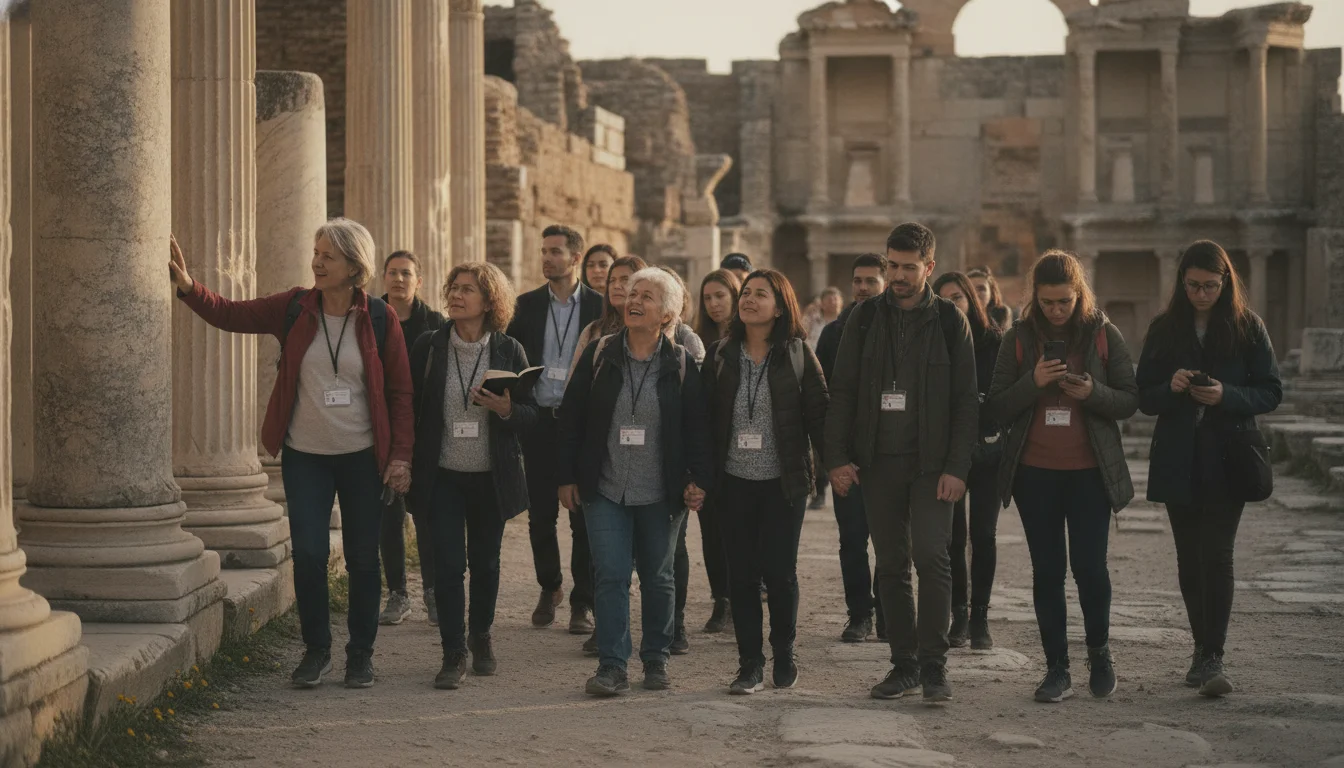
Ephesus is one of the best-preserved ancient cities in the Mediterranean. Your group will walk the marble main street, stand in the great theater where the silversmiths rioted against Paul in Acts 19, and see the facade of the Library of Celsus rising two stories high. This is not a pile of stones you have to imagine your way into. It is a city you walk through. For a congregation, that difference is everything. People who struggle to picture the ancient world suddenly find themselves inside it.
The biblical weight matches the ruins. Paul spent more than two years in Ephesus, longer than almost anywhere else. He wrote First Corinthians from here. The letter to the Ephesians went to this church. John is traditionally believed to have lived his final years here and cared for Mary, and both the House of the Virgin Mary and the Basilica of St. John sit nearby. Ephesus was also the first of the seven churches addressed in Revelation. You can read Revelation 2 aloud on the site the letter was sent to. Few moments on any heritage trip land as hard as that one.
The Seven Churches of Revelation
The seven churches are the reason many groups choose Turkey, and they are worth understanding before you plan, because they shape the whole route.
In Revelation 2 and 3, the risen Christ dictates letters to seven specific congregations: Ephesus, Smyrna, Pergamum, Thyatira, Sardis, Philadelphia, and Laodicea. These were real cities on a real Roman postal road, arranged in a rough circle through western Turkey. That is the part leaders find surprising. The seven churches are not scattered across the country. They form a loop you can actually drive, which is what makes a seven-churches itinerary possible in a single trip.
Each site carries its own message. Smyrna, modern Izmir, was the church that suffered and stayed faithful. Pergamum sits high on a hill with a dramatic acropolis and was called the place “where Satan’s throne is.” Laodicea, the lukewarm church, still has the remains of the water system that helps explain the letter’s imagery of water that was neither hot nor cold. Standing at each one, reading its letter where it was received, turns Revelation from a difficult book into a set of places your people have walked.
Not every group visits all seven. Some sites are more developed for visitors than others, and the full circuit takes real time. A good route usually gives full attention to Ephesus, Smyrna, Pergamum, and Laodicea, and folds in the others as the schedule allows. If the seven churches are your priority, I would build the trip specifically around them, and it pairs naturally with Greece. Our Greece and Turkey for church groups guide shows how the two shores connect into one route.
Cappadocia: Where the Trip Breathes
Here is something I have learned over forty years of building these journeys. A trip that is all ruins and reading, however meaningful, wears a group down by day five. People need a place that lifts the spirit differently. In Turkey, that place is Cappadocia.
Cappadocia is a landscape unlike anywhere else, a valley of soft volcanic rock carved by wind and water into cones and spires that early Christians hollowed into homes, chapels, and entire underground cities. When persecution came, believers here dug down, sometimes eight levels deep, and worshiped in secret. The Göreme valley holds cave churches painted with frescoes that have survived more than a thousand years. For a Christian group, Cappadocia is not a detour from the biblical story. It is the story of a church that went underground to survive and kept its faith intact.
It is also, simply, a place of wonder. The hot-air balloons that rise over the valley at dawn are one of the most photographed sights in the world, and watching that sunrise together tends to become the trip’s emotional high point. I include Cappadocia in most Turkey itineraries for exactly this reason. It gives your group a place to breathe, to talk, to let the week settle before the flight home.
How Many Days You Need
This is the practical question every leader asks, so let me give you real numbers.
A focused Ephesus-and-the-seven-churches trip works well in eight days on the ground, plus travel. That gives you Ephesus in depth, the main churches of Revelation, and the coastal cities without rushing. If you want to add Cappadocia, and I usually recommend you do, plan for ten to eleven days. Cappadocia is a domestic flight from the coast, so it costs you a travel morning, but the payoff is worth the day.
If your group wants Paul’s missionary journeys as well, Antioch, Tarsus, and the sites of the first journey, you are looking at twelve to fourteen days. That is a fuller pilgrimage, and it suits congregations that have studied Acts closely and want to walk the whole arc. For most first-time groups, though, I steer toward the ten-to-eleven-day route: Ephesus, the seven churches, and Cappadocia. It holds together, it does not exhaust people, and it sends them home having seen the heart of Christian Turkey.
Best Seasons to Travel
Turkey has a real climate, and timing matters more here than people expect.
Spring, from April into early June, is the best window for most groups. The weather is mild, the countryside around the ancient sites is green, and the crowds have not yet peaked. Autumn, September into October, is nearly as good, with warm days, cooler evenings, and comfortable walking at the archaeological sites.
I steer groups away from July and August unless there is no other option. Western Turkey and the coast get genuinely hot in high summer, and Ephesus offers little shade. Walking a group of older travelers through a Roman city at noon in August is not the memory you want to build. Winter is quiet and inexpensive, and Cappadocia under snow is beautiful, but some sites and services run on reduced schedules, and the short days limit how much you can see. For a congregation trip, spring and autumn are where I point almost everyone.
Combining Turkey With Greece
This is the combination I recommend most often, and it is worth explaining why.
Turkey and Greece tell one continuous story. Paul crossed between them. He sailed from the Turkish coast to Greece and back. The seven churches of Revelation sit just across the Aegean from Patmos, the island where John received the vision, and Patmos is reached from Greece. When you put the two countries together, you give your group the full sweep of the early church’s expansion, from Asia Minor into Europe, in one journey.
Practically, the two combine well. A group can fly into Athens, walk Paul’s route through Greece, cross to the Turkish coast, and finish with Ephesus, the seven churches, and Cappadocia. A combined trip runs longer, usually thirteen to sixteen days, so it suits groups with the time and appetite for a fuller pilgrimage. For many congregations it is the trip of a lifetime, and doing both countries in one journey costs less than two separate trips would. If this is where your thinking is heading, our guide to Greece and Turkey combined for groups lays out how the two routes stitch together.
The Free-Leader Model
Now the question that decides whether the trip actually happens, which is how the leader affords to go.
With fifteen or more paying participants, the group leader travels free. That covers the leader’s full trip on the same terms as everyone else: international flights, hotel accommodation, ground transportation, site entry fees, and the group meals built into the itinerary. It is not a discount. It is a complimentary seat built into the economics of a group booking. A group of fifteen generates enough margin within the trip’s costing to carry one additional traveler, and that traveler is you, the leader, because you are the reason the group exists.
For a congregation, this changes the shape of the decision entirely. You are not asking your church to send the pastor on an expensive trip. You are organizing a journey your people pay into, and your seat is part of how it is structured. Larger groups create more room, so groups of around twenty-five or thirty can sometimes unlock a reduced or complimentary second seat for a co-leader or spouse. If that matters to you, raise it early so we can build toward it.
Reaching fifteen is more doable than most leaders fear. You do not recruit fifteen strangers. You start with the eight or ten people in your community who already want to go, give them real dates and a real itinerary, and let them bring others. Couples come together. Friends bring friends. Bible study groups travel as a unit. When you can tell your congregation “we are walking Ephesus and the seven churches next May, ten days, here is what we will see,” people can decide, and interest firms up fast once the trip becomes concrete. For the full picture of how to plan and fill a group, our the complete leader’s guide covers it end to end, and what a group trip costs breaks down the numbers.
When the free-leader model takes your personal cost off the table, it also frees your attention. You stop being the trip’s accountant and go back to being its shepherd. That is the point. Your job on a heritage journey is to read Revelation aloud at Ephesus, to lead a moment of reflection in a Cappadocian cave church, to be present for your people in the places that move them. Everything else is ours to make invisible.
FAQ: Church Group Tours to Turkey
How many days do I need for a Turkey church tour?
Eight days on the ground covers Ephesus and the main seven churches. Add Cappadocia and plan for ten to eleven days, which is the route I recommend for most first-time groups. A fuller pilgrimage that adds Paul’s missionary-journey sites runs twelve to fourteen days.
What are the seven churches of Revelation and can we see them all?
They are Ephesus, Smyrna, Pergamum, Thyatira, Sardis, Philadelphia, and Laodicea, all in western Turkey along a route you can drive. Most groups give full attention to Ephesus, Smyrna, Pergamum, and Laodicea and fold in the others as the schedule allows. A trip built specifically around the seven can include all of them.
When is the best time to visit Turkey with a group?
Spring, from April into early June, and autumn, September into October, are the best windows. The weather is mild and the sites are comfortable to walk. I steer groups away from July and August, when western Turkey and the coast get very hot and Ephesus offers little shade.
Can we combine Turkey with Greece in one trip?
Yes, and it is the combination I recommend most often. The two countries tell one continuous story of the early church, from Asia Minor into Europe. A combined trip usually runs thirteen to sixteen days and costs less than two separate journeys would.
How does the group leader travel free?
With fifteen or more paying participants, the leader’s full trip is covered on the same terms as everyone else: flights, hotels, ground transportation, site entries, and included meals. Below fifteen the trip is still possible, but the leader pays a participant’s price. Larger groups can sometimes unlock a second reduced or complimentary seat for a co-leader or spouse.
Turkey holds more of the early church than most leaders realize, and it is closer, more walkable, and more affordable to organize than it looks from the outside. You can see how the full route comes together on our Turkey heritage tours page.
Contact us and we will help you shape the route, pick the season, and run the numbers for your group and your dates.