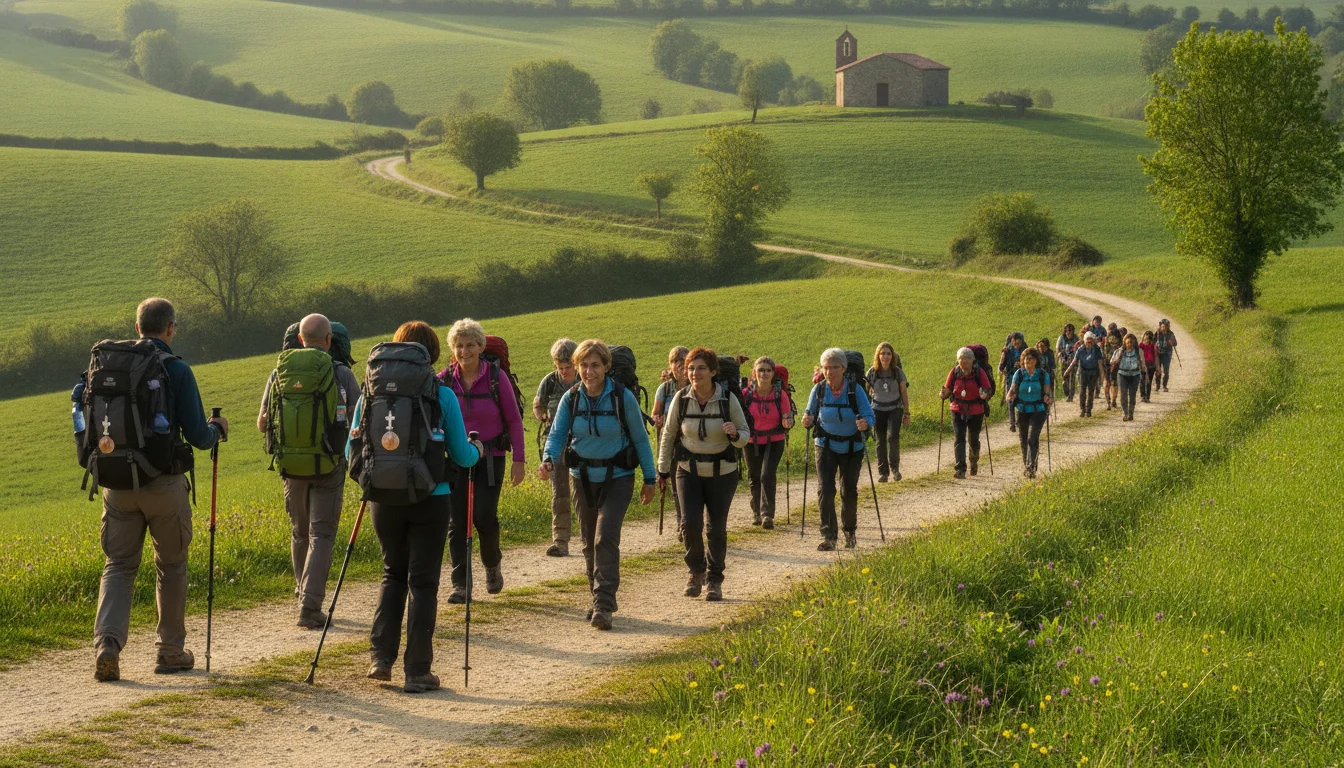
Most of the pastors who call me about the Camino de Santiago have already read the route guides. They know about the yellow arrows, the scallop shell, the pilgrim hostels. What they do not yet know is how you take thirty people from your congregation, half of whom have never walked more than a mile at a stretch, and turn them into a pilgrim group that finishes together in the square at Santiago. That is the question this article answers.
I have organized heritage journeys for more than forty years, and a walking pilgrimage with a group is one of the most rewarding trips a leader can build. It is also the one where logistics matter most. A cathedral tour forgives a loose plan. A five-day walk does not. So let me set aside the route storytelling that lives in our traveler guides and talk to you as an organizer: which section to pick, how far to walk each day with a mixed congregation, and the support structure that makes a group Camino work rather than fall apart on day two.
Why the Camino Works So Well for a Church Group
A pilgrimage on foot does something a coach tour cannot. It gives your group a shared rhythm. Everyone wakes at the same hour, walks the same road, feels the same hills, and arrives at the same town tired in the same way. That shared effort binds a group faster than any icebreaker. By the third evening, people who barely knew each other at the departure gate are walking side by side as friends.
The walking also builds in what a good spiritual retreat tries hard to create: time. Hours of it. On the Camino you cannot rush, and you cannot multitask. The road gives your people long stretches of quiet to pray, to think, to talk, or simply to notice where they are. That is the whole point: a daily pattern of walking, reflecting, and arriving that slows them down enough to hear something.
And there is the arrival. Walking the final steps into the Plaza del Obradoiro, in front of the cathedral where the remains of Saint James are said to rest, is a moment your group will carry for the rest of their lives. They earned it on foot, which is a memory no bus window offers.
Which Section to Choose for a Group
Here is the first decision that separates a smooth group Camino from a hard one. You are not walking the whole thing. The full Camino Frances runs about 500 miles from the French border, and no congregation group is doing that on a single trip. You are choosing a section, and for a group, the choice is almost always the same one.
Walk the last 100 kilometers into Santiago, starting from the town of Sarria.
I recommend Sarria to Santiago for group after group, and the reasons are practical. First, 100 kilometers is the minimum walked distance the Pilgrim’s Office requires for your people to earn the Compostela, the official certificate of completion. Starting at Sarria means everyone qualifies. Second, this stretch has the best spacing of towns, hostels, hotels, cafes, and pharmacies of any part of the route, which matters enormously when you are supporting a group of varied ages. You are never far from a coffee or help. Third, the terrain through Galicia is green, rolling, and manageable. There are hills, but no mountain passes.
The last 100 kilometers is the common group choice for a good reason. It gives your people the true Camino experience, the Compostela at the end, and the walk into Santiago, without the extreme distances, remote stretches, or steep climbs of the sections further east. If you have read our traveler route guides and fallen in love with the mountain stages, save those for a personal trip. For a group, Sarria is the answer.
How Far to Walk Each Day With a Mixed Congregation
This is where leaders most often plan wrong, so let me be specific. The 100 kilometers from Sarria to Santiago is traditionally walked in five days, which averages about 20 kilometers, or roughly 12 to 13 miles, per day. For a fit group of hikers, that is fine. For a typical congregation with a range of ages, I recommend stretching it to six or seven days.
Adding a day or two drops your daily distance to somewhere between 13 and 17 kilometers, which is 8 to 11 miles. That is the difference between a group that arrives at each night’s hotel with energy left and a group that arrives limping and dreading tomorrow. The extra days cost a little more in accommodation, but they protect the experience for everyone. A worn-out group does not reflect, it just endures.
Set the pace to your slowest committed walkers, not your fastest. The trip succeeds or fails on how the people at the back feel. Plan around them, and encourage your group to train at home in the months before departure. A congregation that walks a few miles a week for three months arrives far more ready than one that shows up cold.
If you have travelers who love the idea of the pilgrimage but genuinely cannot walk the distances, do not leave them behind. There are ways to include them, which I cover below and in our guide on accessibility for older travelers.
The Logistics That Make a Group Camino Actually Work
This is the heart of it, what separates an organized group pilgrimage from a hundred individuals struggling on their own.
Luggage transfer. Your people do not carry their full luggage. A local transfer service moves everyone’s main bags from each night’s hotel to the next, so your group walks with only a light daypack holding water, snacks, rain gear, and a jacket. This single service changes everything. It turns a hard trek into a walk that ordinary people can enjoy. For a group, it is the foundation.
A support vehicle. For a group, I strongly recommend a support vehicle shadowing the route. It carries first aid and extra water, and it is there for anyone who needs to stop. A twisted ankle, a bad blister, a person who hits their limit at kilometer 12, all of it is handled. That person rides to the next town and rejoins the group. Without a support vehicle, one struggling walker becomes a crisis. With one, it is a non-event, and it also lets you include travelers who walk part of a day and ride the rest.
Group accommodation, booked ahead. Independent pilgrims sleep in the municipal albergues, the shared bunk hostels, on a first-come basis. You cannot run a group that way. You need proper hotels or guesthouses booked in advance, holding enough rooms for your whole party in one place each night. This lets your group eat together, gather for devotions, and rest in real beds. On the last 100 kilometers, that lodging exists and can be reserved, another reason Sarria to Santiago is right for a group.
A walking pace plan. Before you leave, map each day: where you start, where you stop for lunch, where you sleep, and roughly how many hours of walking it involves. Share it with your group so everyone knows what each day holds, and build in a mid-morning coffee stop and a proper lunch. The plan is not about rushing. It is about your people knowing what to expect and never feeling lost.
The pilgrim passport and the Compostela. Every walker carries a credential, the pilgrim passport, and collects two stamps a day from cafes, churches, and hostels along the way. These stamps prove they walked the route on foot. At the Pilgrim’s Office in Santiago, your group presents their stamped passports and receives the Compostela, the certificate written in Latin. Make sure every person has a credential from the start and understands to collect stamps daily. Losing the stamps means losing the Compostela.
Weaving in Daily Devotions and Mass
A Camino for a church group is a pilgrimage, not a hike, and the walk itself creates natural room for the spiritual rhythm that makes it one.
Open each morning with a short devotion or prayer before you set out. Along the way, the route passes small stone churches and chapels, many of them centuries old, and these make natural stops for a Scripture reading, a hymn, or a few minutes of quiet. In the evenings, gather your group after dinner for reflection. Those evening circles are often where the deepest moments of the whole trip happen.
For Catholic groups, the Pilgrim’s Mass at the Cathedral of Santiago de Compostela is the fitting close to the journey. Attending it together, after walking the final stretch into the city, gives your pilgrimage its ending. If you want Mass or a service at particular points along the route, that can be arranged in advance, so ask about it early. Whatever your tradition, the pattern of walk, reflect, arrive is the spine of a group Camino, and you as the leader set that pattern each day.
Group Size and the Free-Leader Model
Camino groups work well anywhere from 10 to 100 people, though the sweet spot for a first pilgrimage is between 15 and 35. Past about 40 people you will want to split into sub-groups on the trail, each with its own pace leader, so the walkers are never strung out over miles of road.
Here is the part that matters for you as the organizer. With 15 or more paying participants, the group leader travels free. That covers the leader’s full trip on the same terms as everyone else: the walking package, the accommodation, the transfers, and the support. For a pastor or congregation leader, that removes the personal-cost question that so often stalls a trip before it starts. Larger groups can sometimes unlock a second complimentary or reduced spot for a co-leader or spouse, worth raising early if you are building toward 25 or 30 people. Our complete guide for group leaders walks through how the free-leader math works across the whole planning arc.
Combining the Walk With a Coach and Rest Days
You do not have to walk every single day, and for many groups the best trip is a blend. A common shape is to bookend the walk with coach travel and city time. Fly into Madrid or Santiago, spend a day adjusting to the time change, then transfer by coach to Sarria to begin walking. After you arrive in Santiago on foot, add a rest day in the city to explore the cathedral, attend the Pilgrim’s Mass, and let your group recover before flying home. Some groups extend further, adding a few days on the coast at Finisterre or combining the Camino with other heritage sites in Spain.
You can also build rest days into the walk itself. A day off in a town like Portomarin, midway through, gives tired legs a slower morning together. And for travelers who cannot walk the full distances, the coach-and-walk blend is how you include them: they ride to each night’s town, join the group for meals, devotions, and the arrival in Santiago, and walk the shorter stretches they can manage. To see how a Spain itinerary comes together beyond the walk, our Spain heritage tours page lays out the wider options, and if you are weighing the Camino against other routes, our overview of Christian pilgrimage tours in Europe puts it in context.
FAQ: Leading a Group Camino Pilgrimage
Which part of the Camino should a group walk?
The last 100 kilometers from Sarria to Santiago. It is the minimum distance to earn the Compostela certificate, it has the best spacing of towns and lodging for supporting a group, and the Galician terrain is rolling rather than mountainous. It gives your congregation the real Camino experience without the extreme distances of the sections further east.
How far will we walk each day?
Traditionally the 100 kilometers is done in five days at about 20 kilometers a day. For a congregation with mixed fitness, I recommend six or seven days, which drops each day to 13 to 17 kilometers, or 8 to 11 miles. Set the pace to your slowest committed walkers.
What about people in our group who cannot walk the whole thing?
They can still be full members of the pilgrimage. A support vehicle and coach let them ride to each night’s town, join the group for meals and devotions, and walk the shorter, flatter stretches they can manage. Nobody is left behind.
Do we carry our own luggage?
No. A luggage transfer service moves everyone’s main bags from hotel to hotel each day, so your group walks with just a light daypack. This is the single service that makes a group Camino accessible to ordinary walkers, and for a group it is essential.
How does the free group-leader benefit work on the Camino?
With 15 or more paying participants, the group leader’s full trip is covered on the same terms as everyone else, including the walking package, accommodation, and support. Larger groups can sometimes add a reduced or complimentary second seat for a co-leader or spouse, so raise it early if you are planning a group of 25 or more.
A group Camino is one of the most meaningful trips you can lead, and it is doable with the right structure underneath it. The walking is the easy part. The luggage transfer, the support vehicle, the booked accommodation, and the daily pace plan turn a hard trek into a pilgrimage your whole congregation can finish together.
Contact us and we will help you pick your section, map your days, and build a Camino your group can walk from the first step to Santiago.