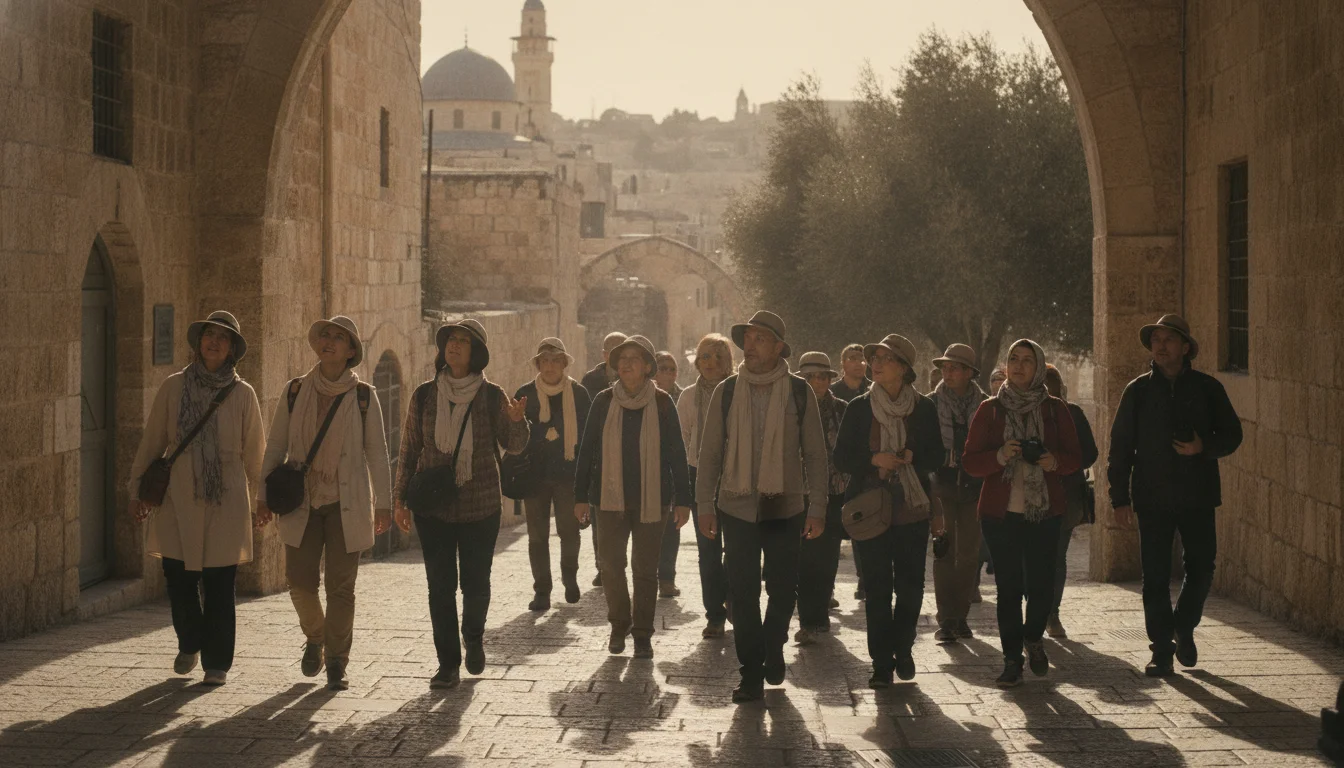
Most pastors who call me about a Holy Land trip have already pictured the ending. They can see their people standing at the empty tomb, or reading a psalm over the Sea of Galilee at dawn. What they cannot see yet is the shape of the ten days in between: what goes where, how much is too much, and where a sixty-eight-year-old in the group can catch her breath. That middle part is my work, and after more than forty years of building heritage journeys, I have learned the itinerary is not a checklist of sites. It is a spiritual arc with a sensible amount of walking.
So here is a real ten-day route, day by day. I will tell you what each place is, why it matters to a congregation, where you as the leader can build in a reading or a devotional, and where to protect your people’s energy. Use it as a working draft. We adjust it to your group, your dates, and your denomination. If you are still deciding whether a trip like this is right for your church, start with our overview of church group trips to Israel and come back here for the day-by-day.
The Shape of the Trip Before We Start
A good Holy Land itinerary moves geographically. We land near the coast, work north into Galilee where Jesus spent most of his ministry, travel south through the Jordan Valley to the Dead Sea, and finish in Jerusalem for the final week. That order lets the trip build. Galilee is green and gentle. Jerusalem is dense, holy, and heavy. Ending there means ending at the cross and the empty tomb, which is where you want your people’s hearts when they fly home. Ten days gives you room to do this without rushing, plus one genuine rest half-day I insist on.
Day 1: Arrival at Tel Aviv
Your group lands at Ben Gurion Airport near Tel Aviv. Most flights from North America arrive in the afternoon or evening, so Day 1 is a travel day and nothing more. We meet you at the airport, load the coach, and transfer to a hotel on the coast, often in Netanya or Tel Aviv itself.
Do not plan touring for this day. Your people have crossed an ocean and lost a night’s sleep, so a shared dinner and an early bed is the whole agenda. If you want to gather everyone, keep it short: a welcome, a word of prayer, and a simple reading. Psalm 122, “I was glad when they said unto me, let us go into the house of the Lord,” lands well on the first night.
Day 2: Caesarea, Mount Carmel, and North to Galilee
Day 2 is your first real day, and a strong one. We drive up the coast to Caesarea Maritima, Herod’s harbor city and the seat of Roman government in the region. This is where Peter met Cornelius and the gospel first opened to the Gentiles, and where Paul was later imprisoned. Standing in the Roman theater with Acts 10 open is a good way to begin.
From there we climb Mount Carmel, where Elijah confronted the prophets of Baal in 1 Kings 18. The view over the Jezreel Valley is wide and clear, and it sets up the whole northern landscape you are about to explore. We continue to your hotel in the Galilee region, often near the Sea of Galilee at Tiberias, your base for the next two nights.
Pacing note: Caesarea is uneven ancient stone with little shade. Manageable for most, but tell anyone with mobility concerns to wear real shoes and bring a hat.
Day 3: Around the Sea of Galilee
This is the day many travelers remember most. We spend it entirely around the Sea of Galilee, and the pace is gentle by design.
We visit Capernaum, the town Jesus made his home base, where you can stand in the ruins of the synagogue and beside what tradition holds is Peter’s house. We go to the Mount of Beatitudes, the quiet hillside above the lake where the Sermon on the Mount was given. This is the best place on the whole trip for a devotional. Gather your group on the grass, read Matthew 5 aloud, and give them ten minutes of silence looking out over the water. I have watched hardened people weep there.
We stop at Tabgha, traditional site of the feeding of the five thousand. The centerpiece of the day is a boat ride on the Sea of Galilee itself. The boat cuts its engine in the middle of the lake, and that is your moment to read Mark 4, the calming of the storm, with the water all around you.
Pacing note: this is one of the easiest days for walking, which is why I like it early. It builds confidence in your older travelers before the harder days come.
Day 4: Nazareth and the Jordan River
We leave Galilee by way of Nazareth, the town where Jesus grew up. We visit the Church of the Annunciation and, if your group connects with it, Nazareth Village, a reconstructed first-century town where you can see how a carpenter’s family actually lived. Nazareth grounds the story in ordinary life, a useful counterweight to all the grand sites.
On the way south we stop at the Jordan River, usually at Yardenit, where the river runs quiet and green. Many groups hold a baptism or a renewal of baptismal vows here. If your congregation wants this, tell me early so we build in the time and arrangements. It is one of the most meaningful stops a leader can offer, and Matthew 3, the baptism of Jesus, reads beautifully at the water’s edge.
We continue down the Jordan Valley toward the Dead Sea region, checking into a hotel near the Dead Sea for the next nights.
Day 5: Beit She’an and Jericho
Day 5 takes you deep into the biblical landscape of the Jordan Valley. We visit Beit She’an, one of the most complete Roman and Byzantine cities in the country, with a main street, a theater, and columns still standing. It is a striking place to talk about the world the early church lived in, and it appears in Scripture as far back as the death of Saul.
We continue to Jericho, the oldest continuously inhabited city on earth and the site of Joshua’s battle in Joshua 6. From nearby you can look up toward the Mount of Temptation. Jericho also sets up the story of Zacchaeus in Luke 19.
Pacing note: Beit She’an is large and sun-exposed, and Jericho sits in one of the hottest, lowest places on earth. This is a day to move slowly, drink water constantly, and keep the midday portion light. I would rather see less and keep everyone well than march a group through the heat.
Day 6: Masada and the Dead Sea
Masada is Herod’s mountaintop fortress above the Dead Sea, the site of the last Jewish stand against Rome. We ascend by cable car, so no one has to climb the Snake Path unless they want to. The story raises deep questions about faith, endurance, and sacrifice, and the view from the top over the desert and the sea is one your group will not forget.
In the afternoon we go to the shore of the Dead Sea itself, the lowest point on the surface of the earth, where the water is so dense you float without effort. This is pure delight for a group, and good for morale after several heavy days. Floating is not strenuous, so it doubles as a soft rest.
Pacing note: the cable car removes almost all the difficulty at Masada. The top is still exposed, so hats and water again. Anyone with heart or breathing concerns is fine as long as they take the cable car both ways.
Day 7: Up to Jerusalem, the Mount of Olives and Gethsemane
Today the trip turns. We drive up from the desert to Jerusalem, and the first sight of the city from the Mount of Olives is a moment worth pausing for. From that ridge you look across the Kidron Valley to the Old City and the Temple Mount, the same view Jesus had when he wept over Jerusalem in Luke 19.
We walk down the Mount of Olives along the Palm Sunday route to the Garden of Gethsemane, where ancient olive trees still stand. Gethsemane is the right place for a quiet, serious devotional. Read Luke 22, the night of the arrest, and give your people room to sit with it. Then we check into your Jerusalem hotel, your base for the rest of the trip.
Pacing note: the walk down the Mount of Olives is steep and sometimes slick. For anyone with knee trouble, we can have the coach meet the group partway. Tell me who needs it and we arrange it quietly, without singling anyone out.
Day 8: The Old City, the Western Wall, and the Way of the Cross
This is the fullest day of the trip, and the most sacred. We enter the walled Old City of Jerusalem and move through its four quarters. We go to the Western Wall, the holiest accessible site in Judaism, where your people can pray and, if they wish, place a written prayer in the stones. We walk the Via Dolorosa, the traditional route of Jesus carrying the cross, through the narrow streets to the Church of the Holy Sepulchre, which stands over the traditional sites of both the crucifixion and the tomb.
The Old City is intense: crowded, loud, layered, and holy all at once. It rewards a group that moves together and stays close to the guide. Build in a reflective reading somewhere along the Via Dolorosa, even a single station, so the day is not only about navigating crowds. Your presence as the leader matters most here, where your people will look to you to help them hold what they feel.
Pacing note: this is a long day on foot over uneven stone, with steps and narrow lanes. Pace it deliberately and build in a real lunch break and a place to sit. If you have travelers who cannot manage the full walking day, we can shorten their route and rejoin the group. Plan that with me in advance.
Day 9: The Garden Tomb, Bethlehem, and a Rest Half-Day
After the density of Day 8, Day 9 breathes. We begin at the Garden Tomb, a quiet garden outside the walls that many Protestant groups find to be the most moving stop of the entire trip. It is calm, green, and unhurried, and the ideal place to gather your whole group, read the resurrection accounts, and share communion if your tradition practices it. Many leaders make this their trip’s spiritual high point.
From there we travel a short distance to Bethlehem, birthplace of Jesus and site of the Church of the Nativity over the traditional grotto. Reading Luke 2 in Bethlehem closes a circle that began in Nazareth on Day 4.
Then I protect the rest of the day. This is the rest half-day I mentioned at the start, and I do not let groups skip it. After eight full days, your people need unstructured time: to nap, to shop for gifts, to sit quietly, to process. A group that rests on Day 9 flies home full instead of frayed. Leaders who push through this half-day always regret it.
Day 10: Departure
Day 10 depends on your flight time. Most departures leave in the late morning or afternoon, so we transfer the group back to Ben Gurion Airport with enough margin for the security process, which takes longer here than most travelers expect. I keep Day 10 loose on purpose. The last morning should feel like a gentle landing, not a scramble.
Before you leave the hotel, gather your group one last time. A closing word, a shared prayer, and a moment to name what they will carry home turns a good trip into one they keep telling for years.
A Few Honest Notes on Pacing and Cost
The pace above is built for a congregation, not for young athletes, and most of my church groups run between fifteen and forty people. If your group skews older, we lengthen the rest windows and lean harder on cable cars and seated moments. If it skews younger, we add an optional climb for those who want it.
On the money side, a ten-day trip has real moving parts: flights, hotels, a licensed guide, the coach, site entries, and most meals. If you want to understand what a group trip costs and how the per-person price is built, we lay it out plainly. And if you are organizing your first trip and want the full playbook, from recruiting your group to the day you land, read the complete leader’s guide.
FAQ: Planning a 10-Day Holy Land Trip
Is ten days enough time to see the Holy Land properly?
Yes. Ten days on the ground covers Galilee, the Jordan Valley, the Dead Sea region, and Jerusalem without rushing, and leaves room for one rest half-day. Shorter trips of seven or eight days work, but they cut the rest and compress Jerusalem, the part your people most want to absorb slowly.
Will the pace work for older members of my congregation?
It is built to. The hardest sites use cable cars, the easiest days come early to build confidence, and the coach can meet the group partway down the steep sections. Tell me in advance who has mobility or health concerns and we adjust the route for them without singling anyone out.
When is the best time of year to go?
Spring, roughly March through May, and fall, September through November, give you the most comfortable weather. Summer is workable but hot in the Jordan Valley and at the Dead Sea, where we shift the schedule to keep the midday portion light.
Can we hold baptisms, communion, or other services along the way?
Yes, and these are often the moments people remember most. The Jordan River works well for baptisms, and the Garden Tomb is ideal for communion. Tell me early which services matter to your congregation so we build in the time and arrangements.
How far ahead should we start planning?
For a group of fifteen to forty, six to nine months is the sweet spot. That gives your people time to budget and request time off, and gives you time to recruit, which is the real work. Trips timed around Easter or a major holiday want nine to twelve months.
The route above is a starting point, not a fixed package. We shape it around your congregation, your dates, and the moments that matter most, and you can see the full picture of what we build on our Israel heritage tours page.
Contact us and we will turn this outline into a real trip for your church, with dates, a price your people can plan around, and the pacing that fits your group.