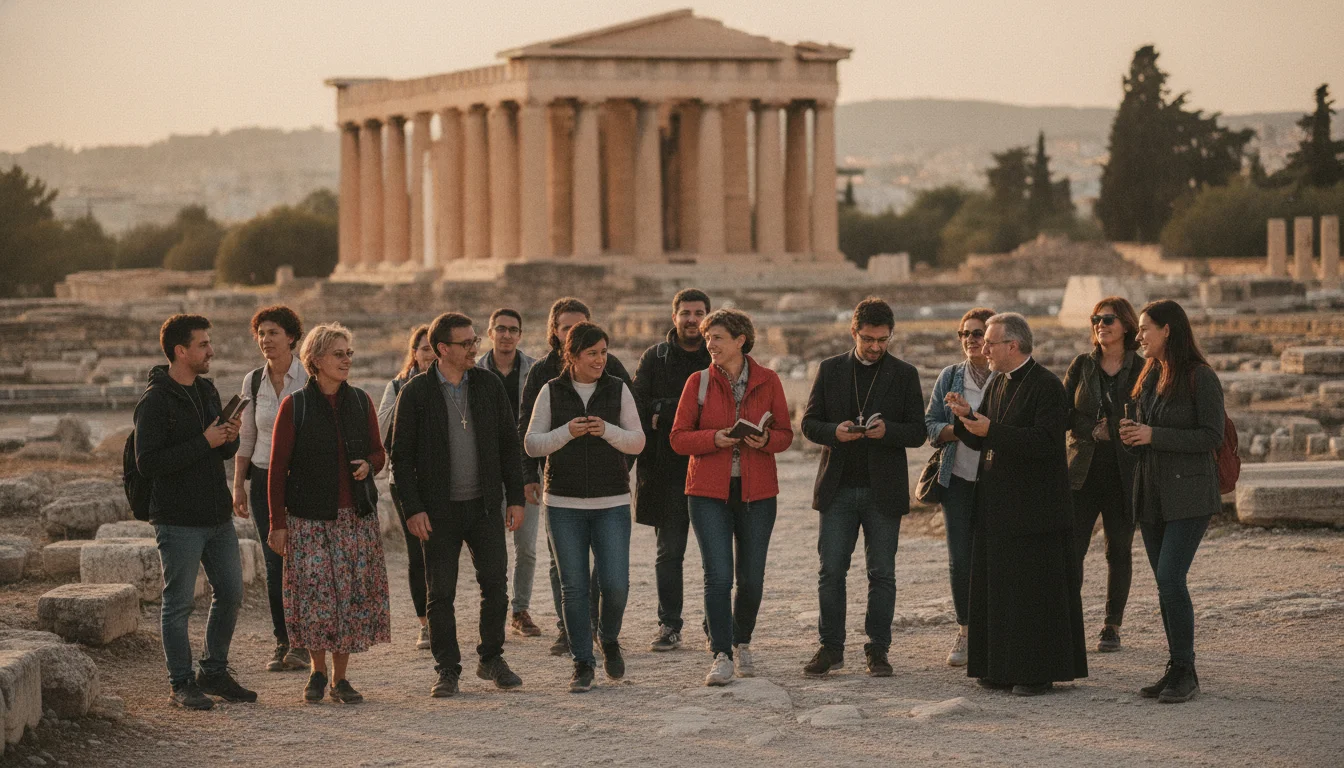
When a pastor tells me he is thinking about taking his congregation to Greece, my first question is never about dates or budget. It is this: what part of Scripture do you want your people to stand inside? Greece is not a sightseeing trip that happens to have a few churches on it. It is the ground where the gospel first walked into Europe. Paul stepped off a boat at Neapolis, walked up to Philippi, and everything that followed for the Western church started on that road. When your group stands where he stood, the New Testament stops being a text they read and becomes a place they remember.
I have built heritage journeys for more than forty years, and Greece is one of the trips I most enjoy planning with a leader, because the payoff for a congregation is so clear. Let me walk you through what a church group tour of Greece actually looks like, the cities that matter, the routes that hold together, how many days you need, when to go, and how the free-leader model makes the whole thing affordable to organize.
Why Greece Is the Trip for a Church Group
Most of your people know Israel is the land of the Bible. Fewer of them realize how much of the New Testament happened in Greece. Acts 16 through 18 is a Greek story. So are Philippians, Thessalonians, and much of Corinthians. When you read those letters at home, they are addressed to cities that feel abstract. In Greece, those cities have addresses. You can walk the agora where Paul argued, sit in the theater where a riot nearly broke out over him, and stand at the judgment seat where he was dragged before a Roman official.
That is the difference a heritage journey makes for a congregation. A sermon on Philippians lands differently after your people have stood at the river outside Philippi where Lydia was baptized. The letters become mail from people they can picture, in places they have touched. For a pastor, that is not a vacation benefit. It is discipleship you cannot reproduce from a pulpit.
The Cities That Anchor the Trip
A church group tour of Greece is built around four or five sites that carry most of the spiritual weight. Here is what each one gives your people.
Philippi and Thessaloniki in the North
The northern leg is where the story begins. Philippi is the first place Paul preached in Europe, and it is where Lydia became the first European convert. There is a small river outside the city where groups read Acts 16 aloud and, for many, renew baptismal vows. The ruins include the traditional site of Paul and Silas’s imprisonment, which reads very differently in person than on the page.
Thessaloniki, an hour or so away, is a living city built on top of an ancient one. Paul wrote two of his warmest letters to the church here. Your group can walk the old Via Egnatia, the Roman road Paul traveled, and stand in a city that has kept its Christian and Jewish history layered right on the surface. For groups that want to weave in Holocaust remembrance, Thessaloniki also holds one of the most significant Jewish histories in Europe.
Athens and Corinth in the South
Athens is where Paul stood on the Areopagus, Mars Hill, and preached to the philosophers about the unknown God. Your group can climb that same rock, look out over the ancient agora, and read Acts 17 with the Parthenon above them. It is one of the moments people talk about for years. Athens also gives your congregation the cultural weight of the place, the birthplace of the ideas Paul was engaging when he quoted their own poets back to them.
Corinth is roughly ninety minutes from Athens and, for many leaders, the emotional center of the trip. Paul lived here for eighteen months. Your group can stand at the bema, the judgment seat where he was brought before Gallio, the exact spot named in Acts 18. You can see the ruins of the marketplace, walk the road to the port, and read First Corinthians in the city that received it. When people understand the money, the sexual pressure, and the divisions Paul was writing into, that letter opens up completely.
The Pauline Route: How It Holds Together
The reason Greece works so well for a group is that these cities connect into one coherent journey rather than a scattered checklist. The classic Pauline route runs north to south, following Paul’s second missionary journey: Philippi, then Thessaloniki, then Berea, then down to Athens, and finishing in Corinth. It moves the way the story moves, and your people feel that progression.
This is the itinerary I most often build for churches, because the narrative does the teaching for you. Each stop builds on the last. By the time your group reaches Corinth, they have watched the European church grow from a riverside prayer meeting to a struggling, striving congregation Paul poured himself into. If you want the full site-by-site breakdown, our footsteps of Paul itinerary lays out each day and what your people will see.
Some groups want to go further and add the cities of Revelation, or trace Paul’s route into Asia Minor. That crosses into modern Turkey: Ephesus, the seven churches, and more. When a congregation wants both, we combine them into one trip. Our guide to Greece and Turkey combined for groups explains how that works and what it adds in days and cost.
Adding a Greek Isles Cruise
Here is an option many leaders do not know is on the table. You can build a short Greek isles cruise into your church group tour, and for the right group it lands beautifully.
A three or four day cruise out of Athens typically visits islands like Mykonos, Patmos, and sometimes a stop on the Turkish coast at Kusadasi for Ephesus. Patmos is the one that matters most for a church group. It is where John received the vision of Revelation, and there is a cave-monastery marking the traditional site. Standing on Patmos and reading the opening of Revelation is a genuine highlight for many congregations.
The cruise also solves a practical problem. It gives your group a stretch of rest in the middle of a walking-heavy itinerary. Older travelers especially appreciate a few days where the hotel moves with them and they unpack once. If your congregation skews toward retirees, which many church groups do, a cruise segment can be the thing that makes the trip comfortable enough for people to say yes. We build these as a land-and-sea combination: the mainland Pauline sites, then the islands by ship.
How Many Days You Need
This is the question every leader asks, so let me give you real numbers.
A focused Greece trip, hitting the core Pauline sites of Athens and Corinth with a taste of the north, runs seven to eight days on the ground. That is enough for a first heritage journey and it keeps the cost accessible.
The full Pauline route, north to south with Philippi, Thessaloniki, Berea, Athens, and Corinth done properly, wants nine to ten days. This is my recommendation for most churches. It gives each site room to breathe and does not rush your people from bus to bus.
Add a Greek isles cruise and you are looking at eleven to fourteen days total, depending on the length of the sailing. Combine Greece with Turkey and you land in the same range. Remember to count travel days on each end, since flights to Greece from North America usually cost your group a full day going and most of a day coming back.
My honest advice: do not try to see everything on a first trip. A congregation remembers the sites you gave them time to absorb, not the number of stops you crossed off. Nine days on the Pauline route with unhurried mornings will do more for your people than fourteen days of rushing.
The Best Seasons to Go
Greece has a clear window, and timing your trip inside it matters for both comfort and cost.
Spring, from April into early June, is the best overall season. The weather is mild, the wildflowers are out across the ruins, and the sites are not yet crowded with summer tourism. Many churches like to tie a spring trip to the season around Easter, though Orthodox Easter draws large local crowds and needs earlier booking.
Fall, from September into October, is the second strong window. The summer heat has broken, the light is beautiful, and the tourist volume drops off. This is a good choice for groups that cannot travel in spring.
I steer groups away from July and August. The heat at open sites like Corinth and the Athens agora is genuinely hard on older travelers, and prices peak with the tourist season. Winter is quiet and inexpensive, but daylight is short and some sites keep reduced hours. For a church group, spring or fall is almost always the right call. Whichever window you choose, book early, because the good seasons fill first.
How the Free-Leader Model Applies
Now the part that makes organizing this realistic. When you bring a group of fifteen or more paying travelers, your seat as the leader is covered. That means your flights, hotels, ground transportation, site entries, and the group meals in the itinerary are all included at no cost to you.
This changes the conversation with your board and with yourself. You are not asking your church to fund an expensive trip for the pastor. You are organizing a journey your people pay into, and your participation is built into how the trip is structured. For a lot of leaders, that free seat is the difference between a Greece trip that happens and one that stays an idea, because Greece, with its coaches and local guides and multiple cities, is not the cheapest destination to build well. Take the leader’s cost off the top and the whole thing becomes feasible.
Larger groups open up more. A congregation that brings twenty-five or thirty travelers can sometimes unlock a second complimentary or reduced seat for a co-leader or a spouse. If that matters to you, raise it early so we can build toward it. Our full explainer on how the free-leader model works walks through the economics in detail.
If you have never organized a group trip before, do not let that stop you. Most of the leaders I work with are first-timers. The operator carries the logistics, the guiding, and the ground coordination. Your job is to gather your people and shepherd them through the experience. For the complete playbook on pulling a group together, from recruiting your core to setting dates, see the complete leader’s guide.
FAQ: Church Group Tours to Greece
How many days do we need for a Greece church trip?
Seven to eight days for a focused first trip covering Athens and Corinth. Nine to ten days for the full Pauline route north to south, which is what I recommend for most groups. Add three to four more if you want a Greek isles cruise or a Turkey extension. Count a travel day on each end for the flights.
What is the best time of year to take a church group to Greece?
Spring, April into early June, is the best overall window for mild weather and thinner crowds. Fall, September into October, is the strong second choice. Avoid July and August, when the heat at open sites is hard on older travelers and prices peak. Book the good seasons early.
Can we add a cruise to the Greek islands?
Yes. A three or four day cruise out of Athens can visit Patmos, where John received Revelation, along with islands like Mykonos and a stop for Ephesus on the Turkish coast. It also gives your group a restful stretch in the middle of a walking-heavy itinerary, which older travelers appreciate.
Do I have to pay my own way as the leader?
No. With fifteen or more paying participants, your full trip is covered: flights, hotels, ground transportation, site entries, and the group meals in the itinerary. Larger groups of twenty-five or thirty can sometimes unlock a second seat for a co-leader or spouse.
I have never organized a group trip. Can I still do this?
Yes, and most of the leaders I work with are first-timers. The operator handles the logistics, guiding, and ground coordination. Your job is to gather your people and lead them spiritually through the sites. We give you a real itinerary and dates so your congregation can decide.
If you are weighing whether Greece is the right journey for your congregation, the Pauline route is usually the thing that makes it click. You can see the full picture on our Greece heritage tours page, and when you are ready to talk dates and group size, contact us and we will help you build a trip your people will carry with them.