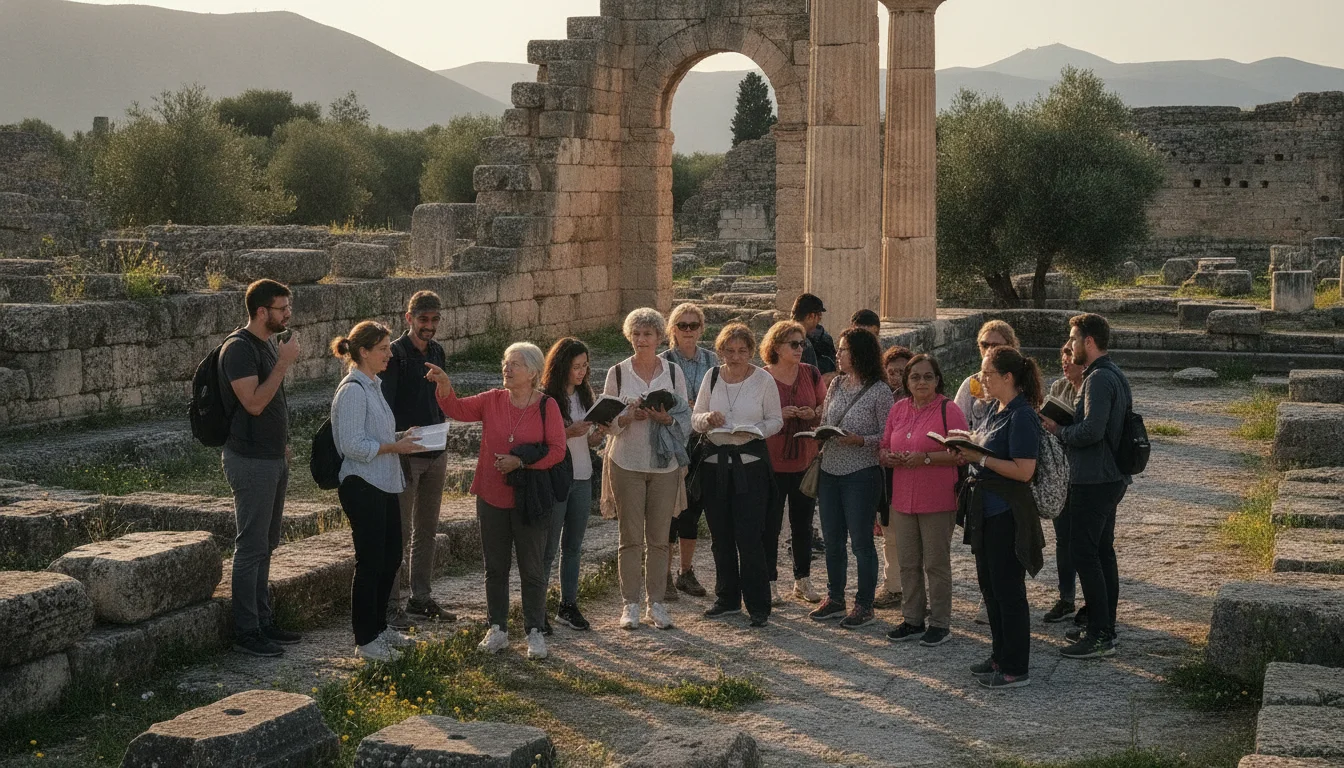
When a pastor asks me for a 7-day Greece Paul itinerary for a group, he is usually not asking for a list of ruins. He is asking a harder question underneath it: can I fit the whole footsteps-of-Paul story into one week, keep my people from burning out, and still come home under budget. That is an organizer’s question, and it deserves an organizer’s answer.
I have built heritage journeys for more than forty years, and Greece in seven days is one of the routes I get asked to plan most. So let me walk you through exactly how I would shape it for your congregation. Not a solo traveler’s dream trip. A group trip you can recruit for, lead, and defend to your board.
What a 7-Day Greece Paul Itinerary Has to Do
Seven days is enough to walk the heart of Paul’s second missionary journey, but only if the route is disciplined. The trap I watch first-time leaders fall into is trying to add Rhodes, Meteora, and an island cruise onto the same week. You end up with a group that spends more time on a coach than at the sites, and by day four half of them are exhausted and quietly resentful.
So the first decision you make as the organizer is a subtraction, not an addition. A tight week runs north to south, from Thessaloniki and Philippi in the north down through Berea and on to Athens and Corinth. That is the spine of Acts 16 and 17, it flows in one geographic direction, and it does not double back. Everything else is a future trip.
The Route, Day by Day
Here is the shape I would build. Treat it as a frame you and I adjust together, not a fixed script.
Day 1. Arrival in Thessaloniki. Your group flies in and settles. No sightseeing on arrival day. People are jet-lagged, and a leader who schedules a museum three hours after a transatlantic flight loses the room for two days. Dinner together, a short welcome, an early night.
Day 2. Thessaloniki and the north. This is where Paul preached to the synagogue and where the letters to the Thessalonians land. You walk the old city, the Roman forum, and the church of Agios Dimitrios. For a Jewish heritage group, Thessaloniki carries a second weight entirely, and the Holocaust memorial and the Jewish Museum belong on the day. Tell me which lens your group is traveling through and I build the day around it.
Day 3. Philippi and Berea. Philippi is the emotional center of the week. This is where Lydia was baptized at the river, where Paul and Silas were jailed, and where the first church in Europe took root. I always leave room here for the leader to read Acts 16 aloud at the river. Berea, where the Bereans checked the scriptures daily, fits the same day as a shorter stop.
Day 4. Travel south to Athens. A longer coach day, broken with stops. This is the day your itinerary earns its keep or falls apart, so the operator’s job is to pace it with real breaks, a proper lunch, and something to see along the way rather than five straight hours of highway.
Day 5. Athens. The Acropolis, the Areopagus where Paul addressed the men of Athens, and the ancient agora. A full day, and a full one is enough. Athens rewards a group that goes deep on a few sites rather than sprinting through ten.
Day 6. Corinth. A day trip from Athens to ancient Corinth, the bema where Paul stood before Gallio, and the Corinth canal on the way. The Corinthian letters come alive standing in the ruins of the city that received them.
Day 7. Departure. A relaxed morning, a final reflection with your group, and the flight home.
Seven days, one direction, no wasted coach hours. If your group is larger or you have an extra two days, Meteora is the first thing I would add, not the last. For the fuller version of the route and the Christian sites site by site, our footsteps of Paul itinerary guide lays it out in more depth, and the Greece heritage page shows how the whole country connects.
The Decision That Comes Before the Route
Here is the thing most planning articles skip. Before you pick a single day, you decide whether this trip is financially real for you as the leader. That decision shapes everything after it.
On a group heritage tour, the leader travels free with fifteen or more paying participants. That means your seat, the flights, the hotels, the ground transportation, the site entries, and the group meals built into the itinerary, is covered. Not discounted. Covered. A group of fifteen paying travelers carries enough margin to absorb one more, and that one is you, because you are the reason the group exists.
I put this before the route on purpose. When your own cost comes off the table, you stop planning defensively. You stop shaving days to save money you were never going to spend. You build the week your people actually need. If you want the mechanics of exactly how the free seat works and where the number fifteen comes from, we cover it in does the pastor travel free and in how many people you need for the leader to go free.
How I Would Have You Recruit for This
A 7-day Greece trip recruits well precisely because it is concrete. Seven days is a length working people can say yes to. One week off, one clear story, one price. Use that.
Start with your core, not your whole congregation. You do not need fifteen strangers. You need the eight or ten people already leaning toward this trip, and you let them bring the rest. Couples come together. Bible study groups travel as a unit. Friends bring friends. I have watched a group cross from thirteen to eighteen in the last two months simply because the dates and the itinerary became real and people stopped treating it as hypothetical.
Give them a reason tied to what your community is already living. If you are preaching through Acts or Philippians, the trip stops being a vacation and becomes the next chapter of what you teach. That is the difference between “we might do Greece someday” and a group that fills. For the full recruiting playbook, see how to recruit for a church trip.
Budget and Payment, From the Organizer’s Chair
Your people will ask two questions before they commit: what does it cost, and how do I pay for it. Have both answers ready before you announce the trip.
On cost, be plain. Give one per-person price that names what is included, flights, hotels, ground transport, site entries, and daily breakfasts plus the group dinners, and name what is not, personal spending, optional excursions, and travel insurance. Vagueness kills commitment faster than a high number does.
On payment, offer a plan. A deposit to hold the seat, then monthly installments spread across the recruiting runway, does more to fill a group than any single discount. It turns a large number into a manageable one. We lay out how to structure this in the group trip payment plan guide, and a full sequence of what to handle when lives in the church group planning checklist.
What About a Camino Heritage Itinerary for a Church Group?
I get this question often, usually from the same leaders weighing Greece: could we walk the Camino instead. It is worth answering honestly, because the two trips are not the same kind of trip, and choosing wrong costs you months.
A Camino heritage itinerary for a church group is a walking pilgrimage across northern Spain toward Santiago de Compostela. The draw is the walking itself. Days on foot, stamps in a pilgrim passport, the shared rhythm of a group covering ground together and arriving at the cathedral as one. For a congregation that wants the journey to be physical and reflective, it is a beautiful fit.
But as the organizer, you plan it differently than Greece, and you need to know that going in:
-
Fitness range matters more. A Greece coach tour includes everyone, whatever their mobility. A Camino group walks, so you either pick a route section that fits your least-mobile traveler or you build in a support vehicle. Know your group’s real range before you commit to a distance.
-
You choose a segment, not the whole thing. The full French Way runs about five weeks. No congregation walks that in a normal trip window. For a church group, you select a meaningful segment, often the final hundred kilometers into Santiago, which is also the distance that earns the Compostela certificate.
-
Lodging and pacing are the whole game. On the Camino, where you sleep each night and how far you walk between beds is the itinerary. That coordination is exactly where a group operator earns its place, so the group is not scrambling for rooms in a full village at dusk.
The same free-leader economics apply. Fifteen paying walkers, and the leader’s place is covered. If a walking pilgrimage speaks to your community more than a coach route through Paul’s cities, the Camino is a genuinely good call, and the trip crosses into Spain and often Portugal, so our Spain heritage page is the place to start picturing it. The planning discipline is the same one, the sites and the shape are different.
Whichever you choose, the underlying method does not change. That is why I point every leader, Greece or Camino, to the same foundation: how to plan a group pilgrimage. Read that first, then pick your route.
The Leader’s Real Job
Once the money is handled and the route is set, your job changes. You are no longer the trip’s accountant or its travel agent. You are its shepherd. Your work on the ground is to read Acts 16 at the river outside Philippi, to lead a quiet reflection at the Areopagus, to be present for your people in the places that move them. The operator makes everything else invisible. The free seat and the fixed itinerary exist to protect exactly that focus.
FAQ: Planning a 7-Day Greece Trip for Your Group
Is seven days really enough to follow Paul’s footsteps in Greece?
Yes, if the route stays disciplined. A tight week runs one direction from Thessaloniki and Philippi in the north down to Athens and Corinth, covering the heart of Acts 16 and 17. It is when leaders try to add islands or Meteora onto the same week that seven days stops working.
How many people do I need before the group leader travels free?
Fifteen paying participants. At fifteen or more, the leader’s full trip is covered: flights, hotels, ground transportation, site entries, and the meals built into the itinerary. Below fifteen the trip is still possible, but the leader pays a participant’s price.
Can we combine Greece with a Camino heritage itinerary in one trip?
I would not. They are two different kinds of journey, a coach route through Paul’s cities versus a walking pilgrimage across Spain, and combining them shortchanges both. Pick the one that fits your congregation and do it well. You can always run the other next year.
How far ahead should we start planning?
Six to nine months for a group of fifteen to thirty on a Greece coach itinerary. A Camino segment wants a similar window or a bit more, because you also have to gauge your group’s walking fitness. The lead time is as much about recruiting your people as it is about booking.
How do people afford it, and how do I present the cost?
Give one clear per-person price that names what is included and what is not, then offer a deposit plus monthly installments across the recruiting window. A payment plan fills a group faster than a discount, because it turns one large number into a manageable monthly one.
If you want, I will take the frame above and build the exact 7-day Greece itinerary for your dates, your group size, and your congregation’s focus, Christian, Jewish, or both. You can see how the group experience works on our group heritage tours page.
Contact us and we will run the route and the numbers for your group together.