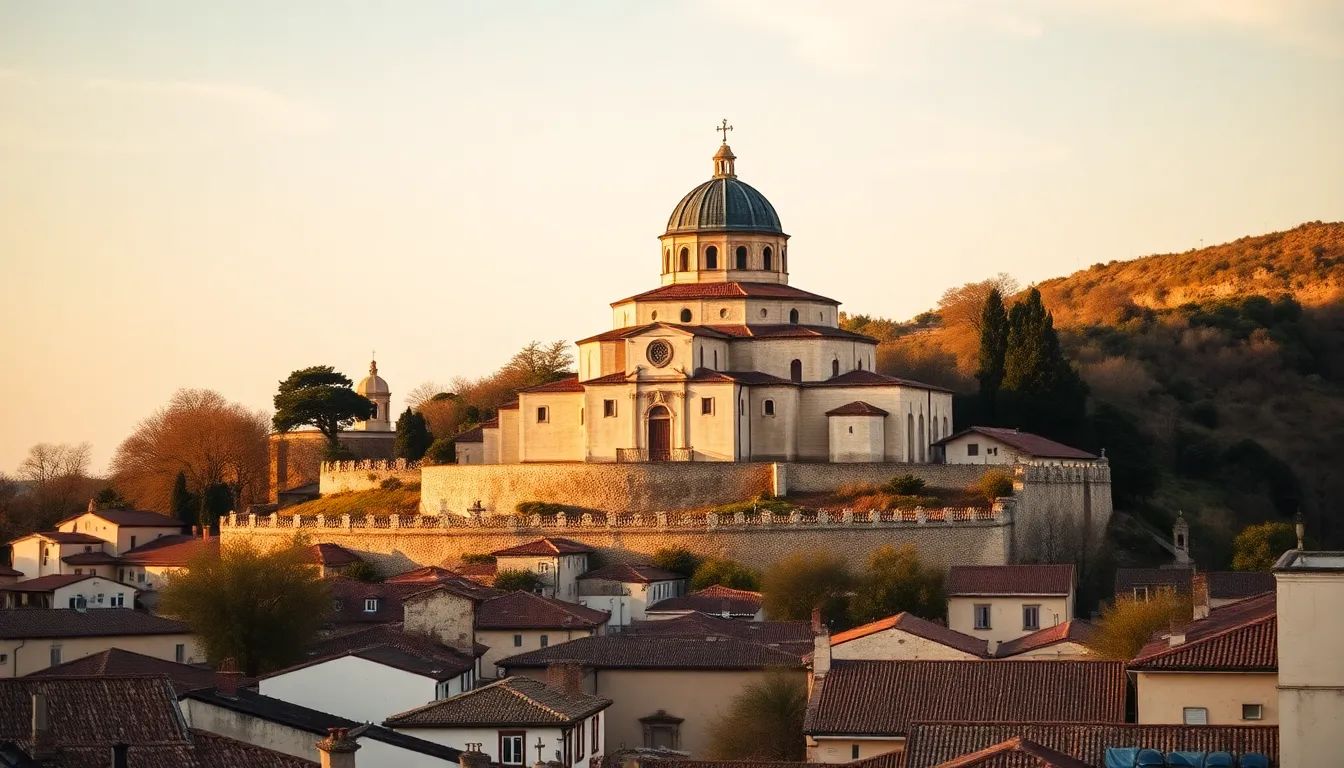
There is a moment I wait for in Tomar. We walk a group up to the Convent of Christ in the morning, the old Templar fortress on the hill, and they feel the weight of medieval Christendom: the round church, the cross of the order, the sheer scale of it. Then in the afternoon we come back down into the town, turn off a narrow lane, and step into a small stone room that is the oldest surviving synagogue in Portugal. The contrast lands every time. Two of the most powerful heritage stories in Europe, the Knights Templar and the hidden Jews, sitting in the same small town, minutes apart.
Tomar is not large. You can walk it. But it concentrates more heritage per square meter than almost anywhere else in the country, and for a faith group it is one of the most rewarding stops in Portugal. Let me walk you through how to read it.
The full national context is in our Portugal heritage travel guide. This guide stays in Tomar.
The Convent of Christ: Templar Heritage
The Convent of Christ began as a Templar stronghold in the twelfth century, founded by the Knights Templar who had helped the young Kingdom of Portugal push back Muslim rule. Its heart is the Charola, the round church modeled on the Holy Sepulchre in Jerusalem, an eight-sided sanctuary that knights are said to have attended on horseback. Standing inside it, you are standing in one of the most evocative spaces in the entire Templar world.
When the Templar order was suppressed across Europe in the early fourteenth century, Portugal did something unusual. Rather than dissolve the knights, the crown reconstituted them as the Order of Christ, which inherited the Templar wealth and properties, including Tomar. That order went on to fund and inspire the age of discovery; its cross sailed on the ships of the explorers. So Tomar is not only where the Templar story survived in Portugal, it is where it transformed into the engine of Portugal’s golden age.
The convent grew over the centuries into a vast complex of cloisters and chapels in the ornate Manueline style, including the famous carved window that is one of the most photographed pieces of stonework in the country. For Christian groups, the layers here, crusade, suppression, survival, exploration, make it one of the great heritage sites in Europe. Our Convent of Christ guide covers it room by room, and the broader Knights Templar in Portugal guide traces the order’s wider story.
I give the convent a full morning. It deserves it, and groups need time to let the scale settle.
The Tomar Synagogue: The Oldest in Portugal
Down in the old town, on a quiet street called Rua Dr. Joaquim Jacinto, stands the most important Jewish heritage site in Portugal: the medieval synagogue of Tomar. Built in the mid-fifteenth century, it is the only intact pre-expulsion synagogue still standing in the country.
It is small. A single stone room, with four columns supporting the vaulted ceiling, and a quality of acoustics that medieval builders engineered with care: clay jars set into the upper walls to carry the sound of prayer. It functioned as a synagogue for only a few decades before the forced conversion of 1497 ended Jewish worship in Portugal. After that it served as a prison, a chapel, a hayloft, a warehouse. It survived by being forgotten.
In the twentieth century it was rescued and turned into a small Jewish museum, the Museu Luso-Hebraico Abraham Zacuto, named for the great Jewish astronomer whose tables guided Portuguese navigators. When I bring a group into that room, I let them stand in silence first. They are standing in a space that predates Columbus, a space where Jews prayed openly before the door closed on five centuries of secrecy. Few rooms in Europe carry that much in so small a space. Our dedicated Tomar synagogue guide tells the full story.
Why These Two Sites Together Matter
It would be easy to treat Tomar as two unrelated attractions, a castle and a museum. I think that misses the point. The Templar convent and the medieval synagogue were built within the same few generations, in the same town, by communities that lived alongside each other. The knights on the hill and the Jewish families in the lanes below were part of one medieval world.
Then 1497 ended that world. The synagogue went dark, the Jews were forced to convert or flee, and the Order of Christ on the hill went on to glory. Walking from one site to the other, in that order, lets a group feel the whole arc: coexistence, catastrophe, and the uneven fates of two communities. That is why I never let a group treat Tomar as a quick photo stop. It is one of the most honest pieces of ground in Portugal.
The Town Itself
Tomar is a pleasant, walkable town built around a central square and the small river that runs through it. The old streets between the synagogue and the square preserve the shape of the medieval town, and a good guide can point out where the Jewish quarter extended and where converso families would have lived on quietly after the conversions.
The town hosts a famous festival every few years, the Festa dos Tabuleiros, with its towering headdresses of bread and flowers, a tradition with roots reaching back centuries. You are unlikely to time a trip to it, but it tells you something about how deep continuity runs in this place.
For groups, Tomar’s walkability is a gift. After the intensity of the two heritage sites, an hour in the town and a meal by the river give people room to absorb. As in Porto, those unstructured stretches are often where the real conversations happen.
How to Visit Tomar with a Group
Tomar sits in central Portugal, well placed between Lisbon and the heritage towns of the interior, and it pairs naturally with Fatima and the great monasteries of Batalha and Alcobaca, which are all within easy reach.
I usually give Tomar a full day: the convent in the morning, lunch and the town in the middle, the synagogue and the old quarter in the afternoon. That rhythm, Christian heritage first, Jewish heritage second, with town and food between, works well and lets the contrast do its work.
A few practical notes. The convent sits on a hill above the town and involves a fair amount of walking on uneven ground, so plan for mixed-age groups accordingly; there is vehicle access partway up. The synagogue is small, and large groups need to enter in waves, which a guide manages. And because Tomar combines so naturally with Fatima, Batalha, and Alcobaca, it usually anchors a central-Portugal cluster rather than standing alone. You can see how those pieces fit in our guides to Batalha Monastery and Alcobaca Monastery.
For groups of fifteen or more, the group leader travels free with Heritage Tours. With Tomar usually sitting inside a fuller central-Portugal route, that threshold is straightforward to reach. The 9-day Portugal heritage itinerary shows the route, and the Portugal destination page is a good starting point.
FAQ: Tomar Heritage Travel
What is the Convent of Christ in Tomar?
It is a former Templar stronghold founded in the twelfth century, centered on the round Charola church modeled on the Holy Sepulchre. After the Templar order was suppressed, the Portuguese crown reconstituted it as the Order of Christ, which inherited Tomar and later helped fund the age of discovery. The complex grew over centuries into a vast set of cloisters and chapels in the Manueline style, and it is one of the great Templar heritage sites in Europe.
Is the Tomar synagogue the oldest in Portugal?
Yes. The medieval synagogue of Tomar, built in the mid-fifteenth century, is the only intact pre-expulsion synagogue still standing in Portugal. It functioned as a synagogue for only a few decades before the forced conversion of 1497 ended Jewish worship in the country. It is now a small Jewish museum named for the astronomer Abraham Zacuto.
Why visit both the convent and the synagogue together?
Because they tell one story. The Templar convent on the hill and the Jewish synagogue in the town below were built within the same few generations, when the two communities lived side by side. The forced conversion of 1497 ended that coexistence: the synagogue went dark while the Order of Christ went on to glory. Walking from one to the other lets a group feel the whole arc of medieval Iberian history.
How long should I spend in Tomar?
A full day works well for a heritage group. The Convent of Christ deserves a morning, and the synagogue and old town fit the afternoon, with lunch and unstructured time in between. Tomar also pairs naturally with Fatima, Batalha, and Alcobaca, which are all within easy reach.
Is Tomar accessible for older travelers?
The town and synagogue are walkable and flat, but the Convent of Christ sits on a hill above the town and involves walking on uneven ground. There is vehicle access partway up. For mixed-age groups, plan the convent visit with rest stops and use coach transport for the climb.
Tomar is one of those places I never get tired of, because the two stories it holds speak to every group differently. If you want to build a Portugal trip where the Christian and Jewish heritages truly meet, Tomar is where that happens. I would be glad to help you plan it.
Contact us when you are ready to begin.