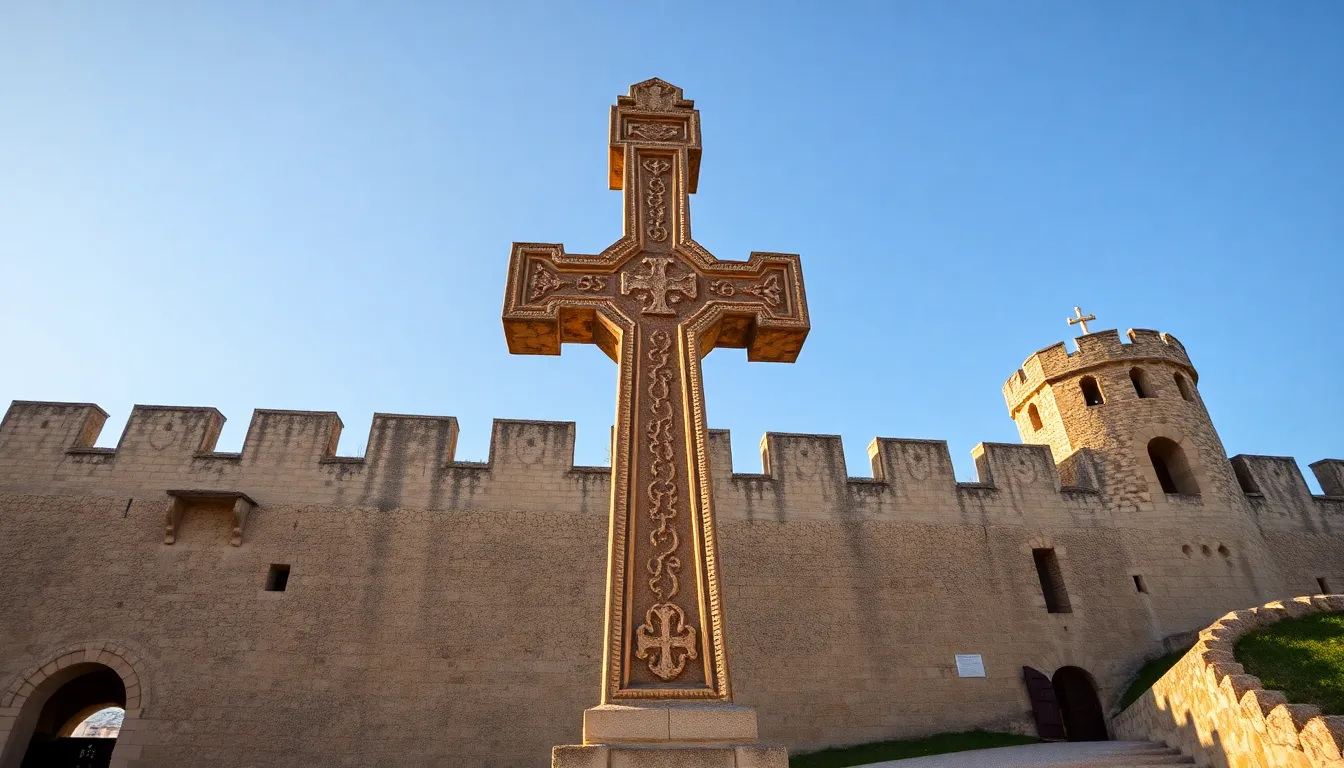
Every group I bring to Portugal includes someone who arrives expecting Templar mystery and treasure maps. I understand the appeal, but the real story is better than the legends, and it is one most pastors and educators have never heard. The Knights Templar did not just pass through Portugal. They helped build the kingdom, and when the order was destroyed across the rest of Europe, Portugal did something no other country did: it let them survive under a new name. Walking that history with a group is one of the most rewarding things I do here.
Let me lay out the trail.
Who the Templars Actually Were
The Order of the Poor Knights of Christ and of the Temple of Solomon, the Knights Templar, was founded around 1119 in the aftermath of the First Crusade. They were warrior monks, men who took religious vows of poverty and chastity and also rode into battle. Their original mission was to protect Christian pilgrims traveling to the Holy Land. Over the next two centuries they grew into one of the most powerful institutions in Christendom, with castles, lands, and an early banking network across Europe.
That power is what eventually destroyed them. In 1307, King Philip IV of France, deeply in debt to the order, had the Templars arrested on charges of heresy. Under torture, confessions were extracted. In 1312, Pope Clement V dissolved the order entirely. In most of Europe, that was the end. Templar properties were seized or handed to rival orders.
Portugal took a different path.
Why Portugal Saved the Templars
To understand what Portugal did, you have to understand what the Templars had done for Portugal.
When the kingdom of Portugal was being carved out of Muslim-held territory in the twelfth century, the Templars were there from the start. They received land, built castles, and fought in the Reconquista, the centuries-long Christian campaign to take the Iberian Peninsula. The first Portuguese king, Afonso Henriques, granted them territory and strongholds. The Templars helped defend the young kingdom’s frontier and helped resettle the land they helped conquer. In Portugal, they were not a distant international order. They were founders.
So when Pope Clement dissolved the Templars in 1312, the Portuguese king, Dom Dinis, refused to let their assets simply vanish or fall to outsiders. He negotiated with the papacy and, in 1319, created an entirely new military order to inherit the Templars’ people, properties, and mission: the Order of Christ.
The Order of Christ: The Templars Reborn
The Order of Christ was the Templars in everything but name. The same brothers, many of the same castles, the same cross, only slightly redrawn. Over the following two centuries, this order became one of the most consequential institutions in Portuguese and world history.
In the fifteenth century, its Grand Master was Prince Henry the Navigator, the man who drove Portugal’s early voyages of exploration down the coast of Africa. The order’s wealth helped fund those expeditions, and the famous red cross of the Order of Christ, descended directly from the Templar cross, was painted on the sails of Portuguese caravels. When Vasco da Gama sailed to India and Portuguese ships crossed the Atlantic, they sailed under a Templar cross. The order that protected pilgrims on the road to Jerusalem became, in its second life, the engine of the Age of Discovery.
This is the thread I most want groups to grasp. The Templar story in Portugal does not end in 1312 with arrests and suppression. It continues, transformed, into the building of a global empire. That continuity is unique to Portugal.
The Heritage Trail: Where to Walk the Story
Several sites across central Portugal let your group stand inside this history.
Tomar: The Capital of the Order
Tomar is the center of the Templar world in Portugal. The town was founded by the order in the twelfth century, and above it sits the Convent of Christ, the order’s headquarters, with its twelve-sided Templar rotunda modeled on the holy sites of Jerusalem. This is the single most important Templar site in the country, and it deserves a visit of its own. Our dedicated guide to the Convent of Christ in Tomar walks through the complex in detail.
Almourol Castle
A short distance from Tomar, on a small island in the middle of the Tagus River, stands Almourol Castle. The Templars built it in the twelfth century on the kingdom’s frontier, and it is one of the most striking castles in Portugal precisely because of its setting. Reaching it requires a short boat crossing, which makes it a memorable stop for groups who enjoy a sense of arrival. It looks exactly like the kind of place legends grow around, and the legends did grow.
Pombal and the Frontier Castles
Across the region of central Portugal, a chain of Templar and Order of Christ castles marked the medieval frontier, including Pombal, granted to the Templars and associated with their last Portuguese Grand Master, Gualdim Pais, who founded Tomar. These strongholds tell the practical side of the story: this was a working military order holding a contested border, not a secret society.
For the wider context of how these Templar sites sit among Portugal’s other faith landmarks, our overview of spiritual sites in Portugal for faith travelers places them in the full picture.
What This Trail Means for a Faith Group
I am careful with groups about separating history from myth. The Templars attract a great deal of fiction, and your educators and skeptics will appreciate a guide who keeps the line clear. What is historically solid is remarkable enough: an order of warrior monks who took vows of poverty, who were created to protect pilgrims, who were crushed by a king’s greed across Europe, and who were preserved by a small kingdom on the edge of the continent because they had helped build it.
For Christian groups, the trail raises real questions worth discussing. What does it mean for monks to also be soldiers? How did the Church hold devotion and warfare together in the medieval mind? And what do we make of an order founded to serve pilgrims that became, in its second life, the financier of empire? These are good conversations to have standing inside a Templar rotunda, and they are the kind of conversation a heritage journey is built to open.
The practical note for planning: with Heritage Tours, group leaders travel free with fifteen or more participants. For a pastor or educator considering whether to lead a Portugal trip, that lowers the barrier considerably.
You can see how these sites fit into a structured itinerary on our Portugal destination page, and our group heritage tours page explains how leading a group works in practice.
FAQ: The Knights Templar in Portugal
Why did the Knights Templar survive in Portugal?
When the order was dissolved across Europe in 1312, the Portuguese king Dom Dinis refused to let the Templars’ lands and brothers be scattered, because the Templars had helped found and defend the kingdom during the Reconquista. He negotiated with the papacy and in 1319 created a new order, the Order of Christ, to inherit the Templars’ people, properties, and mission. In Portugal the order continued in all but name.
What was the Order of Christ?
The Order of Christ was the successor to the Knights Templar in Portugal, established in 1319. It kept the Templars’ members, castles, and cross. In the fifteenth century, under Grand Master Prince Henry the Navigator, the order helped drive and fund Portugal’s voyages of exploration, and its red cross was painted on the sails of Portuguese ships during the Age of Discovery.
Where can you see Templar sites in Portugal?
The most important is the Convent of Christ in Tomar, the order’s headquarters with its twelve-sided rotunda. Other key sites include Almourol Castle, set on an island in the Tagus River, and a chain of frontier castles such as Pombal. Tomar itself was founded by the order and remains the heart of the Templar trail.
Did the Templars really fund the Age of Discovery?
Their successors did. The wealth and lands the Order of Christ inherited from the Templars helped finance Portugal’s early voyages, and Prince Henry the Navigator served as the order’s Grand Master. The famous red cross on Portuguese caravel sails was the cross of the Order of Christ, descended directly from the Templar cross.
Is the Templar history in Portugal accurate or legend?
Both circulate, and a good guide keeps them separate. The historical record is solid: the Templars helped build medieval Portugal, were preserved as the Order of Christ, and shaped Portuguese exploration. Much of the popular treasure-and-secrets material is later fiction. The documented history is compelling on its own. You can plan a trail that focuses on the real story by reaching out through our contact page.
If your group is drawn to this chapter of Christian and medieval history, I would be glad to help you build a Templar trail that stays honest to the record and still delivers the wonder of it. There is nothing quite like standing inside a Templar rotunda and feeling the centuries close in.
Contact us whenever you are ready to begin.