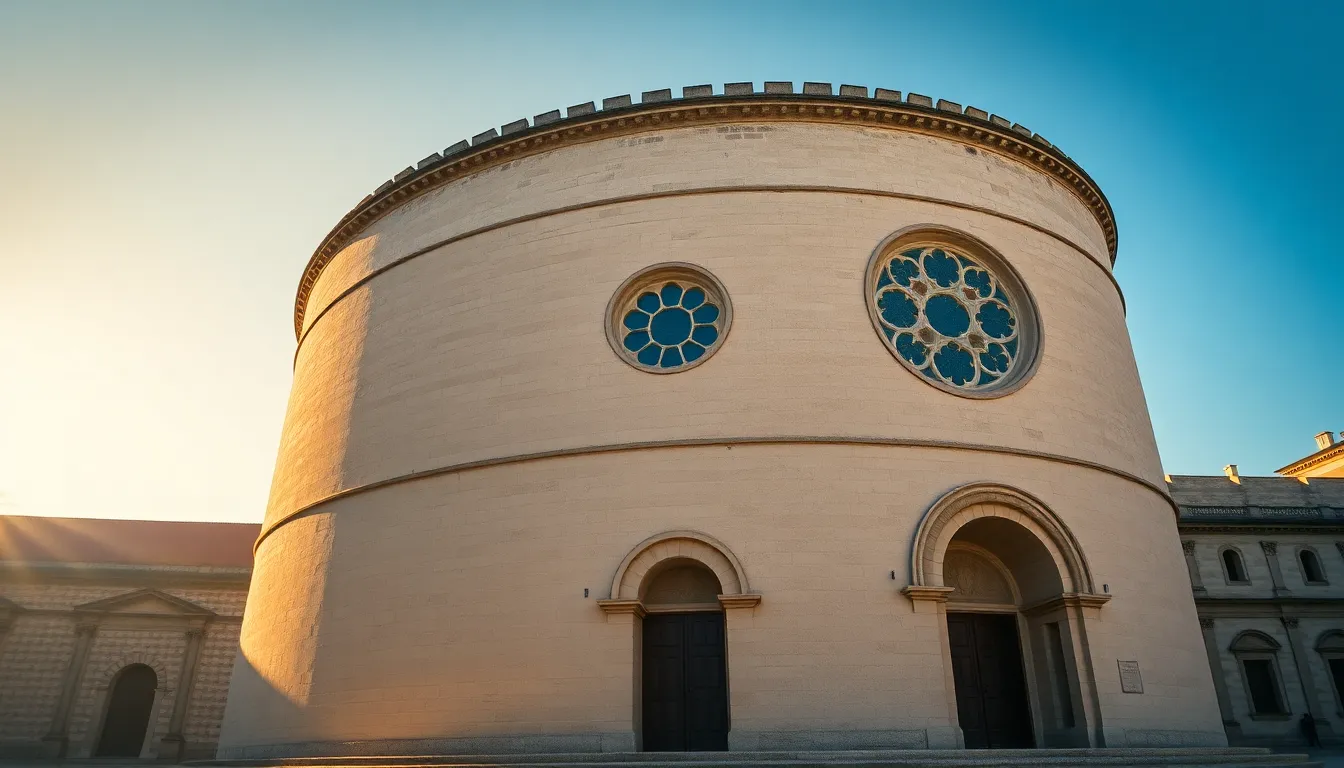
I tell my groups that if Fatima is where you feel Portugal’s faith, the Convent of Christ in Tomar is where you read its history written in stone. It is one of the great religious monuments of Europe, a UNESCO World Heritage Site, and it has the rare quality of containing four centuries of church history layered on top of each other in a single complex. Most visitors rush it in forty minutes and miss almost everything. Let me show you how to actually see it.
A Templar Headquarters Above the Town
The Convent of Christ sits on a hill above the town of Tomar, which the Knights Templar themselves founded in 1160 under their Portuguese Grand Master, Gualdim Pais. The hilltop began as a Templar castle and convent, the headquarters of the order in Portugal. When the Templars were dissolved across Europe and reborn in Portugal as the Order of Christ in 1319, this became the seat of the new order too. For the fuller story of how that survival happened, our guide to the Knights Templar in Portugal lays it out.
What this means in practice is that the complex grew over four hundred years, with each era adding to it. You are not looking at one building. You are walking through a timeline.
The Charola: The Templar Rotunda
The heart of the complex, and the oldest part, is the Charola, the round Templar church, built in the late twelfth century. This is the piece your group should spend real time inside.
The Charola is a sixteen-sided drum with a central octagonal structure, a design the Templars favored because it echoed the round churches of the Holy Land, above all the Church of the Holy Sepulchre in Jerusalem. The idea was deliberate. The Templars existed to serve the holy places, and they built churches that reminded the worshipper of Jerusalem. Standing inside the Charola, you are standing in a deliberate echo of the city the order was founded to protect.
There is a practical legend attached to the round design too. Tradition says the Templar knights could attend Mass on horseback in the central space, ready to ride out. Historians debate whether that is literally true, but the shape genuinely reflects a military order’s worship.
The interior is richly painted and gilded, with sixteenth-century murals and statues added when the Order of Christ enriched the space during Portugal’s age of wealth. The contrast is striking: a severe twelfth-century Templar shell wrapped in the color and gold of the Age of Discovery.
The Manueline Chapter Window
If there is one image that represents Tomar, it is the Chapter Window, and it is worth walking around the building specifically to see it from the outside.
The window belongs to the Manueline style, the uniquely Portuguese form of late Gothic that flourished under King Manuel I around 1500, when wealth from the spice trade and the sea voyages poured into the kingdom. The Chapter Window is the most famous example of it. The entire window frame is carved into a dense tangle of maritime imagery: ropes, coral, seaweed, the cross of the Order of Christ, an armillary sphere, and the king’s emblems, all rendered in stone as if the sea itself had grown over the wall.
It is not decoration for its own sake. It is a statement. By Manuel’s time the Order of Christ was bound up with Portugal’s voyages, and the order’s wealth and cross sailed on the ships. The window carves that union into the building: the warrior-monk order of the Holy Land had become the maritime order of the Atlantic. I always give groups time here, because the window says in stone what takes paragraphs to explain.
The Cloisters and the Full Complex
Beyond the Charola and the window, the complex unfolds through a series of cloisters built across different eras, eight in all, each reflecting the architecture of its century.
The grandest is the Main Cloister, also called the Cloister of Dom Joao III, a masterpiece of Renaissance architecture from the sixteenth century, restrained and classical in a way that contrasts sharply with the Manueline exuberance elsewhere. Its famous spiral staircase and elegant proportions reward a slow walk. Other cloisters, smaller and earlier, carry the marks of the convent’s monastic daily life: the washing places, the cells, the passages that connected work and prayer.
The complex also holds a long aqueduct that once carried water to the convent, a dormitory wing, and the remains of the original Templar castle walls. A thorough visit takes two hours, not forty minutes, and groups that give it the time come away understanding something they cannot get from photographs: the sheer span of history held in one place.
Why It Earned UNESCO Status
The Convent of Christ was inscribed as a UNESCO World Heritage Site in 1983, and the reasoning matters for a faith group. It is recognized not just for its beauty but for how completely it embodies the story of Portugal: the Templar foundation, the survival as the Order of Christ, the link to the Age of Discovery, and the layering of Romanesque, Gothic, Manueline, and Renaissance architecture in one continuous monument. There are few places where you can trace so much of a nation’s religious and political history in a single morning’s walk.
For the wider landscape of Portuguese faith heritage, including how Tomar relates to Fatima and the country’s other great sites, our overview of spiritual sites in Portugal for faith travelers gives the full map. Tomar also pairs naturally with the Sanctuary of Fatima, which sits within easy driving distance.
How Groups Should Visit
A few notes from leading congregations through this complex.
Give it two hours. The biggest mistake groups make is treating Tomar as a quick photo stop between Fatima and Lisbon. It deserves a proper visit.
Start in the Charola. Begin where the story begins, in the round Templar church, before moving outward through the centuries.
Walk the exterior for the window. The Chapter Window is best seen from outside, and many groups miss it because they never leave the interior route.
Pair it with the town. Tomar itself is worth time. It also holds the oldest surviving synagogue in Portugal, a short walk down in the old town, which makes the town a rich stop for groups interested in the full sweep of Portuguese religious history.
And the planning detail that helps: with Heritage Tours, group leaders travel free with fifteen or more participants. For a pastor or educator weighing a Portugal itinerary, that changes what is possible.
You can see how Tomar fits into a structured journey on our Portugal destination page, and our group heritage tours page explains how the group leader role works.
FAQ: The Convent of Christ in Tomar
What is the Convent of Christ in Tomar?
It is a former Templar and Order of Christ monastery and castle complex above the town of Tomar in central Portugal, founded in 1160. It served as the headquarters of the Knights Templar in Portugal and later the Order of Christ. The complex grew over four centuries and is a UNESCO World Heritage Site, holding architecture from the Romanesque, Gothic, Manueline, and Renaissance periods.
What is the Charola at Tomar?
The Charola is the round Templar church at the center of the complex, built in the late twelfth century. Its sixteen-sided design echoes the round churches of the Holy Land, especially the Church of the Holy Sepulchre in Jerusalem, reflecting the Templars’ founding mission to serve the holy places. Inside, the severe Templar structure is decorated with rich sixteenth-century murals and gilding.
What is the Manueline Chapter Window?
It is the most famous architectural detail at Tomar, a window carved around 1500 in the Manueline style, covered in maritime imagery: ropes, coral, an armillary sphere, the cross of the Order of Christ, and royal emblems. It symbolizes the union of the order with Portugal’s Age of Discovery and is best seen from the building’s exterior.
How long should a group spend at the Convent of Christ?
Plan about two hours. The complex includes the Charola, eight cloisters, the Renaissance Main Cloister, the Chapter Window, and the remains of the Templar castle. Groups that rush it in forty minutes miss most of what makes it significant. It rewards a slow, guided walk through its layered history.
Can we visit Tomar and Fatima on the same trip?
Yes. Tomar and the Sanctuary of Fatima are within easy driving distance in central Portugal and are commonly paired on faith itineraries. Together they give a group both the living pilgrimage of Fatima and the deep church history of Tomar. You can talk through how to combine them with us via our contact page.
If your community is drawn to the deep history of the faith, Tomar belongs on your itinerary. I would be glad to help you build a visit that gives it the time it deserves, because a complex like this only opens up when you slow down inside it.
Contact us whenever you would like to start planning.