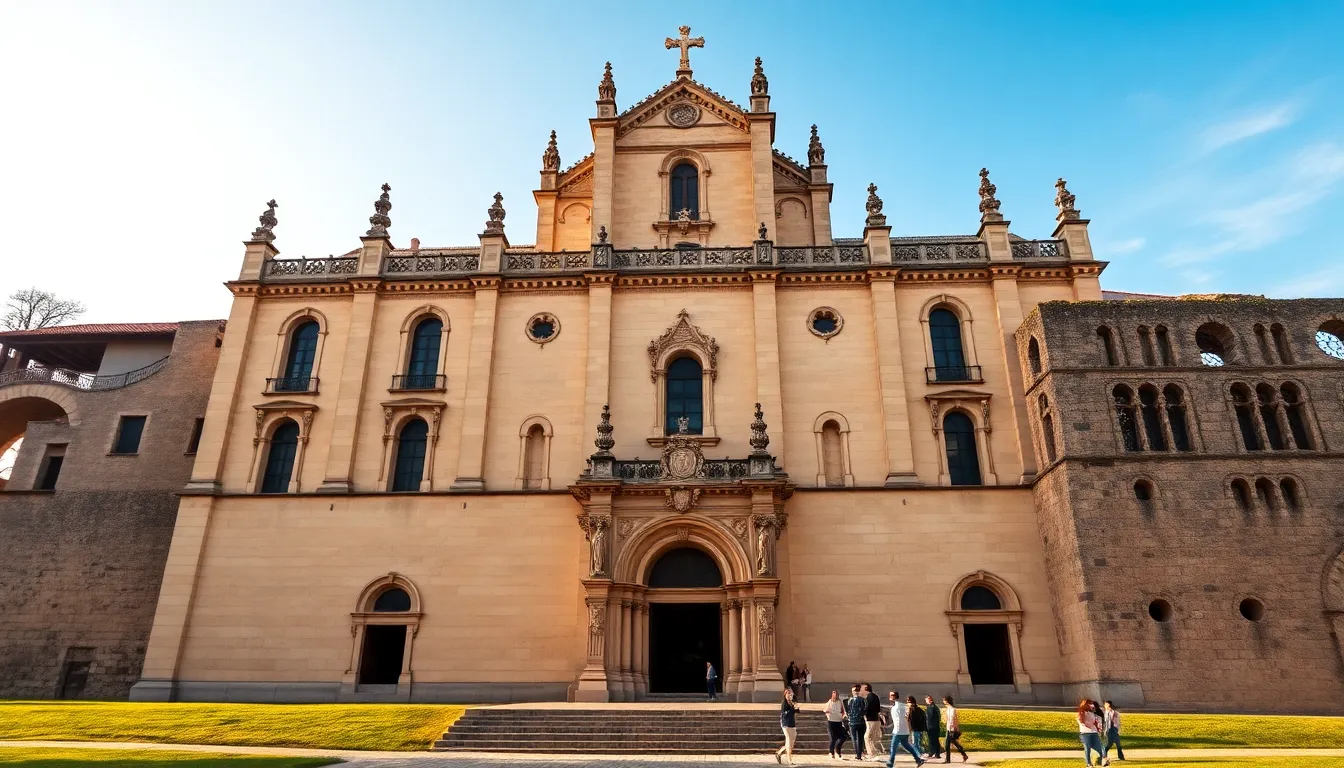
I have watched a lot of groups walk into a lot of churches, and Batalha produces a reaction I rarely see anywhere else. People stop talking. The Gothic facade is so dense with carved stone that the eye does not know where to begin, and the limestone has weathered to a honey color that catches the light. But the thing I most want a group to understand before they walk in is not the architecture. It is why the building exists at all. Batalha was not commissioned to glorify a king or to house a community of monks who happened to need a home. It was built to keep a promise made to God on the edge of a battlefield.
That story is what makes this one of the most rewarding stops on a Portugal heritage itinerary, and too many tours skip it. Let me give you what you need to lead a group here well.
The Vow on the Battlefield
In 1385 Portugal’s independence hung by a thread. The Portuguese throne was contested, and a large Castilian army marched in to claim it. Joao, the Master of Aviz, stood against them with a much smaller force near the village of Aljubarrota.
Before the battle, Joao made a vow. If God granted him victory, he would build a monastery in honor of the Virgin Mary. On August 14, 1385, the outnumbered Portuguese, with English archers among them, broke the Castilian charge and won a decisive victory that secured Portugal’s independence for the next two centuries. Joao became King Joao I, founder of the House of Aviz, and he kept his word. Construction of the monastery began the following year, in 1386.
The Portuguese name says it plainly: Mosteiro de Santa Maria da Vitoria, the Monastery of Saint Mary of the Victory. The town that grew around it is called Batalha, which simply means “battle.” Every stone of this place is, in a sense, the discharge of a debt.
What a Group Sees Inside
The Church and the Nave
The church is high, narrow, and luminous, built in a soaring French-influenced Gothic style. The nave draws the eye straight up. There is a discipline to it, a vertical pull that the later Manueline additions ornament but never overwhelm. Walk a group slowly down the center and let them feel the height before you say a word about the chapels.
The Founders’ Chapel
This is the emotional center of the building, and I always bring groups here with intention. The Capela do Fundador, the Founders’ Chapel, holds the tomb of Joao I and his queen, Philippa of Lancaster. The two lie side by side, their hands clasped together in stone, the first double royal tomb in Portugal. Philippa was English, daughter of John of Gaunt, and their marriage sealed the alliance between Portugal and England that, remarkably, is still in force today, the oldest active diplomatic alliance in the world.
Around them rest their sons, the generation Portuguese history calls the Illustrious Generation. Among them is Prince Henry the Navigator, whose patronage launched the voyages of discovery. Standing in this chapel, a group is standing at the source of an entire age of Portuguese history.
The Royal Cloister
The Claustro Real is where the architecture tells its story most clearly. The Gothic arches were later filled with extraordinary Manueline tracery, stone carved into ropes, armillary spheres, crosses of the Order of Christ, and twisting sea motifs that reflect Portugal’s seafaring identity. The contrast between the restrained Gothic frame and the exuberant Manueline filling is the whole history of the period in a single courtyard. It is also simply beautiful, especially in the soft light of late afternoon.
The Unfinished Chapels
Behind the church stand the Capelas Imperfeitas, the Unfinished Chapels, and they are unlike anything else your group will see in Portugal. King Duarte, son of Joao I, began this octagonal mausoleum, but work stopped, resumed, and finally halted for good, leaving the structure open to the sky. The great doorway is carved with breathtaking Manueline detail, layers of stone lace, and then above it, nothing. No roof. Just open air.
I let groups sit with this one. The Unfinished Chapels are an honest building. They admit that even the grandest human ambition has a limit, that not everything we begin for God gets finished in our lifetime. For a faith community, that is not a flaw in the visit. It is one of the most quietly moving things in the whole monastery.
Why Batalha Belongs on Your Itinerary
Batalha sits only about twenty kilometers from Fatima, which makes it easy to pair, and the two together give a group a remarkable range. Fatima is modern, vast, and centered on a twentieth-century apparition. Batalha is medieval, intricate, and centered on a fourteenth-century vow. One is about what was promised to a people; the other is about what one man promised to God and spent his kingdom keeping.
For pastors and educators, the teaching value is high. The story is concrete: a vow, a battle, a building. Your group can stand inside the answer to a prayer made more than six hundred years ago. That does something to people that a lecture about Gothic vaulting never will.
Practical Notes for Group Leaders
The monastery is a UNESCO World Heritage Site and is well set up for visitors, with accessible paths through most of the complex. Allow at least ninety minutes, more if your group lingers in the cloister and the Unfinished Chapels, which they will. Mornings are quieter than midday. The interior stone keeps the church cool even in summer, which is welcome on a hot Portuguese afternoon. There is a guard of honor ceremony at the tomb of the unknown soldiers within the chapter house, which groups often find unexpectedly affecting.
I usually slot Batalha into the same day or the adjacent day as Fatima, and often pair it with Alcobaca’s Cistercian abbey and the royal tombs of Pedro and Ines, since the three great monasteries of central Portugal sit within easy reach of one another.
FAQ: The Monastery of Batalha
Why was the Monastery of Batalha built?
It was built to fulfill a vow. Before the Battle of Aljubarrota in 1385, Joao I promised to build a monastery in honor of the Virgin Mary if God granted Portugal victory over the much larger Castilian army. Portugal won, securing its independence, and Joao kept his promise. Construction began in 1386, and the monastery is named Santa Maria da Vitoria, Saint Mary of the Victory.
Who is buried at Batalha Monastery?
The Founders’ Chapel holds King Joao I and his English queen, Philippa of Lancaster, in Portugal’s first double royal tomb, with their hands clasped together. Several of their sons are buried nearby, including Prince Henry the Navigator. The Unfinished Chapels behind the church were intended as a mausoleum for King Duarte and his line but were never completed.
What are the Unfinished Chapels at Batalha?
The Capelas Imperfeitas are an octagonal mausoleum begun by King Duarte that was never completed and remains open to the sky. The entrance doorway is covered in some of the finest Manueline carving in Portugal, but the roof was never built. Many visitors find the incompleteness itself moving, a reminder that even the grandest projects undertaken for God can outlast the lives of those who begin them.
How far is Batalha from Fatima?
Batalha is about twenty kilometers from Fatima, roughly a twenty to thirty minute drive. The two are very easy to pair on the same day or on adjacent days, and most heritage itineraries through central Portugal visit both. Batalha also sits within easy reach of the Alcobaca monastery, so the three major sites can be combined into a rich one or two day stretch.
How long should a group spend at Batalha?
Plan for at least ninety minutes, and more if your group is the kind that lingers. The church, the Founders’ Chapel, the Royal Cloister, and the Unfinished Chapels each deserve unhurried time, and the cloister in particular rewards a slower pace. Mornings are generally quieter than midday, and the cool stone interior is a relief on hot afternoons.
If you are building a route through central Portugal, Batalha is one of the stops I most strongly encourage groups not to skip. It pairs naturally with Fatima and the other great monasteries, and the story behind it gives your people something to hold onto long after the trip ends. You can see how it fits the wider route on our spiritual sites in Portugal guide and our Portugal destination page.
We design these journeys around groups, and through our group heritage tours the group leader travels free with fifteen or more participants. Contact us when you are ready to start planning.