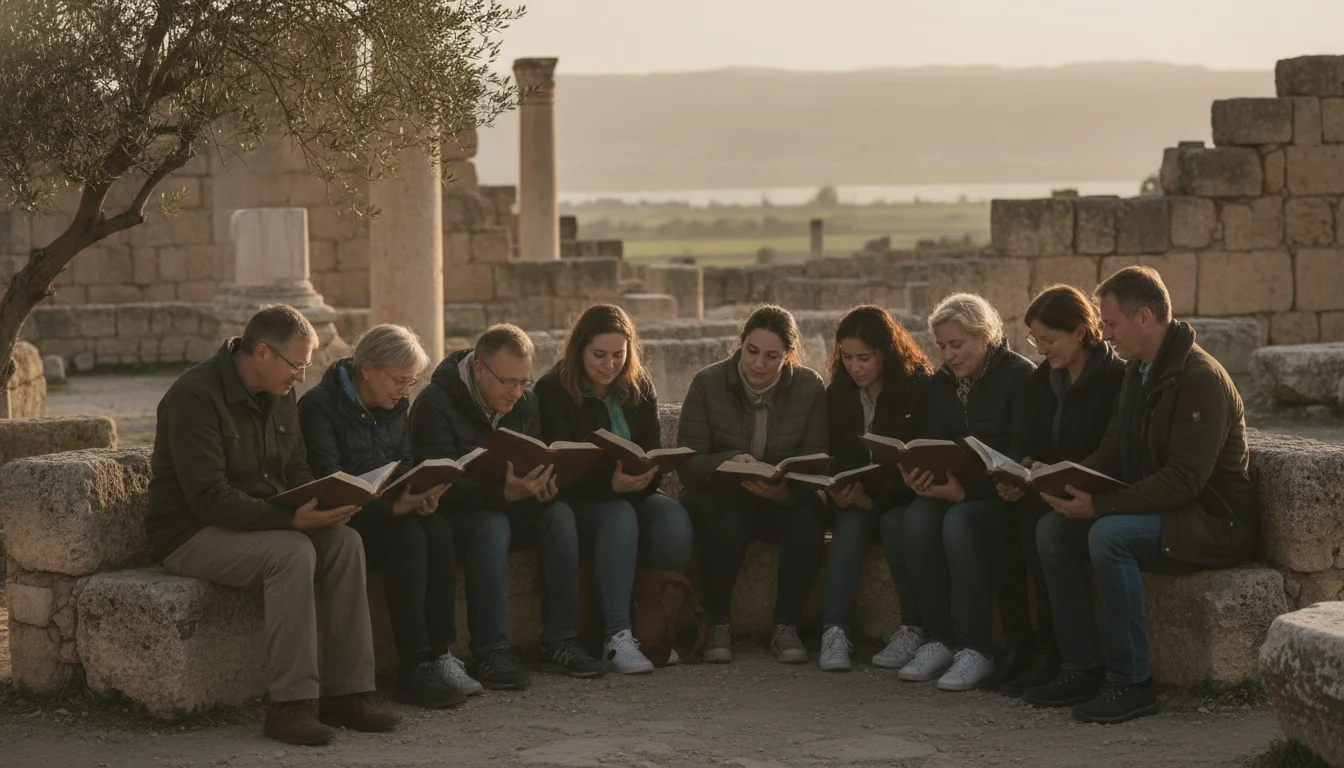
Most of the group leaders I talk to did not set out to plan a trip. They set out to lead a Bible study, and one week the study got quiet in a good way, the kind of quiet where people are picturing the place instead of just reading about it. Somebody said out loud what everybody was thinking: we should actually go there. That is usually the moment the leader calls me, half excited and half worried they have started something they cannot finish.
I have built heritage journeys for more than forty years, and taking a small study group on the road is one of the trips I love most, because the group already exists. You are not recruiting strangers. You have people who read Scripture together every week, and now you want to walk it with them. This guide is for you, the person who leads that study and will lead the trip.
Why a Study Group Is the Easiest Group to Travel
A church small group Bible study trip has a built in advantage that no other group has. The people already trust each other. They show up on the same night every week and share a text and a rhythm. When you turn that into a journey, you are not building a group from nothing. You are extending something that already works.
That matters for the two hardest parts of group travel: recruiting and commitment. A pastor building a general congregation trip has to convince people who barely know each other to spend eight days together. You do not. Your ten or twelve regulars are the core, and the trip fills outward from them as spouses and friends ask to come along. I have seen a group of eight studying the book of Acts turn into a group of nineteen traveling to walk it, and none of that growth felt like work.
So the first thing I want you to hear is this. You are further along than you think. Your job is not to manufacture interest. It is to give it a real date and a real shape.
Sizing the Trip: Where the Free Leader Seat Comes In
Let me get to the number that changes the budget, because it is the question every study leader asks: how am I supposed to pay my own way on top of leading this?
With fifteen or more paying travelers, the group leader travels free. Your full trip cost is covered: the flights, the hotels, the ground transportation, the site entries, and the meals built into the itinerary. You are the reason the group exists, so your seat is the one the structure carries. A group of fifteen paying participants generates enough room in the costing to absorb one more traveler, and that traveler is you.
For a small study group, fifteen is friendlier than it sounds. If you have ten regulars and most bring a spouse or a friend, you are already past the line. I walk leaders through this math constantly, and the pattern holds: groups that start the conversation at ten almost always cross fifteen before departure.
A few things worth knowing as you size it:
- Below fifteen, the trip still happens. We run journeys for ten to fourteen people all the time. That range simply does not include the free leader benefit, so the leader either pays a participant’s price or the group agrees to cover the seat between them.
- Larger groups open a second door. Groups of around twenty five or thirty sometimes unlock a reduced or complimentary spot for a co-leader or a spouse. If your study group has two people who share the teaching, raise that early so we can build toward it.
- You do not need to hit the number on day one. You need a real core and a real date. The rest firms up as people see the trip is happening.
For the full breakdown of how the leader seat is funded, our guide on how many people you need for the leader to travel free lays out the economics, and how pastors afford to lead a trip covers it from the budget side.
Choosing Where to Go: Let the Study Decide
Here is the advice I give every study leader. Do not start with the destination. Start with what your group has been reading.
The best small group trips are an extension of the text, not a break from it. A group that has spent a season in the Gospels wants to stand where the Sermon on the Mount was preached and read it aloud on the hillside. A group working through Acts and the letters of Paul wants to walk his missionary route through Greece and stand where those letters were sent. The destination is the answer to the question your study has already been asking.
When you frame it that way, the trip sells itself, because it is not a vacation with sightseeing bolted on. It is the study, continued, in the place it happened. If your group has been in the Holy Land in spirit for months, our overview of a church group trip to Israel shows how that itinerary comes together, and if your study has followed Paul, the footsteps of Paul itinerary walks the route site by site.
How Denomination Affects the Itinerary, in Real Detail
This is the part leaders often do not know to ask about, and it matters more than people expect. Two groups can visit the same country and have genuinely different trips, because denomination shapes what a site means and how you experience it. Let me be specific, since “we tailor it to you” is not an answer you can plan around.
Catholic and Orthodox groups usually want the sacramental layer built in. That means Mass at significant sites, time at Marian locations, the traditional stations along the Via Dolorosa in Jerusalem, and access to churches and shrines with enough time to actually pray, not just photograph. A parish trip is not complete without daily Mass on the itinerary, so we build the schedule around where and when that can happen. Our note on planning a Catholic parish trip to the Holy Land fits inside the broader planning guide.
Evangelical and Protestant study groups tend to lead with the biblical text. The priority is standing where events in Scripture happened and reading the passage on the spot, so we weight the itinerary toward teaching moments: the Sea of Galilee, Capernaum, the garden tomb, the riverbank at Philippi. There is less emphasis on veneration of specific shrines and more on the geography of the narrative. The leader teaches at each site, so we build in the time and the quiet for that.
Baptist and non denominational groups often want the same biblical focus with room for baptisms in the Jordan River, a moment that has to be arranged in advance, not improvised.
Jewish congregations on heritage routes work from a different calendar and a different set of sites entirely: synagogues, Jewish quarters, Holocaust memorials, and the observance of Shabbat, which shapes the entire weekly rhythm of the trip. A group traveling to Poland or Spain needs an itinerary that respects kashrut and the Sabbath, and that is a structural decision made at the planning stage, not a preference noted at the hotel.
The practical takeaway: tell your operator your tradition on the first call, in plain terms, and ask directly how it changes the daily schedule. A good operator answers with specifics, not reassurance. If the answer is vague, that tells you something. Our guide on how to choose a faith tour operator covers the questions that separate operators who understand your tradition from those who hand you a generic route.
How to Plan an Interfaith Heritage Trip
Some leaders want to travel with a mixed group on purpose: a church and synagogue journeying together, or a study group that crosses denominational lines. These are some of the most meaningful trips I build, and they take a little more care.
The key to an interfaith heritage trip is honest planning about what is shared and what is separate. Much of the Holy Land is common ground: Jerusalem, the Galilee, the archaeology, the history both traditions hold. You build the shared spine of the trip around those places. Then you make room for the moments that belong to one tradition, letting the other group be present as respectful guests rather than forcing everything into a single frame.
In practice that looks like this. You plan the itinerary around history and place first, so everyone has a genuine reason to be at each site. You schedule tradition specific observances (a Shabbat dinner, a Mass, a communion service) as their own moments, clearly, so everyone can choose their level of participation. And you lean on a guide who can speak to more than one tradition without flattening either.
The reward is real. I have watched a mixed group stand together at the Western Wall and later at the Church of the Holy Sepulchre, and the conversations on the bus afterward were the whole trip. If this is the group you lead, say so early, because an interfaith itinerary is designed differently from the ground up.
The Practical Checklist for a Study Group Leader
Once you know roughly where and who, the planning itself is straightforward. Here is the order I put in front of leaders.
- Lock a date range and a length. Eight to twelve days is the sweet spot for a study group. Tie it to a season your people can actually travel, and avoid your congregation’s busiest weeks.
- Count your realistic core. Not the whole church, the people who will actually go. Ten committed travelers is a strong start toward fifteen.
- Start the conversation with an operator early. Six to nine months ahead is right for fifteen to thirty travelers, longer for holiday timed trips. That lead time is recruiting runway as much as logistics.
- Set up a payment plan. People commit more easily when they can pay in installments rather than one lump sum. Our note on a group trip payment plan shows how that is structured.
- Get travel insurance sorted for the group. Do not leave it to individuals to figure out. See travel insurance for a church group.
- Build a simple committee if the group is over twenty. Two or three helpers handling communication and payments keeps the trip off your shoulders alone.
If you want one document that covers the whole arc from first idea to departure, start with our pillar guide on how to plan a group pilgrimage. It is the map for everything above.
Your Real Job on the Trip
I want to close where it matters most. When the free leader model takes your personal cost off the table, and a good operator handles the flights, hotels, coaches, and daily logistics, it frees up the one thing your group actually came for: you, teaching.
You are not the trip’s accountant or its travel agent. You are the person who has read these texts with these people for months, and now you get to read them out loud in the place they happened. You lead the reflection at the tomb. You open the passage at the site. Everything else is my job and the operator’s job to make invisible, so your attention stays where it belongs.
FAQ: Planning a Bible Study Group Trip
How many people do I need in my study group for the trip to work?
You can travel with as few as ten. For the group leader to travel free, you need fifteen or more paying participants. Most small study groups reach fifteen once regulars bring spouses and friends, so if you have ten committed people, you are closer than you think.
Does the group leader really travel free, and what does that cover?
Yes. At fifteen or more paying travelers, the leader’s full trip is covered on the same terms as a participant: international flights, hotels, ground transportation, included site entries, and the meals built into the itinerary. Personal spending and optional add-ons are the leader’s own.
How does our denomination change the itinerary?
More than most people expect. Catholic and Orthodox groups get daily Mass and time at shrines built in. Evangelical and Baptist groups get a text-first schedule weighted toward teaching at biblical sites, with baptisms in the Jordan arranged in advance. Jewish groups get an itinerary that respects Shabbat and kashrut. Tell your operator your tradition on the first call and ask exactly how it changes the daily schedule.
Can we do a trip that includes more than one faith tradition?
Yes, and they are some of the most meaningful journeys I build. The itinerary is planned around shared history and place, with tradition-specific observances scheduled clearly as their own moments so everyone knows what to expect. It takes more care at the planning stage, so raise it early.
How far ahead should we start planning?
Six to nine months for a group of fifteen to thirty, and nine to twelve months for larger groups or trips timed around a holiday. The lead time is as much about giving your people space to commit and budget as it is about booking. A real date and a real itinerary are what move people from interested to going.
If your study group has been reading its way toward a trip, the next step is simple: pick a rough date range and count your core. You can see how the group experience is built on our group heritage tours page.
Contact us and we will help you shape the itinerary around your study, your tradition, and your dates.