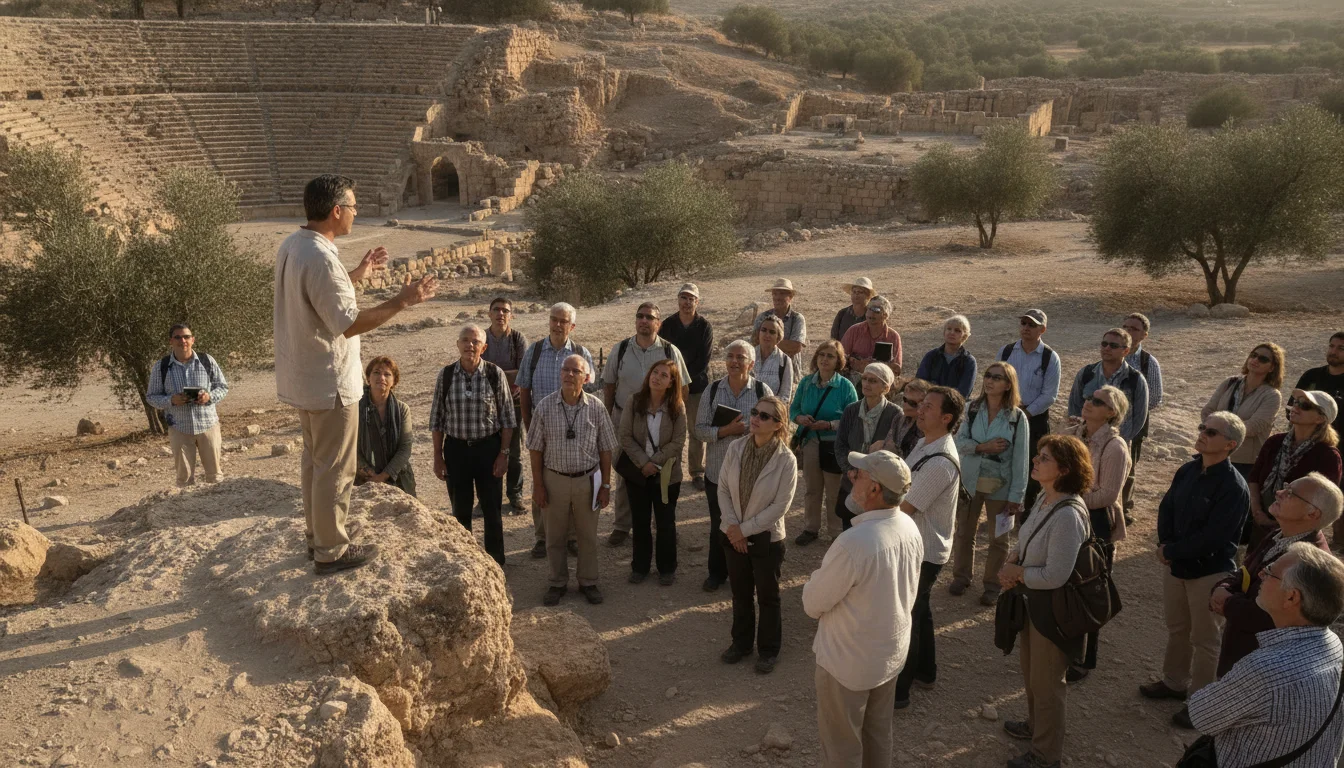
Most pastors who call me about leading a trip to the Holy Land open with a version of the same worry. They want to go. They have wanted to go for years. What stops them is a quiet assumption that leading the group means paying their own way, and then standing in front of a church board to explain why the congregation should fund the pastor’s travel. That is a hard conversation to walk into, and a lot of leaders decide it is not worth having. So the trip stays an idea.
I have built heritage journeys for more than forty years, and I want to take that worry apart piece by piece, because it rests on a wrong assumption. In most cases the leader does not pay to lead the trip. With a group of the right size, the leader’s full trip is covered. That single fact changes the entire shape of the decision, and it changes what you have to bring to your board. Let me walk you through exactly how it works, what it covers, where the number comes from, and how you actually reach it.
The Fear, Named Plainly
The fear usually has two layers. The first is personal. A serious Holy Land itinerary is not a cheap trip, and a pastor’s salary is rarely built to absorb it. The second layer is harder. Even a leader who could scrape the money together does not want to ask the congregation to send him on what looks, from the outside, like a paid vacation. So the leader carries the cost quietly, or drops the whole plan.
Here is what I want you to hear before anything else. You are not the passenger on this trip. You are the reason it exists. The people who travel come because you are leading. The model that operators like ours use is built around that fact. Your seat is the one that comes free, because your leadership is what fills the other seats. Once you understand that, the board conversation stops being a request for a personal favor and becomes a plan for a group program your people pay into.
What the Free-Leader Model Actually Covers
When we say the group leader travels free with fifteen or more paying participants, we mean the leader’s full trip, on the same terms as everyone else in the group. That includes international flights, hotel accommodation, ground transportation by private coach, entry fees to the sites on the itinerary, and the group meals built into the program. The leader joins at no personal cost.
This is not a discount code or a partial credit toward a future trip. It is a complimentary place built into the economics of the booking. A group of fifteen paying travelers generates enough margin within the trip’s own costing to carry one more person, and that person is you. You are not being subsidized as a favor. You are the organizing center of the group, so the structure is designed with your seat as the free one.
For a congregation, this reframes everything. You are no longer asking your church to buy the pastor a plane ticket to Jerusalem. You are organizing a pilgrimage your members pay into, walking the ground where the Scriptures happened, and your participation is simply part of how a group of that size is put together. That is a very different thing to bring to a board.
Where the Fifteen Comes From
People ask me why the number is fifteen and not ten, and not twenty. The honest answer is that fifteen is the point where a group trip becomes economically self-supporting at the quality we build at.
Think about which costs stay the same no matter how many people come. The licensed guide costs the same whether the coach holds twelve or thirty. The coach itself, the local operators, the site coordination, the driver, the logistics of moving a group through Jerusalem, the Galilee, Bethlehem, and the Dead Sea, all of that is largely fixed. Those are the numbers that do not shrink when your group is small. Below fifteen, those fixed costs get spread across too few travelers. The per-person price climbs, and there is simply no room to carry a complimentary seat without pushing everyone else’s cost up.
At fifteen, those same fixed costs are shared widely enough that the structure holds and the leader’s seat fits inside it without raising anyone’s price. That is the whole mechanism. It is not a marketing gimmick. It is arithmetic. If you want the fuller picture of how the pieces add up, I walk through what a Holy Land group trip costs in its own guide, because understanding the cost structure is exactly what lets you speak to it with confidence.
What Happens With Ten to Fourteen
Smaller groups are absolutely possible, and I do not want anyone reading this to think the trip is off the table below fifteen. We run trips for ten to fourteen people regularly, and they are wonderful. They simply do not qualify for the free-leader benefit, because the economics I just described do not yet support a complimentary seat at that size.
In that range, one of two things happens. Either the leader travels at a participant’s price like everyone else, or the group agrees to absorb a small premium spread across the members to cover the leader’s seat. Both are common, and neither is a problem. It is just a matter of deciding together how the group wants to handle it.
If you are sitting close to the line, say you have twelve people committed and three more who are interested but not sure, my advice is always the same. Start planning anyway. Interest firms up once people see real dates and a real itinerary in front of them. I have watched many groups cross from thirteen to seventeen in the final two months, not because anyone pushed, but because the trip stopped being a maybe and became a thing on the calendar. The concrete plan is what converts the fence-sitters.
Larger Groups and the Second Free Seat
The math does not stop being friendly at fifteen. It keeps getting better as the group grows. A group of twenty-five or thirty carries more room inside it, and that room can open a second benefit: a reduced or complimentary place for a co-leader or a spouse.
This matters more than it sounds. Leading a group is real work, and having a second person to share it, whether that is your spouse, an associate pastor, a deacon, or a lay leader who helps herd the group and handle small logistics, makes the whole trip lighter for you. If you are building toward a larger group and you would want a co-leader or your spouse alongside you, raise it early in the planning. It is much easier to build toward when we know from the start, and it gives you a clear reason to grow the group past twenty-five.
How to Justify It to Your Board
This is where many pastors freeze, so let me give you the frame I have seen work.
Do not present the trip as a personal request. Present it as a congregational program with a leader’s seat built into the structure, exactly the way a conference or a mission trip has a leader’s role built in. The board is not being asked to fund your vacation. They are being asked to bless a pilgrimage your members pay for themselves, with the pastor leading because that is his job and because a group of that size includes the leader’s place at no cost to the church.
Bring three things to the meeting. First, the model, stated plainly: at fifteen paying travelers the leader’s full trip is covered, so the church budget is not funding your seat. Second, the spiritual and educational purpose, tied to what your congregation is studying or preaching through. Third, a rough sense of the participant price and the dates, so the board sees this is real and thought through, not a wish. When you walk in with those three, the objection you were dreading usually does not appear. Most boards are relieved to learn the leader’s cost is not coming out of the church budget at all. If you want a fuller playbook for the whole process, the complete leader’s guide lays it out step by step, from first idea to departure.
Freeing the Leader to Shepherd, Not Account
Here is the part I most want leaders to sit with. When the free-leader model takes your personal cost off the table, it also takes something else off your shoulders. You stop being the trip’s accountant.
That is the real gift. Your job on a Holy Land journey is not to track the budget, chase the coach schedule, or worry about entry fees. Your job is to shepherd your people through the places where their faith was born. To read the Sermon on the Mount aloud on a hillside above the Sea of Galilee. To lead a quiet moment at the Garden Tomb, or at the Western Wall, or at the waters of the Jordan. To be fully present for your community in the exact places that will move them for the rest of their lives. The operator’s job is to make everything else invisible so that yours becomes possible. The free seat is part of how we keep your attention where it belongs, on your people and not on a spreadsheet.
I have watched pastors carry both roles at once on trips they organized alone, and it wears them down. They spend the journey managing logistics instead of leading worship. The model exists so you do not have to do that. Once the money is handled and the logistics belong to us, you get to be the leader your congregation came to follow.
FAQ: How Leaders Afford to Lead a Trip
How many participants do I need for the group leader to travel free?
Fifteen. With fifteen or more paying participants, the group leader’s full trip is covered, including flights, hotel accommodation, ground transportation, and site entry fees. Below fifteen the trip is still possible, but the leader pays a participant’s price or the group covers the seat by agreement.
Does the free seat cover everything, or just the flight?
It covers the leader’s full trip on the same terms as a participant: international flights, hotels, ground transportation, included site entries, and the meals built into the itinerary. Personal spending and optional add-ons are the leader’s own.
Can my spouse or a co-leader also travel free?
Not automatically at fifteen, but larger groups create room. Groups of around twenty-five or thirty can sometimes open a reduced or complimentary second seat for a co-leader or a spouse. If that matters to you, raise it early so we can build toward it from the start.
How do I explain this to my church board without it looking like a paid vacation?
Present it as a congregational program, not a personal request. Your members pay their own way, the trip serves a clear spiritual and educational purpose, and the leader’s seat is built into a group of fifteen at no cost to the church budget. Most boards relax once they understand the church is not funding your seat.
What if I can only gather twelve people?
The trip can still happen. We run journeys for ten to fourteen regularly. That size just does not include the free-leader benefit, since the economics that fund the complimentary seat begin at fifteen. Many groups that start at twelve reach fifteen before departure, so it is worth planning as though you will get there.
If you have wanted to lead your people to the Holy Land but assumed the cost put it out of reach, the free-leader model is usually the thing that changes the answer. Once you know how to recruit and fill your group and how the seat math works, the trip stops being an idea and starts being a plan. You can see how the group experience comes together on our group heritage tours page.
Contact us and we will help you run the numbers for your congregation and your dates, so you can walk into that board meeting knowing exactly what to say.