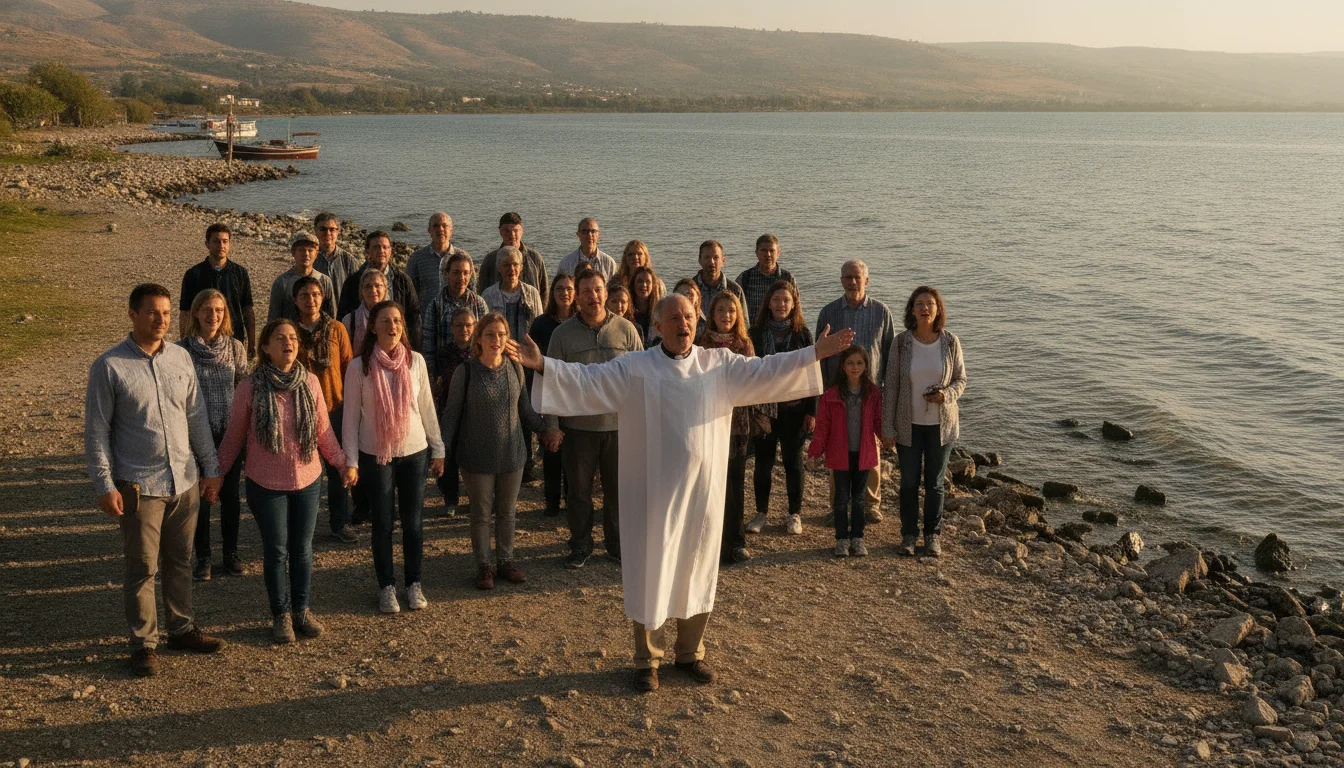
Most pastors who call me about a Baptist church trip to Israel are not asking whether they want to go. They already know they do. What they are really asking is whether they can pull it off: whether they can fill the seats, keep the cost reasonable for their families, and lead the group without turning into a full-time travel agent for six months. Those are the right questions, and I want to answer them the way I would if you were sitting across from me.
I have built heritage journeys for more than forty years, for Baptist, Methodist, Pentecostal, and nondenominational congregations, and for Jewish communities as well. The trip you are picturing is very buildable. What follows is how the organizer’s side of it actually works: the free-leader model, the money, the recruiting, and the logistics that decide whether your group crosses the finish line.
Start With the Decision You Are Actually Making
You are not planning a vacation. You are organizing a journey your congregation pays into and you lead. That distinction changes everything about how you approach it. Your job is not to fund the trip out of your own pocket. Your job is to give your people a reason to go, a real date to plan around, and a leader they trust to walk them through Scripture in the places it happened.
For a Baptist congregation, the pull is usually the same handful of sites: the Jordan River, where baptism stops being an idea and becomes a place you can stand in. The Sea of Galilee at dawn. Capernaum. The Garden Tomb and the Via Dolorosa in Jerusalem. Caesarea, where Peter first brought the gospel to the Gentiles. When you can name those places on a real itinerary and put dates next to them, the trip stops being a someday and becomes a decision your people can say yes to.
If you want the full framework for building one of these from the ground up, our guide to planning a group pilgrimage walks through every stage in order. Treat this article as the Baptist-specific companion to it.
The Free-Leader Model: How Your Seat Gets Covered
Here is the part that takes the pressure off, and it is the first thing I tell every pastor. When you bring fifteen or more paying travelers, your seat is free. Not discounted. Covered.
That means your international flight, your hotel accommodation, your ground transportation, your site entries, and the group meals built into the itinerary are all included at no personal cost to you. The reason is simple once you see the math. A group of fifteen paying participants carries enough margin within the trip’s costing to absorb one more traveler, and that traveler is you. You are the reason the group exists, so the model is built around your seat being the complimentary one.
This matters more than most leaders expect, because it removes the one conversation nobody wants to have with a church board: asking the congregation to send the pastor on an expensive trip. You are not asking for that. You are organizing a journey your people fund by their own participation, and your presence is part of how the numbers are structured. If you want the deeper breakdown of who qualifies and why, we cover it in does the pastor travel free and in how many people you need for the leader-free benefit.
What Happens Below Fifteen
Smaller groups are welcome. We run trips for ten to fourteen people all the time, and they are wonderful. They simply do not trigger the free-leader benefit, because the economics that fund a complimentary seat start at fifteen. In that range, the leader either pays a participant’s price like everyone else, or the group agrees to absorb a small premium to cover the leader’s seat.
If you are sitting at twelve committed with a few maybes, my advice is always the same: start planning anyway. Interest firms up fast once people see real dates and a real itinerary. I have watched groups move from thirteen to eighteen in the final two months simply because the trip became concrete and people stopped treating it as hypothetical.
What a Baptist Church Trip to Israel Actually Costs
Cost is where most leaders want a straight answer, so let me give you the honest shape of it. A well-run Baptist group trip to Israel is typically a nine to twelve day journey. The per-person price covers international flights, hotels, a private coach, a licensed Israeli guide, site entries, and daily breakfasts plus most dinners. What it does not cover is personal spending, lunches on your own, travel insurance, and optional extras.
The single biggest lever on your final price is group size. The larger the group, the more widely the fixed costs (the guide, the coach, the coordination) get spread, and the lower the per-person number goes. That is the same math that funds your free seat, working in your travelers’ favor too. We break the numbers down in detail in the cost of a church trip to Israel, and if you are building a budget for your board, how to budget a church trip gives you the line items to plan around.
One practical note for organizers: offer a payment plan from day one. When people can put down a deposit and pay in installments over several months, your yes rate climbs and your group fills faster. A trip that costs a family thousands of dollars in one payment feels impossible. The same trip spread across six or eight payments feels doable. We lay out how to structure this in group trip payment plans.
How to Recruit Fifteen Without Stress
This is the part leaders worry about most, so let me be practical.
You do not need to recruit fifteen strangers. You need to find the eight to ten people in your congregation who already want to go, and let them bring others. Every trip I have run started with a small committed core. Couples travel together. Friends bring friends. Sunday school classes and Bible study groups travel as a unit. Fifteen becomes easy once you start from the people leaning in rather than the whole membership roll.
Give them a reason and a date. “We are walking the life of Christ from Galilee to Jerusalem next March, ten days, here is what we will see” converts. “We might do an Israel trip someday” never does. Tie the journey to a sermon series or a book of the Bible your church is studying and the interest sharpens on its own. Announce it from the pulpit, put a simple interest card in the bulletin, and host one information night with real photos and a real itinerary on the screen.
For the full recruiting playbook, including timelines and the exact steps that fill a group, see how to recruit for a church trip. And if the money side of leading feels like the obstacle, how pastors afford to lead a trip walks through it plainly.
Plan Far Enough Ahead
Six to nine months is the sweet spot for a group of fifteen to thirty. That gives your people time to budget, request time off work, and commit. It also gives you time to build interest, which is the real work. Larger groups, or trips timed around Easter or a specific season, want nine to twelve months of runway.
Earlier planning is not just about logistics. It is about recruiting. The lead time is what lets word spread through your congregation, what lets a couple talk it over and say yes, what lets someone quietly start saving. If you are wondering how early is early enough, we answer it directly in how far ahead to plan a group trip.
A Word to Methodist and Pentecostal Leaders
Baptist congregations are far from the only ones I build for, and the same structure serves other traditions well.
For a Methodist group tour of the Holy Land, the itinerary tends to lean into the full arc of the Gospels and the early church, with room for the reflective, connectional rhythm Methodist groups often want. The free-leader model works identically: fifteen paying travelers, and the pastor’s seat is covered. The recruiting approach is the same too, starting from your committed core and building outward. If you lead a Methodist congregation, everything in this guide applies to you with only the itinerary emphasis adjusted, and our church group trip to Israel overview is a good next read.
For Pentecostal leaders, I often get asked about a Pentecostal church trip to Greece and Turkey rather than Israel, following the footsteps of Paul through the seven churches of Revelation, Ephesus, Philippi, Corinth, and the sites of Acts. That is one of the most moving routes we run, and it operates on the same free-leader economics. If Greece and Turkey are where your heart is pointing, look at the footsteps of Paul church trip and Greece and Turkey for groups. Some congregations even combine a Holy Land core with a Pauline extension. It is worth asking about early if that appeals to you.
Your Real Job Once the Logistics Are Handled
Here is what I most want you to hear. When the free-leader model takes your personal cost off the table and a good operator handles the ground work, your attention is freed for the only thing that actually matters on a trip like this. You are not the accountant. You are the shepherd.
That is the point of the whole structure. Your role is to guide your people through a spiritual experience, to read the Sermon on the Mount aloud on the hillside above Galilee, to baptize a believer in the Jordan, to stand quietly with your congregation at the empty tomb. The operator’s job is to make everything else invisible: the coaches, the check-ins, the entries, the timing. When that machinery runs in the background, you get to be fully present for your people in the places that will change them. The free seat is part of how we keep your focus where it belongs.
FAQ: Leading a Baptist Church Trip to Israel
How many people do I need for the group leader to travel free?
Fifteen. With fifteen or more paying participants, the group leader’s full trip cost is covered, including international flights, hotels, ground transportation, and site entries. Below fifteen the trip still runs, but the leader pays a participant’s price or the group covers the seat by agreement.
What does a Baptist church trip to Israel usually cost per person?
It depends most on group size and length, but plan on a nine to twelve day trip that includes flights, hotels, a private coach, a licensed guide, site entries, and most meals. Larger groups lower the per-person price, and a payment plan spread over several months makes it manageable for families.
How far ahead should we start planning?
Six to nine months for a group of fifteen to thirty, and nine to twelve months for larger groups or season-specific dates. The lead time is as much about recruiting your group as it is about booking, so earlier is always better.
Can I lead a Methodist group tour of the Holy Land the same way?
Yes. The free-leader model and the recruiting approach work identically for Methodist, Baptist, Pentecostal, and nondenominational groups. Only the itinerary emphasis changes to fit your tradition.
What about a Pentecostal church trip to Greece and Turkey instead?
We run those on the same free-leader economics, following the footsteps of Paul through the sites of Acts and the seven churches of Revelation. Some groups combine an Israel core with a Greece and Turkey extension, which is worth raising early so we can build toward it.
If you are weighing whether a trip is realistic for your congregation, the free-leader math is usually the thing that tips it. You can see how the group experience comes together on our group heritage tours page, or look at the full route on our Israel heritage page.
Contact us and we will help you run the numbers for your group and your dates.