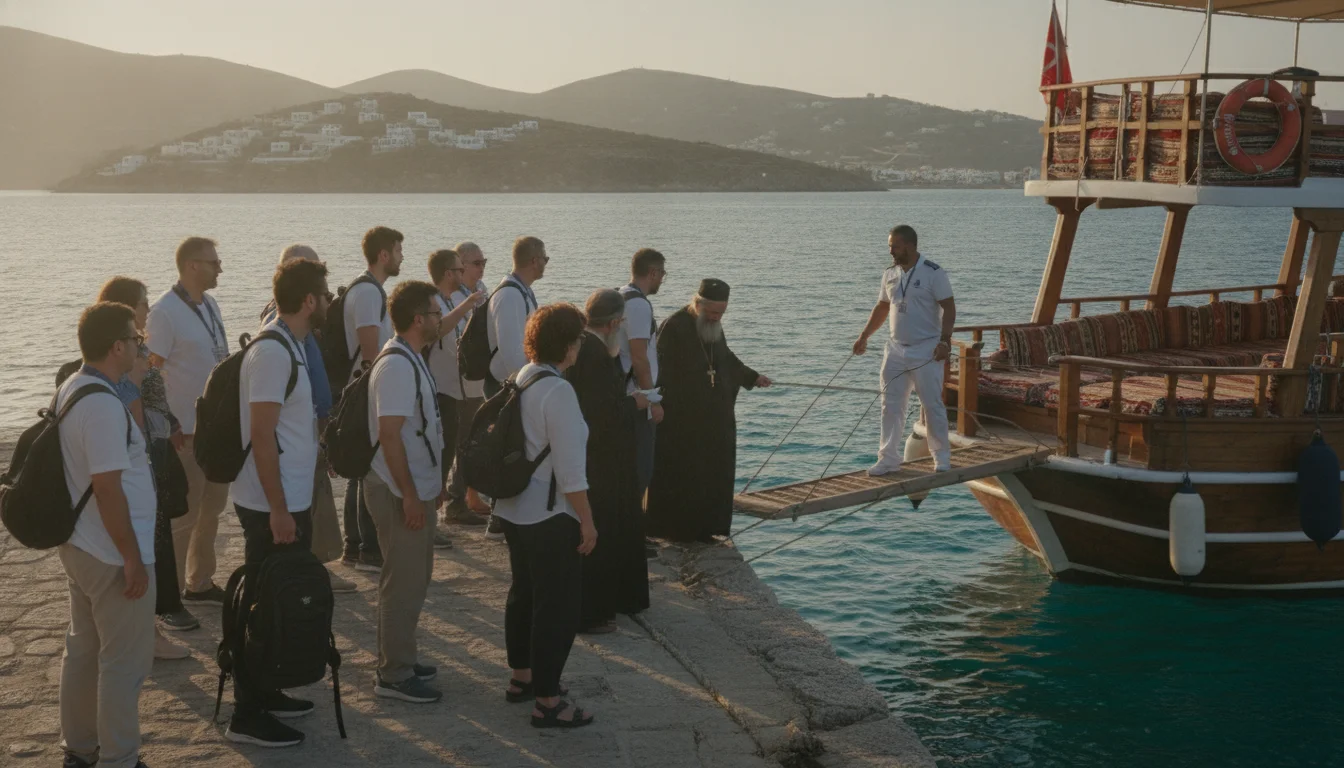
Most pastors come to me thinking they have to choose. Greece or Turkey. Athens and Corinth, or Ephesus and the seven churches. They have a study series in mind, a budget in mind, and a sense that combining the two would double the cost and double the complexity. So they pick one, run a good trip, and quietly file the other country away for “someday.”
I have built heritage journeys for more than forty years, and I want to change how you see this. Greece and Turkey are not two trips. For a church group reading through Acts or Revelation, they are one trip that happens to cross a border. The New Testament does not respect the modern map. Paul did not. John did not. The moment you stop treating these as separate destinations, the whole thing gets simpler, richer, and easier to fill than you expect.
Let me walk you through why the two belong together, what your people will actually see, how the routing works, how many days it takes, and how the free-leader model keeps your own seat off the budget.
Why the Two Countries Are Really One Story
Open your New Testament and start marking the cities. You will find them scattered across both sides of the Aegean, and you will find the same men moving between them.
Paul sailed from Troas, on the Turkish coast, and landed at Neapolis in Greece to plant the first church on European soil at Philippi. He spent years in Ephesus, in Turkey, and years in Corinth, in Greece. He wrote letters from one to the other. The seven churches of Revelation sit in western Turkey, but the man who received that vision, John, wrote it while exiled on Patmos, a Greek island a short sail off the Turkish shore. Antioch, where believers were first called Christians, anchors the story further east in Turkey. The book of Acts treats the Aegean the way we treat a lake. People crossed it constantly.
So when a group studies Paul’s missionary journeys or reads through Revelation and only visits one country, they see half the map. They stand in Corinth but never see Ephesus, where Paul spent more time. Or they walk the seven churches but never stand at Philippi, where the European church began. Combining the two closes the loop. Your people leave with the whole geography in their bodies, not a fragment of it.
That is the case for going together. The biblical narrative was already one story across both shores.
The Seven Churches of Revelation
If Revelation is anywhere in your teaching, Turkey is not optional. All seven churches John addressed sit in what is now western Turkey, within reach of one another.
Ephesus is the anchor and the most complete ancient city your group will ever walk. The marble street, the great theater where the silversmiths rioted in Acts 19, the library facade, the sheer scale of it. From there the route runs to Smyrna, modern Izmir, the church that suffered. Then Pergamum on its high acropolis, “where Satan’s throne is.” Thyatira, Sardis with its temple and its warning, Philadelphia, and Laodicea, the lukewarm church, where you can still see the remains of the water system that ran neither hot nor cold.
Standing in these places changes how the letters read. When you have felt the wind on the Pergamum acropolis or seen how little is left of wealthy Laodicea, John’s words to each church stop being abstract. I have watched groups grow quiet in Sardis in a way no sermon prep produces. The stones preach.
You can walk all seven in a focused run, or select the strongest few if your days are limited. Our church group tours to Turkey guide lays out how the seven-churches route is built and paced.
Paul’s Journeys Across Both Shores
For a group centered on Acts, the combined trip is the footsteps of Paul, complete rather than partial.
In Greece you have the European chapter. Philippi, where Lydia was baptized at the river and where Paul and Silas sang in prison. Thessalonica and Berea, where the people searched the Scriptures. Athens, where Paul reasoned on the Areopagus below the Acropolis. Corinth, where he stayed a year and a half and where you can still stand at the bema, the judgment seat where he was brought before Gallio.
In Turkey you have the eastern and coastal chapters. Ephesus, his long base in Asia. Troas, where he saw the vision of the man from Macedonia that sent him to Greece in the first place. Depending on the route, Antioch and the cities of the first journey. The point is that Paul’s story runs east to west and back, and a trip that holds both shores lets your group follow the actual arc of the mission instead of a slice of it.
If you want to see how a full Pauline route sequences the cities, we lay it out in a footsteps of Paul itinerary. Pair it with our church group tours to Greece guide for the European leg on its own.
Patmos and the Cruise Option
Here is where the two countries stop being a logistics problem and start being a gift.
The Greek islands of the eastern Aegean sit right against the Turkish coast. Patmos, where John received the Revelation, is one of them. So the natural way to move a group between the seven churches of Turkey and the Pauline sites of mainland Greece is not a long overland detour. It is water.
A three or four night Aegean cruise is often the cleanest way to stitch the trip together. The ship becomes your moving hotel. You unpack once. Your people sleep in the same bed while the itinerary carries them from Ephesus to Patmos to other islands like Rhodes, Crete, or Santorini, and back toward Athens. On Patmos you climb to the Cave of the Apocalypse, where tradition holds John received the vision, and to the monastery above the town. For a group reading Revelation, standing on Patmos after walking the seven churches is the whole book in the right order.
The cruise also solves the border and transfer question. Instead of coaches, airports, and a land crossing, the sea does the connecting for you, and it does it while your people rest. Older travelers in particular appreciate not repacking every night. Not every combined trip needs a cruise. Some groups prefer to stay on land and fly the one connection between the countries. But when people ask me for the smoothest way to hold Greece and Turkey together, the Aegean cruise leg is usually my first answer.
Sample Routing and How Many Days
Let me make this concrete. Here is how a combined trip commonly shapes up. Treat these as starting frames, not fixed products. We build the route around your group and your teaching.
Twelve days, land plus cruise. This is the fullest single trip most groups can absorb without exhaustion.
- Days 1 to 2: Arrive Istanbul. The city, and a first orientation.
- Days 3 to 5: Fly to Izmir. Ephesus and the seven churches route through western Turkey.
- Days 6 to 8: Board an Aegean cruise. Patmos, one or two more islands, sailing toward Greece.
- Days 9 to 11: Mainland Greece. Athens and the Areopagus, Corinth, and if days allow, a run north toward Philippi and Thessalonica.
- Day 12: Depart Athens.
Ten days, focused. Trim to the strongest sites. A few days around Ephesus and the nearest churches, a short cruise leg through Patmos, then Athens and Corinth. This is the right length for a first-time group or one with a tighter budget.
Fourteen to sixteen days, complete. For groups that want the whole arc, including the northern Greek sites of Philippi, Thessalonica, and Berea, plus more of the seven churches and more island time. This suits a group that has traveled together before and wants depth over pace.
If I had to name one number, ten to twelve days is the sweet spot. Long enough to hold both countries and the sea between them, short enough that working pastors and their people can actually get away. Under ten days you start cutting the sites people came for. Over sixteen you narrow the pool of who can join.
For the full planning frame, from group size to lead time to trip design, our complete leader’s guide walks through every step.
Best Seasons to Travel
Timing matters more on a combined trip than on a single-country one, because you are moving across a wider stretch of land and sea.
Spring, roughly April into early June, is the strongest window. The weather across both the Turkish coast and mainland Greece is mild, the sites are green, and the Aegean is calm enough for comfortable cruising. Groups tied to an Easter theme often aim here.
Fall, September into late October, is the close second and my frequent recommendation. The summer heat has broken, the crowds have thinned from their August peak, the sea is still warm, and the light on the ruins is beautiful. For many groups the fall trip is the most comfortable of the year.
Summer, July and August, is workable but hot. Ephesus and the inland Turkish sites can be genuinely draining in midday heat, and the islands are at their busiest. If summer is your only option, we build the days around early starts and shade, but spring or fall is easier on everyone.
Winter is quiet and inexpensive, but cruise schedules thin out and some island access narrows, so it is less suited to the combined route. If your group is set on winter, a land-only version makes more sense than the cruise leg.
Plan six to nine months ahead for a group of fifteen to thirty. Longer, nine to twelve months, if you are aiming at spring around Easter or building toward a larger group. The lead time is not just booking. It is recruiting runway.
The Free-Leader Model on a Combined Trip
Now the part that changes the decision for most leaders. You do not pay your own way.
With fifteen or more paying participants, the group leader travels free. That covers your full trip on the same terms as a participant: flights, hotels, the cruise cabin if the route includes one, ground transportation, included site entries, and the meals built into the itinerary. Your seat is complimentary because you are the reason the group exists. The economics of a group of fifteen carry one additional traveler, and that traveler is you.
This matters even more on a Greece and Turkey trip than on a single country, because a combined route costs more to build. Two countries, a cruise leg, more internal flights, more coordination. When the leader’s seat sits on top of all that as a personal expense, a lot of pastors quietly decide the trip is out of reach. Remove that one line and it becomes feasible again. I have watched the free seat be the exact thing that turns a combined trip from an idea into a departure.
If your group grows past fifteen, the math only gets friendlier. Groups of around twenty-five or thirty can sometimes unlock a reduced or complimentary second seat for a co-leader or a spouse. If that matters to you, raise it early so we can build toward it.
And here is what the free seat really buys you. Not just the savings. Your attention. When your own cost is off the table, you stop being the trip’s accountant and become its shepherd. You are free to read Acts 16 aloud at the river outside Philippi, to lead a quiet moment in the Cave of the Apocalypse on Patmos, to be present for your people in Ephesus and Corinth. The operator makes everything else invisible. That is the point of the model.
FAQ: Greece and Turkey for Church Groups
Why combine Greece and Turkey instead of doing one country?
Because the New Testament story crosses both shores. Paul’s mission ran between Ephesus in Turkey and Corinth and Philippi in Greece. The seven churches of Revelation sit in Turkey, but John wrote from Patmos, a Greek island off the Turkish coast. A single-country trip shows your group half the map. Combining the two lets them follow the whole biblical geography in one journey.
How many days do I need for a combined trip?
Ten to twelve days is the sweet spot. That holds both countries and the sea between them without exhausting your group. A focused version runs ten days, a complete version with the northern Greek sites and more islands runs fourteen to sixteen. Under ten days you start cutting the sites people came to see.
Do we have to take a cruise?
No, but it is often the smoothest way to connect the two countries. A three or four night Aegean cruise carries your group from Ephesus to Patmos to Greece while they sleep in the same cabin each night, which removes the border, transfer, and repacking problem. Groups that prefer to stay on land can fly the single connection between the countries instead.
When is the best time to go?
Spring, April into early June, and fall, September into late October, are the two strongest windows. Both give mild weather across Turkey and Greece and a calm Aegean for cruising. Summer is workable but hot, especially at the inland Turkish sites. Winter narrows cruise and island access, so a land-only route fits better then.
How does the free-leader benefit work on a two-country trip?
With fifteen or more paying participants, the group leader travels free, including the cruise cabin if the route has one, flights, hotels, ground transport, and included entries. The leader’s seat is covered on the same terms as a participant. Below fifteen the trip is still possible, but the leader pays a participant’s price. Larger groups can sometimes add a reduced or complimentary second seat for a co-leader or spouse.
If you are weighing a Greece and Turkey trip for your congregation, the honest answer is that it is more reachable than it looks, and the free-leader math is usually what tips it. You can see how the European leg fits together on our Greece heritage tours page.
Contact us and we will help you shape the route, the dates, and the numbers for your group.