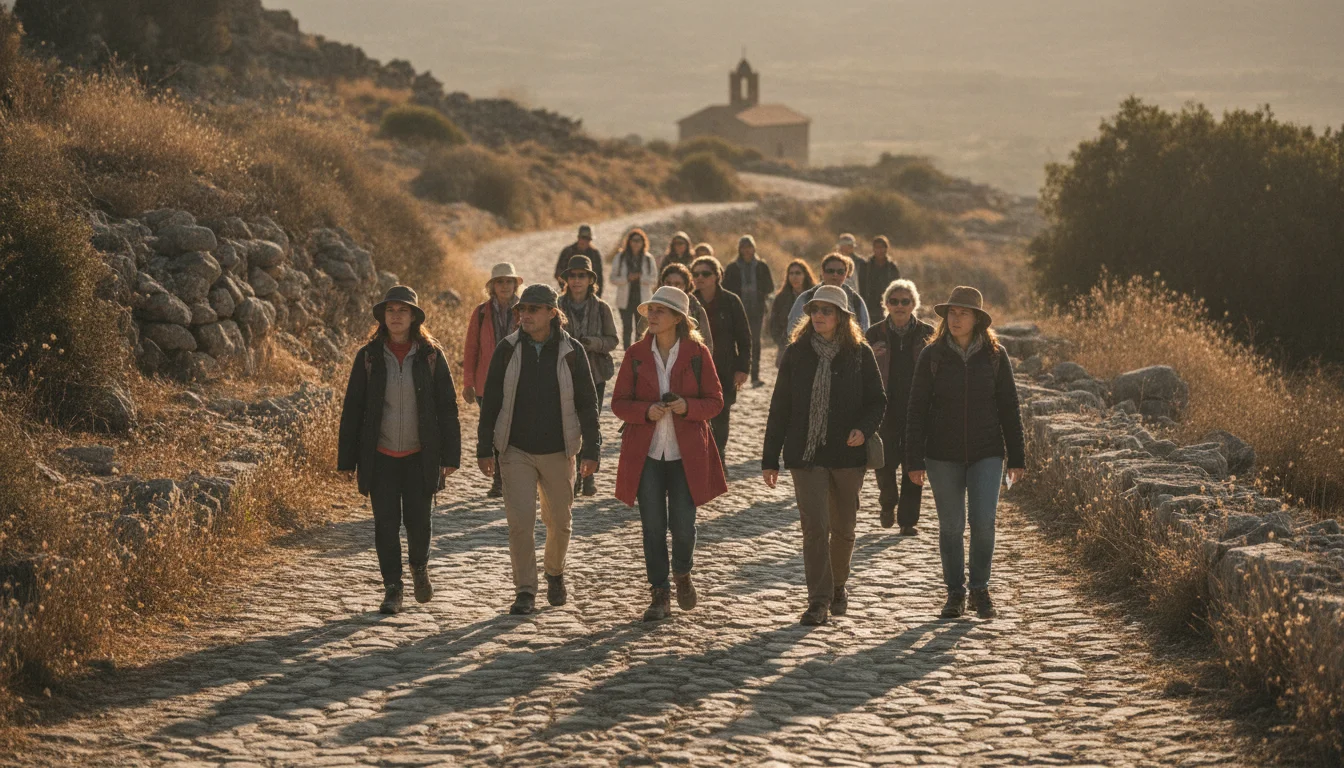
A pastor once told me that his congregation had been reading through Acts for most of a year, and by the time they reached the shipwreck on Malta, half the church wanted to know if the places were still there. They are. That is the quiet power of a footsteps of Paul trip. You spend months preaching a book, and then you stand in the actual harbor where the ship broke apart, and the text stops being a story that happened to other people. It becomes a place your people walked.
I have built heritage journeys for more than forty years, and Paul’s route is the one I get asked about most by church leaders. This piece is the wide-angle view. Not the day-by-day schedule, but the reason the trip resonates, the countries it crosses, the sites that carry the most weight, and how you shape the whole thing for a congregation rather than a group of tourists. If you want the hour-by-hour version, we keep a day-by-day footsteps of Paul itinerary as the companion to this overview. Read this one first. It tells you what you are building and why.
Why Paul’s Route Resonates With a Congregation
Most heritage trips are organized around a place. A footsteps of Paul trip is organized around a person, and that changes how your people experience it.
Paul did not visit these cities as a sightseer. He walked into them, preached, got thrown out of some, planted churches in others, wrote letters back to the ones he loved and worried over. When your group stands in Philippi or Corinth, they are not looking at ruins. They are standing where a specific person, whose letters they have read their whole lives, did specific things. The trip becomes a walk through the second half of the New Testament, in order, on the ground.
That is why it lands so well with a congregation. Your people already know the names. They have heard Philippians preached. They have sat through studies of First and Second Corinthians. The trip gives all of that reading a geography. It also gives your church something to rally around for a year before you ever leave, which is worth more than most leaders expect.
The Countries Paul’s Journey Crosses
One thing to settle early. A footsteps of Paul trip is not a single-country trip. Paul’s missionary journeys and his final voyage to Rome cross several modern nations, and part of your job as the organizer is deciding how much of that map you take on.
The three that matter most for a church group are Greece, Turkey, and Malta. Greece and Turkey carry the missionary journeys, the churches Paul planted, and most of the sites people picture when they think of his ministry. Malta carries the shipwreck from Acts 27 and 28. Some groups also extend to Rome, where Paul spent his final imprisonment, and a few reach back to Israel, where the whole story begins with a man named Saul on the road to Damascus.
You do not have to cover all of it. A strong church trip usually picks a spine and commits to it rather than trying to touch every location. Here is how the pieces fit.
Greece: The Heart of the European Mission
If you build only one country into the trip, most leaders choose Greece, and for good reason. Greece is where Paul first carried the gospel into Europe, and the sites there are close enough together to visit well in a single journey.
Philippi is where it starts. This is where Paul met Lydia by the river, where he and Silas were jailed and sang hymns at midnight, where the first European convert came to faith. Reading Acts 16 aloud beside the river outside Philippi is one of those moments that stays with a group long after they fly home. From there the route runs through Thessaloniki, then Berea, where the people were commended for searching the Scriptures, and down toward the south.
Athens is the intellectual turn. Standing on or near the Areopagus, where Paul addressed the philosophers about the unknown god, gives your group a picture of Paul reasoning with a culture rather than a synagogue. Then Corinth, where he stayed a year and a half, worked as a tentmaker, and wrote letters that still shape how the church understands grace and unity and love. The bema at Corinth, where Paul stood before Gallio, is still there.
Greece works for congregations because the spiritual weight is high and the logistics are manageable. If you want the fuller picture of how a Greece-focused trip comes together for a church, we walk through it in our guide to church group tours to Greece.
Turkey: Where the Story Begins and the Churches Take Root
Turkey holds more of Paul’s ministry than any other country, and it carries a different texture than Greece. This is Asia Minor, where Paul was born in Tarsus, where his first missionary journey unfolded, and where several of the churches he wrote to actually stood.
Antioch is the sending church, the place where believers were first called Christians and where Paul and Barnabas were commissioned. From there the map opens into cities like Ephesus, which deserves special attention. Ephesus is where Paul spent more than two years, where the riot of the silversmiths broke out in the great theater, and where one of his most quoted letters was addressed. That theater still seats thousands, and it is a striking place to read from Acts 19.
Turkey also holds the seven churches of Revelation, which many groups fold into a Paul-themed trip because the geography overlaps. Ephesus, Smyrna, Pergamum, and the others sit along a route that pairs naturally with Paul’s ministry. A trip that combines Paul’s journeys with the seven churches gives a congregation a sweep from the earliest mission through the letters of Revelation. Our guide to church group tours to Turkey lays out how those sites connect.
The practical note on Turkey is that it rewards a bit more travel time. The sites are farther apart than in Greece, so a Turkey-heavy trip wants more days on the ground to do it without rushing.
Malta: Where Paul Was Shipwrecked
Malta is the piece that surprises people, and it is one of my favorites to include.
In Acts 27, Paul is a prisoner being shipped to Rome when a violent storm drives the vessel for two weeks and finally breaks it apart on the coast of Malta. Everyone survives. Paul spends the winter on the island, is bitten by a viper and unharmed, heals the sick, and leaves behind the beginning of a Christian community that Malta still honors today. St. Paul’s Bay marks the traditional site of the wreck, and there is a small island offshore that tradition ties to the story.
For a congregation, Malta does something the mainland sites cannot. It shows Paul not as a preacher in a city but as a prisoner in a disaster, still faithful, still serving, still trusting God when the ship is coming apart. Groups that have read Acts together feel the weight of standing at that bay. It is the point in the trip where the story of Paul stops being about ministry strategy and becomes about endurance.
Malta is a natural bridge if your trip extends toward Rome, since it sits on the sea route between Greece and Italy. Even as a standalone stop, it gives your itinerary an emotional high point that most footsteps of Paul trips skip.
How to Shape the Trip for Your Congregation
Here is where the organizer’s real work lives. The sites are fixed. How you frame them for your people is not, and that framing is what separates a church trip from a tour with a Christian theme.
Pick a Spine, Not the Whole Map
The most common mistake I see is trying to cover Greece, Turkey, Malta, and Rome in one trip. It can be done, but it turns a pilgrimage into a race. For a first congregational trip, pick one country as your spine and add a second piece only if the days allow. Greece alone makes a full, satisfying trip. Greece plus Malta is a strong pairing. Turkey with the seven churches is its own complete journey. Choose the spine that fits what your church has been studying.
Tie the Route to What Your People Have Been Reading
A footsteps of Paul trip works best when it grows out of your teaching. If your congregation has spent a season in Philippians, build toward Philippi. If you have been in Corinthians, make Corinth the anchor. When the trip echoes the preaching your people already know, the sites land with recognition rather than novelty. The connection between pulpit and place is the whole point.
Build In Room for Worship, Not Just Sightseeing
The difference between a tour and a pilgrimage is what you do when you arrive at a site. Plan for it. Read the relevant passage aloud at each location. Leave time for a short devotional at Philippi, a moment of reflection at the Areopagus, communion at a site that matters to your group. These moments do not happen on their own. As the leader, you build them into the rhythm so your people know the trip is a spiritual journey, not a schedule of stops.
Let the Operator Carry the Logistics
Your job on this trip is to shepherd your people, not to manage coaches and hotel check-ins and site entry times. That is what we handle. When the logistics are invisible, you are free to be present, to teach at the sites, to sit with the couple who came on this trip as a last big journey together. The complete picture of how a leader plans a congregational trip, from recruiting to roles, is in the complete leader’s guide. Read it alongside this one.
What This Kind of Trip Does for a Church
I have watched a lot of congregations come home from Paul’s route, and the change is real. People who read Acts one way before the trip read it differently after. The letters land harder. The names on the map are places they have stood. And the group that traveled together comes back with a bond that a year of Sunday mornings does not quite create.
That is the return on a footsteps of Paul trip. Not photographs, though there are plenty. It is a congregation that has walked through the story together and carries it home in their bodies as much as their notebooks.
FAQ: A Footsteps of Paul Church Trip
Which countries does a footsteps of Paul trip cover?
Mainly Greece, Turkey, and Malta. Greece and Turkey hold Paul’s missionary journeys and the churches he planted. Malta holds the shipwreck from Acts 27 and 28. Some groups also extend to Rome, where Paul was imprisoned at the end of his life. You do not need to cover all of it in one trip.
Where was Paul shipwrecked, and can we visit?
Paul was shipwrecked on Malta during his voyage to Rome, described in Acts 27 and 28. St. Paul’s Bay marks the traditional site, and yes, you can visit it. Malta gives a congregation the part of Paul’s story that is about endurance in a crisis rather than ministry in a city, which is why many groups include it.
Should we do Greece or Turkey for our first trip?
For a first congregational trip, Greece is the common choice because the sites sit close together and the logistics are manageable. Turkey holds more of Paul’s ministry, including Ephesus and the seven churches of Revelation, but the sites are farther apart and want more days. Pick the spine that matches what your church has been studying.
How is this different from the day-by-day itinerary?
This overview explains the why and what: why the trip resonates, which countries it crosses, and how to shape it for your people. The day-by-day footsteps of Paul itinerary gives you the actual schedule, site by site and day by day. Most leaders read this overview first to decide the shape, then use the itinerary to plan the days.
How do we make it feel like a pilgrimage and not just a tour?
Build in room for worship at the sites. Read the relevant passage aloud where it happened, leave time for devotionals and reflection, and tie the route to what your congregation has been reading. The sites are fixed, but the framing is yours, and that framing is what turns a tour into a pilgrimage.
If you are weighing a footsteps of Paul trip for your congregation, the first step is deciding the spine, and we can help you shape it around what your church has been studying. You can see how the group experience works on our group heritage tours page.
Contact us and we will help you map the route that fits your people and your dates.