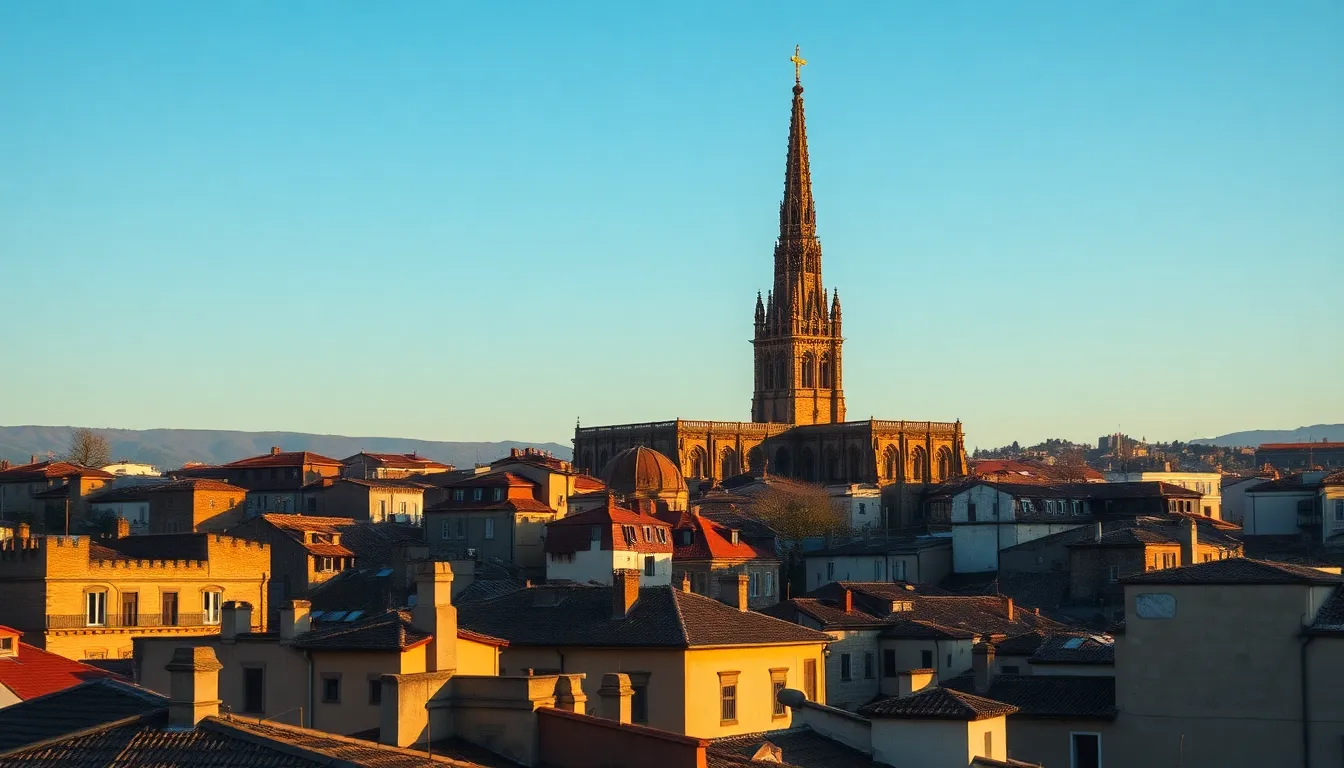
I always tell groups to approach Toledo from across the river first, before we go in. We stop on the far bank, where the whole city rises on its hill inside a loop of the Tagus, packed tight, and one tower stands above all the others. That is the cathedral. From that viewpoint you understand Toledo before you have entered a single building. It is a fortress city, a holy city, and at its center is the church that calls itself the head of all the churches of Spain.
Toledo Cathedral is the primate see of Spain, the seat of the senior archbishop, and one of the high masterpieces of Gothic architecture in Europe. But it sits inside a city famous for something else: for being, for a few remarkable centuries, a place where Jews, Christians, and Muslims lived and worked side by side. You cannot understand the cathedral without understanding that city, and you cannot lead a group well here without holding both at once. Let me show you how I do it.
The Primate See: What That Title Means
When people hear “primate see” they sometimes think of animals. It is worth taking thirty seconds with a group to explain. The primate is the senior bishop of a country, first in honor among them. Toledo has held this rank for the Spanish church since the early Middle Ages, going back to the period when Toledo was the capital of the Visigothic Christian kingdom before the Muslim conquest of 711. When Christian forces retook the city in 1085, that ancient primacy was restored, and the archbishop of Toledo became, and remains, the spiritual head of the Spanish church.
This matters for a group because it tells you why the cathedral is so staggeringly rich. This was not a provincial church. It was the most important seat in the Spanish church, funded by the most powerful archbishopric in the land for centuries. Everything in it is on that scale.
The Gothic Cathedral: Begun in 1226
The present cathedral was begun in 1226 under King Ferdinand III, the same king who started Burgos, and built on the site of an earlier church that had itself been a mosque, which had earlier been a Visigothic church. The layers go down a long way here. Construction continued for more than two and a half centuries, into the late fifteenth century, so the building gathered the styles of generation after generation.
What to Show a Group Inside
Toledo’s interior is dense, dim, and overwhelming. As at Burgos and Leon, I give groups anchors.
The high altar, the Capilla Mayor. An enormous late Gothic carved and gilded altarpiece, the retablo, rising the full height of the sanctuary, telling the life of Christ in painted and gilded wood. Give your group time to read it from bottom to top.
The choir, the coro. The carved wooden choir stalls in the center of the nave are among the finest in Spain. The lower stalls carry scenes of the conquest of Granada in 1492, carved by people for whom it was recent news.
The treasury and the monstrance. The cathedral treasury holds an immense gold and silver monstrance, the Custodia de Arfe, carried through the streets each year at the feast of Corpus Christi. It is one of the great pieces of Spanish goldsmithing.
The sacristy and El Greco. The sacristy functions as a picture gallery, with works by El Greco, who made Toledo his home, including his famous “Disrobing of Christ,” “El Expolio,” painted for this very cathedral, along with paintings by Goya, Titian, and others.
The Transparente: Light Through the Ceiling
The single most surprising thing in Toledo Cathedral, and the piece I save for last with a group, is the Transparente. Behind the high altar, in the ambulatory, is a soaring Baroque sculpture in marble, bronze, and gilt by Narciso Tome, completed in 1732. Angels and saints and clouds tumble upward in carved stone toward a hidden opening.
Here is the genius of it. Tome cut a hole through the vaulted Gothic roof above and behind the altar, an opening invisible from most of the church, and shaped it so that daylight pours down through it onto the Baroque sculpture and onto the tabernacle of the high altar. On a sunny afternoon, a shaft of real sunlight falls through the medieval roof onto this swirl of gilded angels, and the whole composition seems to be lit from heaven. It is theatrical, it is Baroque to its bones, and groups never forget it. Time your visit so you are at the Transparente when the sun can reach it, generally midday into the afternoon.
The City of Three Faiths
Now for the part that makes Toledo more than a great cathedral. For centuries this was a city where three religious communities lived together, and the physical evidence still stands within a short walk of the cathedral doors. I cover the full picture in our guide to spiritual sites in Spain, but a group standing at the cathedral should at least know what surrounds them.
A few minutes’ walk away are two surviving medieval synagogues. Santa Maria la Blanca, built around 1180, has rows of white horseshoe arches that are Moorish in style, a striking reminder that Jewish architecture in Spain drew deeply on Islamic forms. El Transito synagogue, built in the 1350s by Samuel ha-Levi, treasurer to the king, carries Hebrew inscriptions along its upper walls and now houses Spain’s national Sephardic museum. Both were taken from the Jewish community after persecution and expulsion. They are among the most important medieval synagogues left in the world.
Holding the History Honestly
I am careful with groups here, and I encourage you to be too. The “three faiths” story is real and worth celebrating, but it was not a simple harmony. Toledo’s centuries of shared scholarship, when Jewish, Christian, and Muslim translators worked together turning Arabic and Hebrew learning into Latin for the rest of Europe, were genuine and remarkable. So were the riots of 1391, the pressures of conversion, and the expulsion of the Jews in 1492 that emptied those synagogues. A cathedral that names itself the head of Spanish Christianity stands a few hundred meters from synagogues that were confiscated by that same Christian kingdom. Telling your group both halves is what makes the visit honest. The cathedral and the synagogues together tell the truth of Toledo more clearly than either could alone.
How Toledo Fits an Itinerary
Toledo sits just south of Madrid, less than an hour away, which makes it one of the easiest great heritage cities to reach and a natural day trip or overnight from the capital. I strongly prefer an overnight when the schedule allows, because Toledo empties of day-trippers in the evening, and walking those narrow stone streets at night, with the cathedral floodlit above you, is an experience the day crowds never get.
The old city is steep and paved in stone, so plan the pace for older travelers and use the escalators and the right entry points your guide will know. Give the cathedral at least ninety minutes. Add the two synagogues and, if you can, the church of Santo Tome to see El Greco’s “Burial of the Count of Orgaz” in the spot it was painted for.
For groups building a wider Spain trip, Toledo pairs naturally with the great northern cathedrals of Burgos and Leon, and it sits at the heart of the long story I tell in our Reconquista heritage guide.
FAQ: Visiting Toledo Cathedral
What does it mean that Toledo Cathedral is the primate see of Spain?
The primate is the senior bishop of a country, first in honor among its bishops. Toledo has held this rank for the Spanish church since the early Middle Ages, rooted in the period when the city was the Visigothic Christian capital before 711. When Christian forces retook Toledo in 1085, that primacy was restored, and the archbishop of Toledo remains the spiritual head of the Spanish church. This is why the cathedral is so exceptionally rich; it was the most important church seat in Spain.
What is the Transparente in Toledo Cathedral?
The Transparente is a soaring Baroque sculpture in marble, bronze, and gilt, completed by Narciso Tome in 1732, set behind the high altar. Its genius is that Tome cut a hidden opening through the medieval Gothic roof above and behind it, so that real daylight pours down onto the carved angels and onto the high altar’s tabernacle. On a sunny afternoon the whole composition appears lit from heaven. Time your visit for midday into the afternoon so the sun can reach it.
Why is Toledo called the city of three faiths?
For several centuries Toledo was home to Jewish, Christian, and Muslim communities who lived and worked alongside each other, most famously in the scholarly translation work that carried Arabic and Hebrew learning into Latin for the rest of Europe. The physical evidence still stands: two medieval synagogues, churches built over former mosques, and the great cathedral, all within a short walk. The coexistence was real but not without conflict, and it ended with persecution and the expulsion of the Jews in 1492.
What should a group see near the cathedral?
Within a few minutes’ walk are two of the most important surviving medieval synagogues in the world: Santa Maria la Blanca, with its white Moorish-style horseshoe arches, and El Transito, which houses Spain’s national Sephardic museum. The church of Santo Tome holds El Greco’s masterpiece “The Burial of the Count of Orgaz.” Together with the cathedral, these sites let a group read the full story of Toledo, both its shared learning and its later persecutions.
Is Toledo a day trip or an overnight from Madrid?
Toledo is less than an hour from Madrid, so a day trip is entirely possible and common. But where the schedule allows, I recommend an overnight. In the evening the day-trippers leave, the narrow stone streets empty, and the floodlit cathedral over the quiet old city is an experience the day crowds miss entirely. An overnight also lets a group pace the steep old city more comfortably, which matters for older travelers.
If Toledo and its layered history speak to your community, I would be glad to help you build it into a Spain itinerary, ideally with an evening in the old city. Reach out to us here.