How to Use This Itinerary (and How to Customize It)
I’ve been building Spain itineraries for faith groups for over twenty years now. What I’ve learned is that no two groups are alike. A synagogue group tracing Sephardic roots will want two full days in Toledo. A church group may want to end with Santiago de Compostela. Some groups want rest days built in. Others want to see everything.
So think of this 10-day structure as a starting point, not a fixed schedule. Every section includes notes for group leaders on pacing, timing, and what to watch for. If something doesn’t fit your community, we’ll reshape it together.
One thing I will say: ten days is the right length for Spain. Shorter trips mean rushing through cities that deserve time. Longer trips wear people out. Ten days gives your group enough room to stand in a 14th-century synagogue or sit quietly in a cathedral without feeling like the bus is waiting.
Days 1-2: Madrid, Arrival, Context, and the Prado’s Jewish Collections
Your group arrives in Madrid. We handle airport transfers and hotel check-in, so your first job as a group leader is simple: let everyone rest.
Day 2 is when the trip begins in earnest. The Prado Museum holds a collection most visitors walk right past. There are paintings that document Jewish and Christian life in medieval Spain, works that show the cultural world that existed before 1492. Starting here gives your group a visual foundation for everything they’ll see over the next eight days.
Group leader note: Jet lag is real, especially for older congregants. Schedule the Prado visit for late morning, not early. Give people a slow breakfast and time to get their bearings. Madrid’s Retiro Park is a five-minute walk from the Prado and is a good place for the group to gather before heading inside.
Days 3-4: Toledo, El Transito, Santa Maria la Blanca, and the Cathedral
Toledo is the emotional center of this trip. I’ve watched it happen dozens of times. Groups walk into El Transito synagogue, built in 1357 by Samuel ha-Levi, and the room goes quiet. The Hebrew inscriptions along the upper walls call the synagogue “a crown of beauty.” It survived the expulsion of 1492. It’s still standing.
Santa Maria la Blanca is the other surviving synagogue in Toledo, older than El Transito by about a century. Its white horseshoe arches reflect the Moorish influence on Jewish life in medieval Spain. For groups tracing Sephardic heritage, these two buildings together tell a story that no textbook can match.
The Toledo Cathedral is one of the great Gothic cathedrals of Europe. For Christian groups, its chapels and choir are worth a full morning. For mixed heritage groups, it’s a reminder that Toledo’s identity was shaped by three faiths living in close quarters for centuries.
Group leader note: Toledo’s old city is built on a hill. The streets are steep, uneven, and cobblestoned. If you have older congregants or anyone with mobility concerns, plan for a slower pace and build in seated breaks. Morning visits are best because the heat builds through the afternoon, especially in May through September.
Day 5: Cordoba, the Surviving Synagogue and the Mezquita
Cordoba’s synagogue is small. It’s one of only three medieval synagogues still standing in all of Spain. The stucco work inside is extraordinary, with Hebrew inscriptions and geometric patterns that show the same artistic traditions found in the Alhambra. Most visitors spend fifteen minutes here. Your group should spend longer.
The Mezquita is Cordoba’s defining site, a mosque that became a cathedral, with Roman columns, Moorish arches, and a Renaissance nave built inside it. For faith travelers, the Mezquita is a physical history of Spain’s religious transformations. Walking through it with a knowledgeable guide who can explain each layer changes the experience entirely.
Group leader note: Cordoba is hot. In summer, temperatures in the old city regularly pass 40 degrees Celsius. If your trip falls between June and September, schedule the Mezquita visit for first thing in the morning and plan an indoor lunch before the afternoon heat peaks.
Days 6-7: Seville and Granada, the Alhambra’s Jewish Chapter
Seville is a city of layers. The Alcazar, the Cathedral, and the old Jewish quarter of Santa Cruz together tell the story of a city where power changed hands repeatedly over centuries. For Jewish groups, Santa Cruz is where the community lived before the pogroms of 1391 and the eventual expulsion. The streets are narrow and the buildings are old enough to carry that weight.
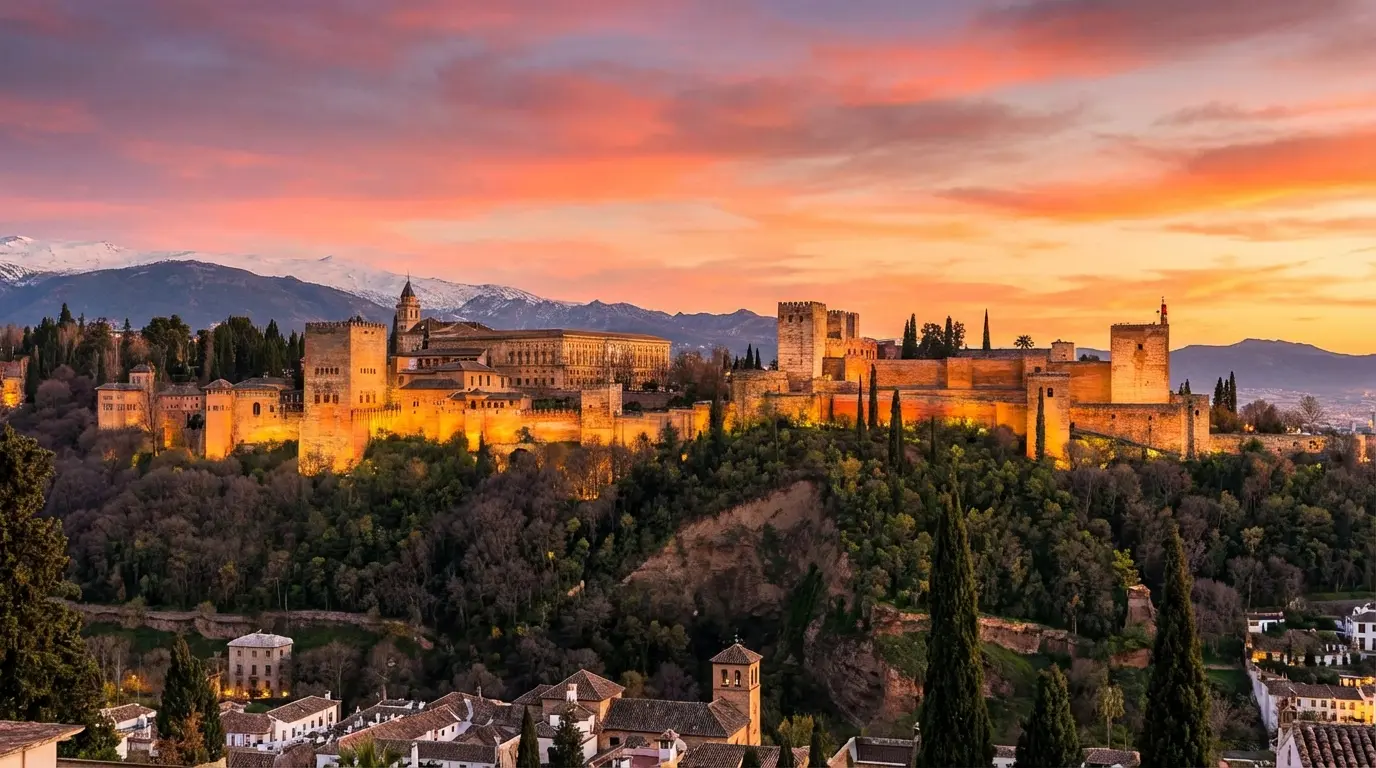
Granada is the Alhambra. But the Alhambra’s story is more complex than most guidebooks let on. Jewish viziers, scholars, and physicians served the Nasrid court. Samuel ibn Naghrillah rose to become the first Jewish grand vizier of a Muslim kingdom. The palace complex your group will walk through was shaped, in part, by Jewish intellectual and political life.
Group leader note: The Alhambra requires advance booking and timed entry. We handle this, but it means your schedule on the Granada day is structured around the assigned time slot. Plan the rest of the day around it, not the other way around. Evening visits are available in some seasons and are genuinely beautiful for groups that can manage the later hour.
Days 8-9: Barcelona and Girona, the Call and the Costa Brava
Barcelona’s Gothic Quarter contains El Call, the medieval Jewish quarter. The streets are narrow and easy to miss if you’re not looking. There’s a small synagogue here that may date to the 3rd century, which would make it one of the oldest in Europe. The claim is debated among historians, but the site itself is real and worth visiting.
Girona, about an hour north, has one of the best-preserved Jewish quarters in Europe. The Museum of Jewish History sits inside it. The Call in Girona feels different from Barcelona’s. It’s quieter, smaller, and the sense of walking through a medieval neighborhood that was once entirely Jewish is stronger here.
For groups with an extra day, the Costa Brava coastline between Barcelona and Girona is one of the most beautiful stretches of the Mediterranean. It’s not a heritage site, but after eight days of emotionally dense history, some groups welcome the change of pace.
Group leader note: Barcelona is a large city with its own rhythm. Pickpocketing near the Ramblas and the Gothic Quarter is a real concern for groups. Brief your congregants clearly before the visit: keep bags closed and close to the body, don’t stop to watch street performers, and stay with the group in crowded areas.
Day 10: Santiago de Compostela (for Christian Groups) or Departure
For Christian groups, ending the trip in Santiago de Compostela adds a dimension that nothing else can match. The Cathedral of Santiago has been the endpoint of the Camino pilgrimage for over a thousand years. You won’t walk the full Camino in a day, but arriving at the Cathedral and attending the Pilgrim’s Mass connects your group to a tradition that has drawn millions of faithful travelers across centuries.
For Jewish heritage groups, Day 10 is typically a departure day from Barcelona or Madrid, depending on the itinerary routing. Some groups use this day for a final morning in the Jewish quarter or a closing reflection at the hotel before heading to the airport.
Group leader note: If your group is flying out of Madrid but your last stop is Barcelona, the internal flight is about ninety minutes. We build the transfer timing so there’s no rushing. If you’re ending in Santiago de Compostela, the return to Madrid is either a domestic flight or an overnight stay, depending on your group’s energy and preference.
Adapting This Itinerary for a Purely Jewish or Purely Christian Group
This itinerary is designed to work for groups of any faith background, but it can be focused.
For a purely Jewish heritage group, the emphasis shifts to Toledo (two full days), Cordoba, Girona, and the Sephardic history embedded in each city. Santiago de Compostela comes off the itinerary, and the extra day goes to Granada or a deeper visit in Barcelona’s Call.
For a purely Christian group, the Camino de Santiago and Santiago de Compostela take center stage, along with Toledo’s Cathedral, Montserrat Monastery near Barcelona, and the Sagrada Familia. The synagogue visits can be included as cultural context or replaced with additional Christian sites.
For groups that include both Jewish and Christian members, the itinerary as written works well. The shared history of these cities means the same sites often hold meaning for both communities, seen through different lenses.
FAQ: Spain Heritage Tour Itinerary Questions
Is 10 days enough for a heritage tour of Spain?
Yes. Ten days allows your group to visit the major heritage cities without rushing. You can cover Madrid, Toledo, Cordoba, Seville, Granada, Barcelona, and either Girona or Santiago de Compostela. Trying to add more cities in the same timeframe usually leads to fatigue, which undercuts the experience at each site. If your community wants to go deeper into one region, we can adjust the pace rather than adding days.
Can a Spain itinerary cover both Jewish and Christian heritage sites?
It can, and in most Spanish cities, the sites are physically close to each other. In Toledo, El Transito synagogue and the Cathedral are a short walk apart. In Cordoba, the synagogue and the Mezquita are in the same neighborhood. The shared geography reflects the shared history. A well-structured itinerary doesn’t need to choose one tradition over the other.
What cities should a Jewish heritage tour of Spain include?
Toledo is essential. It holds two of Spain’s three surviving medieval synagogues and was the intellectual capital of Sephardic life for centuries. Cordoba, Girona, and Barcelona’s Call are the other priorities. Granada matters for the story of Jewish leadership in the Nasrid court. Seville’s Santa Cruz quarter carries the memory of the community that lived there before 1391.
How do you organize hotel stays for a group tour of Spain?
We book hotels in each city so your group doesn’t live out of suitcases on a bus. The standard approach is two nights in Madrid, two in Toledo, one in Cordoba, two covering Seville and Granada, and two in Barcelona. Transfers between cities are handled by private coach with hotel pickup and dropoff, so your group never has to navigate train stations or rental cars.
Can Heritage Tours customize this itinerary for my group?
Every itinerary we build is customized. This 10-day structure is a framework, not a fixed product. If your group wants three days in Toledo instead of two, or wants to skip Barcelona in favor of Santiago de Compostela, we’ll adjust. The itinerary should reflect what matters to your specific community.
If you’re thinking about bringing your group to Spain and want to talk through what a 10-day itinerary could look like for your community, we’d welcome that conversation. You can reach us here to get started.