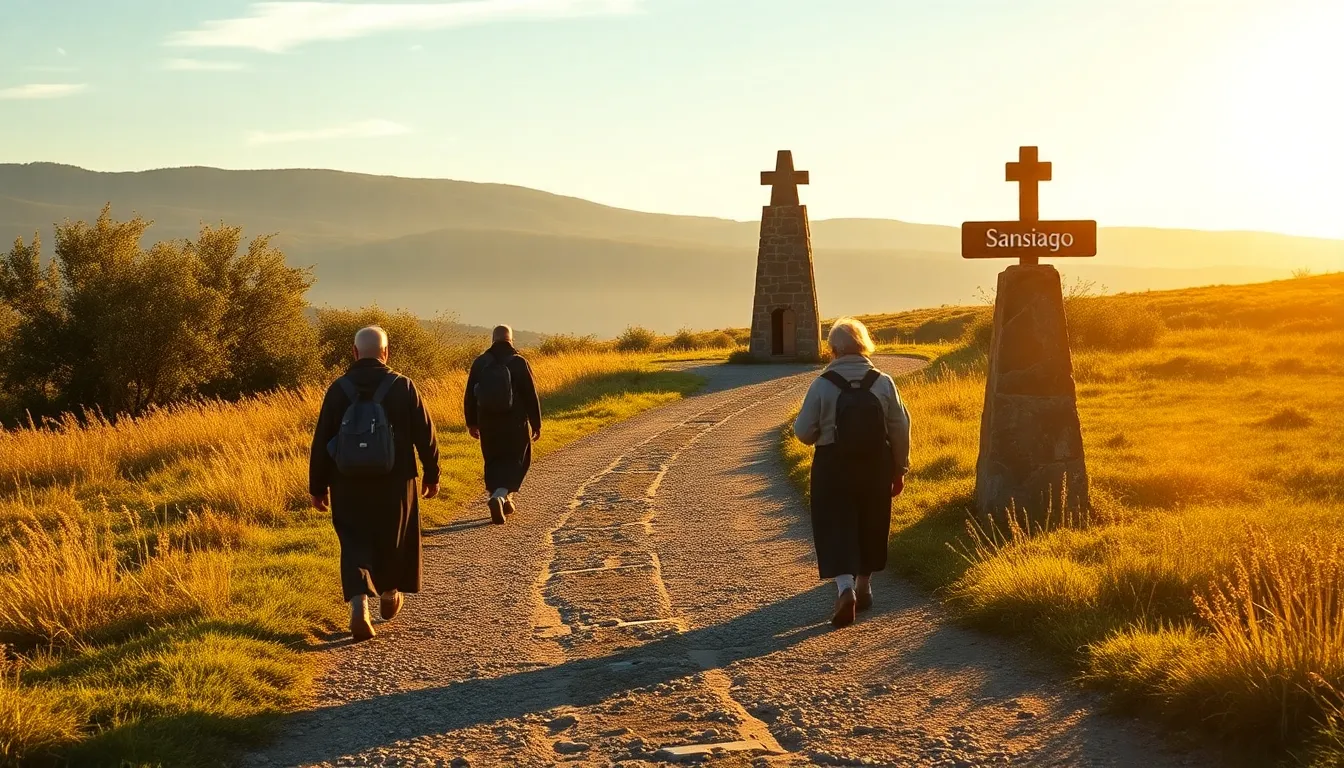
Most pastors who call me about the Camino are not training for a marathon, and neither is their congregation. They have a group that ranges from forty to seventy-five years old, with a mix of fitness levels, and they want to walk a real pilgrimage that ends at the tomb of St. James without anyone getting hurt or left behind. That is exactly what this itinerary is built for.
You do not need to walk the full Camino Frances, which runs nearly 500 miles from the French border, to make a true pilgrimage. The tradition itself recognizes the final 100 kilometers from Sarria as enough to receive the Compostela, the certificate of completion. So that is where this plan walks: the last stretch into Santiago, broken into gentle daily stages, with a support coach carrying the luggage and meeting the group along the way. Your people walk; they do not haul.
This is the walking-pilgrimage cousin to our broader 10-day Spain heritage itinerary. If your group wants the cathedrals and cities without the daily miles, start there. If your group wants to actually walk to Santiago, stay here.
Day 1: Arrival in Madrid
Your group flies into Madrid and we handle the transfer and hotel. The arrival day is for rest and for fitting the group with anything they still need: walking poles, a quick check on footwear, a reminder about layering for Galician weather.
In the evening I gather the group for a short orientation. We talk about the rhythm of the days ahead, the pace, and the one rule that makes a group Camino work: walk your own walk. Nobody races. The support coach is always reachable.
Group leader note: Footwear is the single biggest variable on a walking trip. Ask every participant to break in their shoes for weeks before departure. Blisters from new boots ruin more Caminos than any hill.
Day 2: Madrid to Sarria
We travel from Madrid up to Sarria in Galicia, the traditional starting point for the final 100 kilometers. The transfer is long, so this is mostly a travel day, and the walking begins tomorrow.
Sarria in the evening is full of pilgrims at the start of their journey. The group collects their pilgrim passports, the credential that gets stamped at each stop and proves the journey for the Compostela at the end. There is an energy in Sarria that sets the tone. People feel the start of something.
Group leader note: Make sure every participant has their pilgrim credential before the first stamp. We arrange them, but it is worth confirming each person physically holds theirs the night before you walk.
Day 3: Sarria to Portomarin
The first walking day, about 22 kilometers through the green Galician countryside, past stone hamlets, oak woods, and old churches. The path is well marked with the yellow scallop shell and arrow, and the support coach shadows the route so anyone who needs to stop can.
Portomarin sits above a reservoir, and the climb up to the town at the end of the day is the first real test. The group arrives, gets stamped, and sleeps well.
Group leader note: The first day always feels longest because bodies are adjusting. Start early, keep the pace honest, and tell the group that day three is the hardest mentally. Once they finish it, they believe they can do the rest.
Day 4: Portomarin to Palas de Rei
About 25 kilometers, with some rolling climbs. By now the group has found its rhythm. This is the day people stop checking their watches and start noticing the path: the eucalyptus groves, the wayside crosses, the other pilgrims from all over the world.
I build a longer lunch into this stage so the group can rest the legs midway.
Group leader note: Day four is when small group friendships form on the trail. Let them. Some of the most meaningful conversations of the whole trip happen between two people walking side by side for an hour. Do not over-program the walking hours.
Day 5: Palas de Rei to Arzua
Around 28 kilometers, the longest stage, so I split it with options. Walkers who want the full distance take it. Anyone who needs a shorter day rides the coach forward to a midpoint and walks in from there. Nobody is penalized for choosing the shorter walk.
Arzua is Galician cheese country, and the evening meal here is one the group remembers.
Group leader note: This is the stage where the split-walking option matters most. Make it normal to take the coach for part of the day. If you frame the shorter walk as a failure, tired members will push through injury to avoid it. Frame it as wisdom.
Day 6: Arzua to O Pedrouzo
About 19 kilometers, a gentler day on purpose, because Santiago is close now and I want the group to have something in reserve for the final push. The forests are thick here, and the path has a quiet to it. Anticipation builds. People know they are almost there.
Group leader note: Use the evening for a reflection session. The group is one day from Santiago. This is the moment to gather and let people name what they came to find. It deepens the arrival the next day.
Day 7: O Pedrouzo to Santiago de Compostela
The final stage, about 20 kilometers, ending in the Plaza del Obradoiro in front of the Cathedral of Santiago. I have watched this arrival many times and it never loses its power. The group comes through the old city, hears the bagpipes under the archway, and steps into the square where pilgrims have arrived for over a thousand years.
The Cathedral holds the tomb of St. James. Your group collects the Compostela at the Pilgrim Office, then we attend the Pilgrim’s Mass, where arriving pilgrims are welcomed. On many days the great botafumeiro, the giant incense censer, swings across the transept. It is hard to describe to someone who has not seen it.
Group leader note: Arrival day is emotional. People cry. Build in unstructured time in the square before any group activity. Let them sit, let them take it in, let them call home. The schedule can wait twenty minutes.
Day 8: Santiago de Compostela
A full day in Santiago with no walking. The group rests legs and explores the old city, the Cathedral museum, and the rooftop tour if mobility allows. I keep this day loose. After six days of walking, people need a day that asks nothing of them.
For groups that want it, a visit to the Cathedral for a quieter, less crowded moment of prayer is worth arranging in the early morning.
Group leader note: This rest day is not optional padding. It is recovery, and it is also the day the experience consolidates. Groups that walk into Santiago and fly out the next morning miss the part where the meaning lands.
Days 9-10: Finisterre and Departure
For groups with the energy, a day trip out to Finisterre and Muxia on the Atlantic coast is a fitting coda. Medieval pilgrims continued to this point, the “end of the earth,” to watch the sun set over the ocean. It is an hour and a half by coach, and standing at the lighthouse with the Atlantic in front of you closes the pilgrimage in a way the cathedral alone does not.
Day ten is departure. We transfer the group from Santiago to the airport, or to Madrid for connecting flights, depending on the routing.
Group leader note: Finisterre is optional, and some groups skip it for an extra rest day or an earlier flight home. Read your group’s energy. After seven days of walking, some are ready for the ocean and some are ready for the couch. Both are fine.
FAQ: 10-Day Camino de Santiago Group Itinerary
Do we have to walk the entire Camino de Santiago?
No. The full Camino Frances is nearly 500 miles and takes most pilgrims four to five weeks. The tradition recognizes the final 100 kilometers from Sarria as enough to receive the Compostela, and that is what this itinerary walks, broken into gentle daily stages with a support coach. Your group does a true pilgrimage without the month-long commitment.
How fit does my group need to be to walk this Camino?
Fitter than a sightseeing trip, but this is not mountaineering. The stages run roughly 19 to 28 kilometers a day on well-marked paths with manageable hills. Anyone who can comfortably walk several miles and is willing to train beforehand can do it. The support coach means anyone can shorten a day without leaving the group, so a range of fitness levels works on the same trip.
What is the pilgrim passport and the Compostela?
The pilgrim passport, or credential, is a document you carry and get stamped at stops along the route. It proves you walked the journey. At the end in Santiago, you present it at the Pilgrim Office to receive the Compostela, the official certificate of completion. We arrange the credentials and make sure your group collects their certificates at the end.
What is the best time of year to walk the Camino with a group?
Late spring and early fall, roughly May, June, September, and early October, give the best combination of mild Galician weather and a path that is busy but not overwhelmed. July and August are hotter and far more crowded. Winter is wet and many services on the route reduce hours. For a mixed-age church group, the shoulder seasons are the safe and comfortable choice.
Can Heritage Tours customize this Camino itinerary?
Yes. Every Camino we run is built around the specific group. If your congregation wants more rest days, shorter daily stages, an extra reflection element each evening, or to start farther back for a longer walk, we adjust. You can read more on our Spain destination page and our group heritage tours page, and remember that group leaders travel free with fifteen or more participants.
If you are a pastor thinking about leading your congregation to Santiago on foot, I would love to talk it through. The Camino changes people, and leading it well is its own kind of pilgrimage. Tell me about your group and we will build the walk that fits them. Contact us whenever you are ready.