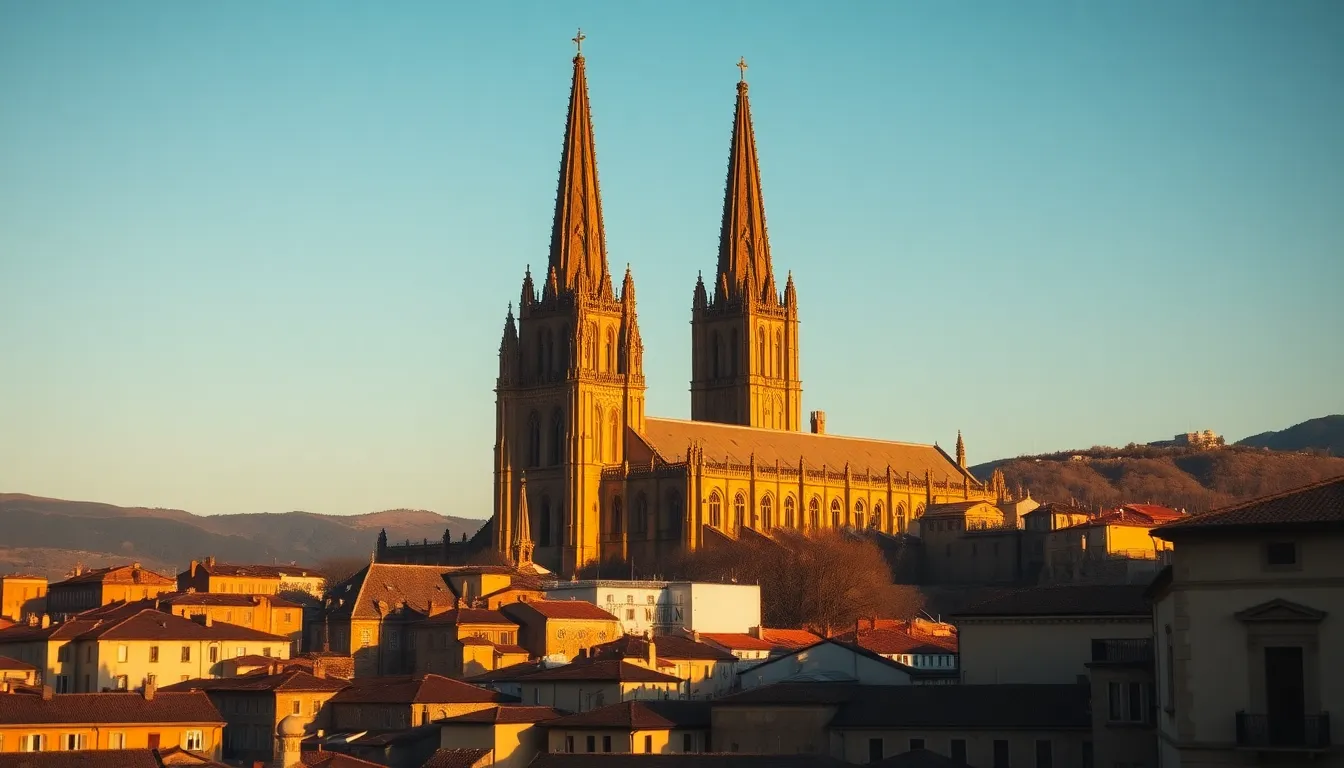
I tell groups that Burgos is where the Camino gets serious. By the time you reach this city in northern Castile, you have crossed the Pyrenees, walked through wine country and across the high plains, and your legs know it. And then the cathedral comes into view, those two openwork stone spires standing over the rooftops, and you understand why medieval pilgrims who had walked a great deal further than your group considered this one of the prizes of the road.
Burgos Cathedral is one of the great Gothic churches of Europe, the only Spanish cathedral inscribed by itself on the UNESCO World Heritage list. But for a faith group it is more than architecture. It is a Reconquista city, the seat of the kings who pushed the Christian frontier south, and the resting place of Spain’s most famous warrior. Let me walk you through what your people should see and, more importantly, what it means.
A City Born of the Reconquista
To understand Burgos you have to understand why it exists. It was founded in 884 as a frontier fortress, a “burg,” during the long centuries when Christian kingdoms in the north were slowly pushing back against the Muslim states that controlled most of the peninsula after the conquest of 711. Burgos grew into the capital of the County and then the Kingdom of Castile, the engine of the Reconquista. From here kings organized the campaigns that, over generations, moved the frontier south toward Toledo, Andalusia, and eventually Granada.
When your group stands in the old city, they are standing in what was once a command center of medieval Christendom in Spain. The cathedral is the religious expression of that political power. Kings who took cities from their enemies built churches like this one to give thanks and to declare who they were.
The Gothic Cathedral: Begun in 1221
Construction of the present cathedral began in 1221 under King Ferdinand III, called Ferdinand the Saint, and Bishop Mauricio. The early work was done in the French High Gothic style, which had just reached its height at Chartres and Reims, so Burgos brought the most current architecture in Europe to the Castilian frontier. Building went on for centuries, and the cathedral grew richer and more elaborate with each generation that added to it.
What to Show a Group Inside
The cathedral can overwhelm people, so I give my groups a few anchors rather than trying to see everything.
The west front and its twin spires. The openwork stone spires, pierced like lace, were added in the fifteenth century by a German master, Juan de Colonia, John of Cologne. They are the silhouette of the city.
The Golden Staircase. The Escalera Dorada, designed by Diego de Siloe in the Renaissance, is a richly gilded double staircase climbing the inside of the north transept wall. It is one of the most admired pieces of its kind in Spain.
The lantern tower, the cimborrio. Stand under the crossing and look straight up into the star-vaulted lantern. It is dizzying, and it is directly above a grave I will come to in a moment.
The Constable’s Chapel. The Capilla de los Condestables, behind the high altar, is a chapel within the cathedral so grand it functions almost as a small cathedral of its own, with an eight-pointed star vault overhead. It holds the tombs of the constables of Castile.
The Papamoscas. High on the wall is a strange automaton, a figure that opens its mouth and strikes the hours. Groups love it, and it is a reminder that these cathedrals were the wonder-machines of their age.
The Tomb of El Cid
Set into the floor directly beneath the soaring lantern tower, marked by a simple slab, are the remains of Rodrigo Diaz de Vivar and his wife Jimena. Rodrigo Diaz is better known by the name his enemies and admirers gave him: El Cid, from the Arabic “sayyid,” lord.
El Cid is the great hero of medieval Spain, born near Burgos around 1043. His story is the subject of the oldest surviving epic poem in Spanish, the “Cantar de Mio Cid.” He was a brilliant military commander who fought through the chaotic frontier world of eleventh-century Spain, and here I always make sure groups hear the full, complicated truth rather than the legend.
The Nuance Groups Should Hear
The popular image is of El Cid as the pure Christian champion driving out the Muslims. The history is more interesting and more honest than that. In the fragmented Spain of his time, the lines were not simply Christian against Muslim. Kingdoms fought each other across the religious divide and within it. El Cid, when he was exiled by his own Christian king, served Muslim rulers of Zaragoza for years and fought other Christians on their behalf. Later he conquered the city of Valencia and ruled it until his death in 1099.
I press this point with groups because it is the truth of the Reconquista in miniature. It was a long, messy, centuries-spanning struggle, not a clean crusade, and the man buried under the lantern of Burgos Cathedral lived in that complexity. Telling your people the real story does not diminish the cathedral. It makes the history honest, and honesty is what separates a heritage trip from a postcard. I cover this fuller picture in our Reconquista heritage guide.
Burgos on the Camino Frances
Burgos is one of the major stages of the Camino Frances, the main French route of the Camino de Santiago that I write about in our spiritual sites guide. Pilgrims have passed through here for a thousand years on their way to Santiago de Compostela, and the cathedral was both a goal in itself and a place to pause, pray, and rest before the hard crossing of the high plains ahead.
For a faith group, this changes how you experience Burgos. You are not just a tourist in a great church. You are standing where countless pilgrims stood, in a city built to receive them. If your group is walking even a short section of the Camino, Burgos is a natural and meaningful overnight. If you are traveling by coach, it pairs beautifully with Leon Cathedral further along the same road, giving your group two of the finest Gothic cathedrals in Spain within a few days of each other.
Planning the Visit
Burgos sits in northern Castile, on the main route between the Basque country and Leon, which makes it an easy stop on a northern Spain itinerary. The cathedral is in the heart of the old city, walkable and surrounded by squares and cafes, which makes it comfortable for a group with older members.
Give the cathedral at least ninety minutes inside, more if your group likes detail. Build in time to walk the riverside and the old streets, and if your timing allows, sit in one of the squares facing the west front in the late afternoon when the low sun catches the spires. Burgos is also famous for its food, and a shared meal here is part of the experience for many of my groups.
FAQ: Visiting Burgos Cathedral
Why is Burgos Cathedral so important?
Burgos Cathedral is one of the greatest Gothic cathedrals in Europe and the only Spanish cathedral inscribed by itself on the UNESCO World Heritage list. Begun in 1221 in the French High Gothic style, it was the religious heart of Castile, the kingdom that drove the Reconquista. It combines extraordinary architecture, including its lace-like stone spires and gilded staircase, with deep historical significance as a frontier capital of medieval Christian Spain.
Who is buried in Burgos Cathedral?
The most famous burial is that of El Cid, Rodrigo Diaz de Vivar, the eleventh-century military hero of medieval Spain, and his wife Jimena. Their remains lie beneath a simple slab directly under the cathedral’s soaring lantern tower. The cathedral also holds the elaborate tombs of the constables of Castile in the Constable’s Chapel, along with numerous bishops and nobles.
Was El Cid really a Christian hero against the Muslims?
The reality is more complex than the legend. El Cid was a Christian-born commander, but in the fragmented Spain of his time he served both Christian and Muslim rulers at different points, including the Muslim kingdom of Zaragoza after his own Christian king exiled him. He later conquered and ruled Valencia. His story reflects the true, messy nature of the Reconquista, which was not a clean religious crusade but a centuries-long struggle with shifting alliances across the religious divide.
Is Burgos on the Camino de Santiago?
Yes. Burgos is one of the major stages of the Camino Frances, the main French route of the Camino de Santiago, and pilgrims have stopped here for a thousand years on their way to Santiago de Compostela. The cathedral served both as a destination in itself and as a place of rest and prayer before the demanding crossing of the high plains. It makes a natural and meaningful overnight for groups walking even part of the route.
How much time should a group spend in Burgos?
Plan at least ninety minutes inside the cathedral, and more if your group enjoys architectural detail. Add time to walk the old city, the riverside, and the squares around the cathedral, which are comfortable for older travelers. Many groups make Burgos an overnight stop, which lets them enjoy the city’s renowned food and see the spires in the changing afternoon light.
If the cathedral cities of northern Spain are part of your vision for your congregation’s trip, I would be glad to help you connect Burgos, Leon, and the Camino into one journey. Get in touch with us here.