What Makes Spain Unique for Faith Travel
Spain holds something that very few countries in the world can offer. It is a place where Jewish, Christian, and Muslim communities lived alongside each other for centuries, and the physical evidence of that shared life is still standing. In Toledo, a 14th-century synagogue and a Gothic cathedral share the same hilltop. In Cordoba, a mosque became a cathedral, and a tiny synagogue survived just down the street. In Santiago de Compostela, pilgrims have been arriving on foot for over a thousand years.
For a rabbi or pastor leading a group, this matters. Spain isn’t a destination where you visit one tradition’s sites and move on. It’s a place where the layers of faith are literally built on top of each other. Understanding those layers, and being able to share them with your congregation, is what makes a heritage trip to Spain different from anything else.
The Camino de Santiago: A 1,200-Year-Old Living Pilgrimage
The Camino de Santiago is not a hiking trail. It is a pilgrimage route that has been walked by Christians since the 9th century, when the remains of the Apostle James were believed to have been discovered in what is now Santiago de Compostela. For 1,200 years, people have walked toward that city, sometimes for months, sometimes in the last days of their lives.
What surprises many group leaders, especially Protestant pastors, is that the Camino doesn’t feel exclusively Catholic. The practice of walking toward something sacred, of putting your body through effort in the service of faith, resonates across denominations. Groups that walk even a short section of the Camino often describe it as one of the most spiritually powerful experiences of the entire trip.
You don’t need to walk the full 800 kilometers. Many faith groups walk the final stage, from Sarria to Santiago de Compostela, which takes about five days. Others walk a single day’s portion and then travel by coach to the Cathedral. The point is the practice, not the distance.
Santiago de Compostela Cathedral: The End of the Road
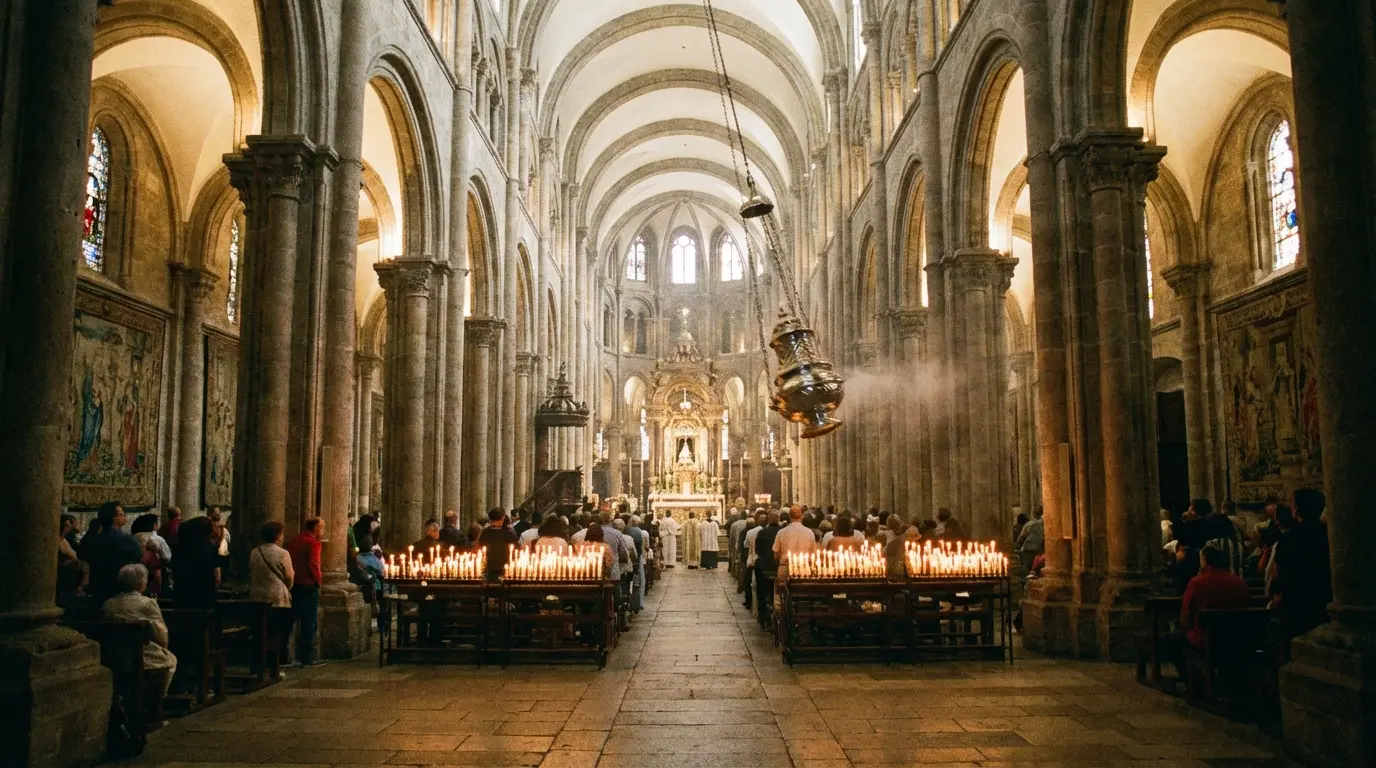
The Cathedral of Santiago de Compostela is where the Camino ends. Pilgrims have been arriving here since the Middle Ages, and the tradition continues today. The Pilgrim’s Mass, held daily, is attended by walkers who have come from across Europe and beyond. The Botafumeiro, the enormous incense burner that swings through the transept, is one of the most recognizable rituals in Christian worship.
For a faith group, attending the Pilgrim’s Mass is not a tourist activity. It is a participation in something ongoing. Your group stands among people who have walked for weeks to reach this place. That context changes the experience entirely.
Montserrat Monastery: Catalonia’s Mountain Sanctuary
Montserrat sits on a jagged mountain about an hour northwest of Barcelona. The Benedictine monastery has been here since the 10th century, clinging to the rock face at about 720 meters above the valley floor. The Black Madonna of Montserrat, a wooden statue from the 12th century, is the spiritual center of Catalonia.
For Christian groups, Montserrat is a place of genuine devotion. The boys’ choir, one of the oldest in Europe, performs daily. The basilica is a working monastery, not a museum. For non-Catholic groups, the setting itself carries spiritual weight. The mountain, the silence, and the sense of a community that has lived in prayer on this rock for a thousand years speak across denominational lines.
For Jewish groups, Montserrat is typically included as a cultural visit rather than a spiritual one. The mountain’s beauty and the monastery’s history are worth the morning trip even without the devotional connection.
Toledo’s Sacred Triangle: Cathedral, El Transito, and Santa Maria la Blanca
Toledo was the intellectual capital of medieval Spain. For roughly three centuries, Jewish, Christian, and Muslim scholars worked together here, translating texts from Arabic to Latin, advancing mathematics and medicine, and creating a culture of learning that shaped all of Europe.
What remains is extraordinary. El Transito synagogue, built in 1357 by Samuel ha-Levi, is one of the finest surviving medieval synagogues in the world. The Hebrew inscriptions running along the upper walls call it “a crown of beauty.” The synagogue was confiscated after the expulsion of 1492 and used as a church, a barracks, and a storage space before being restored. Standing inside it, reading those inscriptions, your group is in the presence of something that survived when everything around it was lost.
Santa Maria la Blanca, the older of Toledo’s two surviving synagogues, was built around 1180. Its white horseshoe arches are Moorish in style, a reminder that Jewish architecture in Spain was deeply influenced by Islamic aesthetics. The building was converted to a church after the anti-Jewish riots of 1391.
Toledo Cathedral, one of the great Gothic cathedrals of Europe, sits just a short walk from both synagogues. For Christian groups, its chapels, the choir, and the treasury are worth a full visit. For all groups, the proximity of these three buildings tells the story of Toledo more clearly than any lecture.
The Alhambra’s Jewish Chapter: Where Viziers and Scholars Shaped a Kingdom
The Alhambra in Granada is one of the most visited sites in Spain, but most visitors don’t hear about its Jewish history. Samuel ibn Naghrillah, who rose to become the grand vizier of the Zirid kingdom in the 11th century, was the first Jewish person to lead a Muslim state in medieval Spain. His son succeeded him. Jewish scholars, physicians, and administrators were woven into the fabric of the Nasrid court that built what we see today.
Walking through the Alhambra with this context transforms the visit. The palace is not just beautiful architecture. It is evidence of a period when Jewish intellectual and political life was integral to the culture that produced it. For a group tracing Sephardic heritage, this connection is powerful.
Sagrada Familia: An Unfinished Cathedral That Asks the Right Questions
Gaudi’s Sagrada Familia in Barcelona is unlike any other house of worship in the world. It has been under construction since 1882 and is expected to be completed in the coming years. Every surface tells a story from scripture. The columns are designed to look like trees, so the interior feels like standing in a forest of light.
What makes the Sagrada Familia meaningful for faith groups, beyond its beauty, is what it represents. A man spent his entire life building something he knew he would never see finished. The community that inherited his vision has continued the work for over a century. For a congregation, that’s a powerful conversation about commitment, legacy, and what it means to build something larger than yourself.
FAQ: Spiritual Sites in Spain for Faith Travel Groups
What is the Camino de Santiago and is it suitable for a faith group?
The Camino de Santiago is a Christian pilgrimage route that has been walked for over 1,200 years, ending at the Cathedral of Santiago de Compostela. It is well suited for faith groups. Many groups walk only the final stage or a single day’s portion, making it accessible regardless of fitness level. The spiritual experience is in the practice of pilgrimage itself, not in completing the entire distance.
What are the most spiritually significant Jewish sites in Spain?
El Transito synagogue and Santa Maria la Blanca in Toledo are the most significant. Both are among the only medieval synagogues still standing in Spain. Cordoba’s synagogue, Girona’s Jewish quarter, and Barcelona’s El Call are also deeply important. The Alhambra in Granada carries a less obvious but powerful Jewish story through the scholars and viziers who served the Nasrid court.
Is Montserrat Monastery worth visiting for a non-Catholic group?
Yes. The mountain setting alone is remarkable, and the monastery’s thousand-year history speaks beyond any single denomination. The boys’ choir performs most days and is worth hearing. For Jewish groups, it works well as a cultural and scenic visit rather than a devotional one. Most group leaders who include Montserrat report that their congregants found it meaningful regardless of background.
Can faith groups arrange private prayer time at Spain’s sacred sites?
At some sites, yes. Heritage Tours can arrange private moments for reflection and prayer at certain locations that are otherwise open to general tourists. This depends on the site, the season, and advance planning. Not every site allows it, but where possible, having even twenty quiet minutes in a place like El Transito without a crowd changes the experience entirely.
How do you structure a spiritual itinerary in Spain for a mixed Jewish-Christian group?
The good news is that Spain’s spiritual sites naturally accommodate both traditions because the history is shared. Toledo’s synagogues and cathedral are steps apart. The Alhambra holds meaning for Jewish and Christian visitors through different lenses. The key is pacing. Give each site enough time for your group to absorb it rather than rushing between checkpoints, and let your guide provide the context that connects each visit to the larger story.
If you’re considering Spain for your congregation’s next heritage journey, we’d be glad to help you think through which sites will resonate most with your community. Learn more about our Spain programs here.