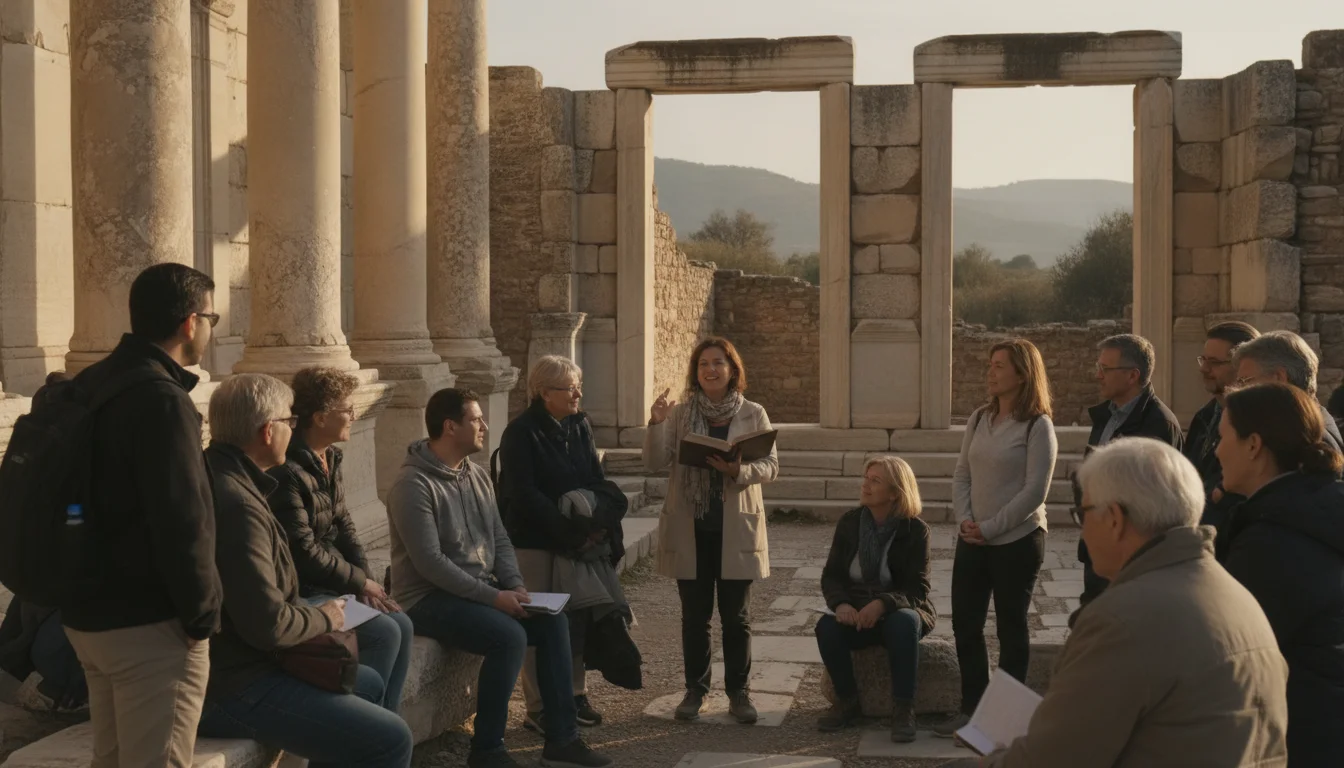
When a pastor calls me about the seven churches, the first question is almost never about theology. It is about logistics. He knows Revelation 2 and 3 cold. What he does not know is whether he can move forty people through western Turkey in a way that feels ordered rather than chaotic, whether the budget holds, and whether his own seat is going to sink the whole idea. Those are the right questions to ask. They are the questions I want to answer here.
I have built heritage journeys for more than forty years, and the seven churches of Revelation itinerary is one I have run more times than I can count. This guide is written for you, the person organizing and leading the trip, not for the traveler sitting in seat 14C. My job is to hand you the route, the sequence, the cost structure, and the recruiting reality so you can decide with real information. If you want the full framework for building any group faith journey, our guide to planning a group pilgrimage is the pillar I point every leader to first.
What the Seven Churches Itinerary Actually Covers
The seven churches of Revelation sit in what was Roman Asia, the western third of modern Turkey. They are Ephesus, Smyrna (modern Izmir), Pergamum (Bergama), Thyatira (Akhisar), Sardis, Philadelphia (Alasehir), and Laodicea. John addressed them in order in Revelation, and that order is not random. It traces a rough loop a Roman postal courier would have ridden, starting at Ephesus and circling clockwise.
That geography is a gift to you as an organizer, because the biblical sequence and the driving sequence are close to the same thing. You are not asking your group to backtrack across the country. You are following a circle. A well-built version anchors on Izmir or Kusadasi on the coast, runs the loop inland and back, and gives your people the text and the stones in the order John wrote them.
A realistic core itinerary for the seven churches alone runs seven to nine days on the ground. Fewer than seven and you are rushing Ephesus, which is a mistake, because Ephesus is where your group will spend the most time and feel the most. More than nine and you have room to add the coast, a Cappadocia extension, or the crossing into Greece that I will get to below.
Building the Route in the Right Order
Here is the sequence I hand leaders, with the organizer’s reasons attached to each stop.
- Ephesus. Start here. It is the largest and best preserved, it carries the deepest weight (the theater of Acts 19, the traditional home of Mary, the Basilica of St. John), and it sets the tone for everything after. Give it a full day.
- Smyrna and Pergamum. Smyrna is a working modern city, so the ancient agora is a shorter, focused stop. Pergamum rewards the climb with the acropolis and the Asclepion. The “throne of Satan” line in Revelation 2:13 lands differently when your group is standing under the great altar terrace.
- Thyatira, Sardis, Philadelphia. These three are the quieter churches, smaller sites in the middle of everyday Turkish towns. Do not skip them because the ruins are modest. For a congregation reading through Revelation, standing in Thyatira and Sardis is the point. This is where your teaching does the heavy lifting.
- Laodicea. Close the loop here. The lukewarm church, the cold and hot water sources you can still trace in the landscape, the wealth that made them self-satisfied. It is a strong place to end because the text ends the leader’s group where John’s warning is sharpest.
The reason I lay it out this way is that your recruiting pitch and your teaching plan should match the drive. When you tell your congregation “we walk the seven churches in the order John wrote them, from Ephesus to Laodicea,” you are giving them a story with a shape, and a shaped story fills a group faster than a list of ruins.
Turkey and Greece Biblical Itinerary: Extending the Journey
Most leaders who plan the seven churches eventually ask the same thing: can we add Greece? The answer is yes, and it is one of the most natural extensions in all of biblical travel.
A Turkey and Greece biblical itinerary works because the geography cooperates. After you finish the seven churches loop, you fly or sail from Izmir toward Athens and pick up Paul’s Greek route: Athens (Mars Hill and the agora of Acts 17), Corinth, and if you have the days, north to Philippi, Thessaloniki, and Berea. You end up with a single journey that holds both John’s letters to the churches and Paul’s founding of them. For a congregation, that pairing preaches itself.
The trade-off you are managing as the organizer is length and cost. Turkey alone is seven to nine days. Add the Greek leg and you are looking at twelve to sixteen days total, which changes the budget and changes who can take the time off. My counsel is to decide this early, because a twelve-day trip and an eight-day trip recruit differently and cost differently. If the combined route is where your heart is, our Greece and Turkey group planning guide walks through how the two legs stitch together, and the footsteps of Paul itinerary covers the Greek route stop by stop.
One practical note. When you combine countries, keep the transition simple. One clean flight or one ferry between Izmir and Athens, not a patchwork of connections. A messy border crossing in the middle of a spiritual journey is the fastest way to lose the group’s focus, and holding that focus is your real job.
Italy Early Christianity Itinerary for a Group
The other extension leaders ask about is Italy, and it belongs to a different chapter of the same story. Where Turkey and Greece hold the churches Paul planted and John addressed, an Italy early Christianity itinerary follows the faith to the capital of the empire that tried to stamp it out.
An Italy leg for a group centers on Rome: the Mamertine Prison where tradition holds Paul was held, the Appian Way he walked into the city, the catacombs where the early believers buried their dead and marked their faith in the dark, St. Paul Outside the Walls, and the Vatican with St. Peter’s. For many congregations this is the emotional close of the whole arc, the letters to the seven churches at one end and the martyrs of Rome at the other.
You can build Italy as its own eight to ten day trip, or as a shorter three to four day bookend after Turkey. I usually steer first-time group leaders toward keeping Turkey and Italy as separate journeys rather than one giant trip, because a two-week route through three countries asks a lot of an ordinary congregation’s stamina and budget. If your people are seasoned travelers, the full arc is magnificent. If this is your church’s first heritage trip, do the seven churches well, then bring them back for Italy next year. Our church group tour to Italy guide lays out the early Christianity route and what it costs to run for a group.
The Cost Math That Decides Whether You Go
Now the part that actually determines whether this trip happens: your seat.
The number that matters is fifteen. With fifteen or more paying participants, the group leader travels free. That is the leader’s full trip covered, flights, hotels, ground transportation, site entries, and the group meals built into the itinerary. It is not a discount or a partial credit. It is a complimentary seat built into the economics of a group booking, and the seat is yours because you are the reason the group exists.
Why this matters so much on a seven churches trip specifically: this is not a single-hotel vacation. The route moves. It runs a loop through inland Turkey with coaches, local guides, and site operators in towns like Bergama and Alasehir who know how to get a group real access. All of that coordination costs money. When the leader’s seat sits on top of it as a personal expense, plenty of pastors quietly conclude the trip is not feasible and let the idea die. Take that one expense off the table and the trip becomes possible again. I have watched it tip the decision more times than I can count.
For your congregation, this reframes the whole conversation. You are no longer asking the church to send the pastor on an expensive trip. You are organizing a journey your people pay into, and your participation is part of how it is structured. If you want the mechanics in more detail, does the pastor travel free and how many people you need for a free leader seat both go deeper on exactly how the benefit works.
Larger groups open more room. A group of twenty-five or thirty sometimes unlocks a reduced or complimentary second seat for a co-leader or a spouse. If you are building toward a bigger group, raise it early so we can structure the trip around it.
How to Recruit a Group That Reaches Fifteen
Fifteen is the number leaders worry about most, so let me be practical.
Start with your core, not your whole congregation. You do not need to find fifteen strangers. You need the eight to ten people already leaning toward this trip, and you let them bring others. Couples travel together. Bible study groups go as a unit. Friends bring friends. Every group I have run started from a small committed core, not a mass mailing.
Preach it before you sell it. The strongest recruiting tool you have is your own pulpit. Run a sermon series or a study through Revelation 2 and 3, then tell your people you are taking them to stand in those seven cities. When the trip is tied to what your community is already studying, interest sharpens fast. For the full recruiting playbook, how to recruit for a church trip is the guide I hand leaders.
Give real dates and a real route. Vague interest never fills a group. “We might do a Turkey trip someday” converts no one. “We walk the seven churches from Ephesus to Laodicea next April, nine days, here is what we will see” lets people decide. Concrete beats open-ended every time.
How Far Ahead to Plan
For a seven churches group of fifteen to thirty, six to nine months is the sweet spot. That gives your people time to budget, request time off, and commit, and it gives you time to do the real work, which is recruiting. If you are combining Turkey with Greece or Italy, or timing the trip around a holiday, push that to nine to twelve months.
The lead time is not mostly about booking hotels. It is about recruiting runway. A group crosses from thirteen committed to eighteen committed in the final stretch precisely because the dates and the itinerary became real. Give yourself that runway. Our guide on how far ahead to plan a group trip breaks the timeline down month by month.
FAQ: Planning the Seven Churches of Revelation Itinerary
How many days do I need for the seven churches of Revelation itinerary?
Seven to nine days on the ground covers all seven churches without rushing Ephesus, which deserves a full day on its own. If you add the coast, Cappadocia, or a crossing into Greece, plan for twelve to sixteen days total.
What order should we visit the seven churches in?
Follow John’s order, which also follows the natural driving loop: Ephesus, Smyrna, Pergamum, Thyatira, Sardis, Philadelphia, and Laodicea. Starting at Ephesus and circling clockwise means your group reads the text and sees the sites in the same sequence, with almost no backtracking.
Can we combine the seven churches with Greece or Italy?
Yes. A Turkey and Greece biblical itinerary pairs John’s churches with Paul’s Greek route through Athens and Corinth, and it flows well because a single flight or ferry links Izmir and Athens. Italy is best treated as its own early Christianity journey through Rome and the catacombs, either as a short bookend or a separate trip the following year.
Do I as the group leader really travel free?
With fifteen or more paying participants, yes. Your full trip is covered on the same terms as a participant: flights, hotels, ground transportation, included site entries, and the meals built into the itinerary. Below fifteen the trip is still possible, but you would pay a participant’s price.
How long does it take to recruit a group of fifteen?
Plan on six to nine months for a group of fifteen to thirty, and nine to twelve months if you are combining countries or timing around a holiday. Most of that window is recruiting, not booking. A trip fills fastest when it is tied to something you are preaching or studying and when your people can see real dates.
The seven churches route is one of the most rewarding journeys a congregation can take together, and the free-leader math is usually the thing that makes it real for the person leading it. You can see how the group experience works on our group heritage tours page, and look at the full country route on our Turkey heritage page.
Contact us and we will help you build the itinerary, run the numbers for your group and your dates, and get you to fifteen.