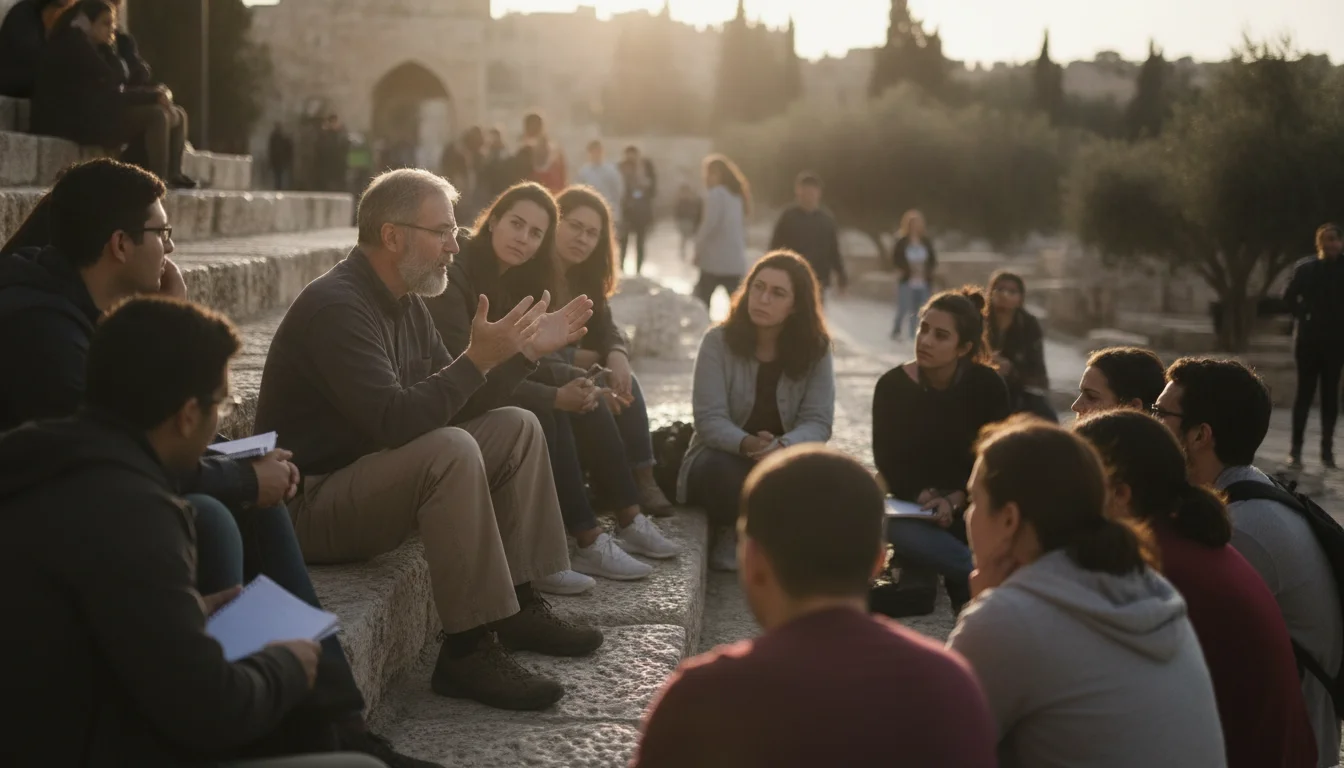
Most professors and campus pastors who call me about a seminary study trip to Israel are not worried about whether the trip is worth doing. They already know it is. What keeps them up at night is the logistics: how to build an itinerary that earns academic credit, how to recruit enough students to make it run, and how to justify their own seat in the budget. Those are organizer problems, not traveler problems, and they are the ones I want to solve with you here.
I have built heritage journeys for more than forty years, and a study trip to Israel is one of the few things I have watched change how students read Scripture for the rest of their lives. Standing on the Southern Steps where teachers taught, reading the text at the actual site, walking a distance instead of measuring it on a map. That is the difference between a course and a formation. This guide is about how you, the person organizing and leading it, make it happen without carrying the whole weight yourself.
What a Seminary Study Trip to Israel Actually Involves
A study trip is not a pilgrimage with a reading list stapled to it. It is a structured academic experience that happens on location, and it has a different shape than a congregational tour.
The itinerary carries teaching load. You are not just visiting Capernaum, you are teaching the Sermon on the Plain in Galilee, or working through the geography of the Kingdom while you can see the Jezreel Valley in front of you. That means the days are built around learning objectives, not just sights. A serious route moves through Galilee, the Jordan Valley, Samaria, the Judean wilderness, and Jerusalem, so students see how the land itself shapes the biblical narrative.
The academic side has to be handled deliberately. If students are earning credit, you need reading before departure, contact hours on site, and some form of assessment after. Good faculty leaders build the syllabus first and then ask the operator to shape the ground logistics around it. That order matters. The trip serves the course, not the other way around.
For you as the leader, the practical questions are the same ones every group organizer faces: dates, cost per student, how many you need, and what your own participation costs. The rest of this guide works through each of those. If you want the full framework before you dive into the specifics, our complete guide to planning a group pilgrimage lays out the whole process from first idea to departure.
The Free Leader Seat and What It Means for Your Budget
Here is the piece that changes the math for most faculty leaders. With fifteen or more paying participants, the group leader travels free. Full trip cost covered: flights, hotels, ground transportation, site entries, and the group meals built into the itinerary.
This is not a discount or a partial credit. It is a complimentary seat built into the economics of a group booking. Fifteen paying students generate enough margin within the trip’s costing to carry one additional traveler, and that traveler is you. You are the reason the trip exists, so the structure is built around your seat being the free one.
For a seminary or a campus ministry, this solves a real problem. Most departments cannot easily justify sending a professor overseas on the institution’s dime. When the leader’s seat is covered by the group model instead, that conversation with your dean or your board gets much simpler. You are organizing a trip students pay into, and your participation is part of how it is structured, not a separate line item someone has to approve.
Larger groups open more room. A group of twenty-five or thirty can sometimes unlock a reduced or complimentary second seat for a co-leader, a teaching assistant, or a spouse. For a deeper look at exactly how the covered seat works, our explainer on whether the group leader travels free walks through it, and the piece on how many people you need for the leader-free benefit covers the thresholds.
What Happens Below Fifteen
Smaller cohorts are absolutely possible. We run trips for ten to fourteen regularly, and a tight seminar group of twelve can be a wonderful teaching environment. Those groups simply do not qualify for the free-leader benefit, because the economics that fund the complimentary seat start at fifteen. In that range, the leader pays a participant’s price, or the group absorbs a small premium by agreement.
If you are close to the line, start planning anyway. Interest firms up once students see real dates and a real syllabus. I have watched cohorts cross from thirteen to eighteen in the final two months because the trip stopped being hypothetical.
How to Plan a College Campus Ministry Trip
Campus ministry trips run on a different rhythm than a seminary course, and the recruiting works differently too. Your travelers are undergraduates, your budget is tighter, and your planning window fights the academic calendar.
Start with your core, not the whole ministry. You do not need to recruit fifteen strangers. You need the eight or ten students already leaning in, the ones who show up early and stay late, and then let them bring roommates and friends. Every strong group I have run started from a committed core, not a mass appeal.
Time it to the calendar that actually frees students. For campus ministry, that usually means winter break, spring break, or the first weeks after finals in May. Lock the dates before you promote anything, because undergraduates commit to specifics and drift away from maybes. Six to nine months of lead time is the working range for a group of fifteen to thirty, and that window is as much about recruiting runway as it is about booking.
Build a payment plan into the pitch from day one. Undergraduates cannot write one check. A deposit plus monthly installments over several months makes the trip reachable, and it dramatically improves your conversion from interested to committed. Our guide on setting up a group trip payment plan shows how to structure it, and the piece on recruiting for a church trip applies directly to filling a student cohort.
Bible College Heritage Tour Planning
Bible colleges sit between a seminary and a campus ministry, and the planning reflects that. You have academic weight to honor and a student body with limited funds, so both the syllabus and the budget need real attention.
The strongest bible college trips tie the itinerary to a course already in the catalog. A survey of the Gospels becomes ten days in Galilee and Jerusalem. A Pauline epistles course becomes a route through Greece and Turkey. When the trip maps onto existing curriculum, it recruits itself, because students are already enrolled in the subject and the trip becomes the capstone.
Faculty ownership is the other half. A bible college trip needs a professor who owns the teaching content and treats the operator as the logistics partner, not the tour designer. You bring the learning objectives and the on-site teaching. We handle the coaches, the licensed local guides, the hotels, the site access, and the sequencing so your teaching days flow. That division of labor is what keeps the academic quality high while the ground work stays invisible. Our group heritage tours page shows how the group experience is structured, and if you are pricing a first trip, the breakdown of what a church group trip to Israel costs gives you realistic per-student numbers to build a budget around.
Homeschool Group Heritage Tours
Homeschool co-ops are one of the most natural fits for a heritage study trip, and one of the most rewarding to lead. The families are already committed to experiential, faith-rooted education, so a trip that turns a year of Bible or ancient history study into a lived experience is an easy case to make.
The planning has its own character. Homeschool groups usually travel as families, which means mixed ages, parents alongside students, and a pace that has to work for a fourteen-year-old and a grandparent in the same group. That is workable, and often it is the point, but it shapes the itinerary. You want a route with enough substance for the teens and enough comfort for the multigenerational reality of the group.
Counting toward the fifteen works in your favor here. Because homeschool groups travel as family units, a co-op of six or seven families reaches the free-leader threshold quickly, and the leader (often the co-op coordinator or a lead teaching parent) travels free. The recruiting also runs through an existing community that already meets, already trusts each other, and already shares an educational vision. That is the easiest kind of group to fill. Our group heritage page for Israel shows the destination in full, and the church group planning checklist works just as well for a co-op coordinator as it does for a pastor.
Christian School Group Tours to Greece
Not every study trip goes to Israel, and for a Christian school studying the early church, Greece is often the better fit. A christian school group tour to Greece walks the world of Acts and the Pauline letters, which lines up cleanly with a New Testament or church history course.
A Greece route for a school group moves. It runs from Thessaloniki and Philippi in the north to Athens and Corinth, following Paul’s second and third journeys, so students read Acts at the places it describes. That teaching connection is why school groups often pair well with Greece: the geography is the lesson. The same free-leader model applies, so a class of fifteen students plus chaperones easily covers the lead teacher’s seat.
If your school is weighing Israel against Greece, or considering both across two years, our overview of a church group tour to Greece covers the itinerary options, and the Greece and Turkey groups guide shows how to combine the two into one Footsteps of Paul route. For a school building a multi-year travel program, that combination is worth looking at early.
Jewish Youth Group Trips to Poland and Israel
For Jewish congregations and day schools, the study trip often takes a specific and powerful shape: Poland and Israel together, in that order. The journey moves from the sites of loss in Poland to the life of the land in Israel, and the sequence itself carries the meaning. Students stand at the memorials and the camps, and then they land in Jerusalem. From memory to continuity.
Organizing this trip is a serious undertaking, and it rewards early planning. A Poland and Israel journey for a youth group wants nine to twelve months of lead time, both for the logistics and for the emotional and educational preparation the students need before they go. You are not just booking flights. You are building a curriculum of memory, which means pre-trip learning, trained educators who can hold difficult moments, and a structure that gives students space to process what they see.
The free-leader model applies here too. A youth group of fifteen or more covers the seat of the rabbi, educator, or youth director leading the trip, which matters for congregations and schools working within tight budgets. For the destination side of the journey, our pages for Poland and Israel show both halves of the route, and because these trips take the most lead time of any I plan, the guide on how far ahead to plan is worth reading before you set a date.
FAQ: Planning a Seminary Study Trip to Israel
How many students do I need for the trip leader to travel free?
Fifteen. With fifteen or more paying participants, the group leader’s full trip cost is covered, including flights, hotels, ground transportation, and site entries. Below fifteen the trip is still possible, but the leader pays a participant’s price rather than traveling free.
Can students earn academic credit for a study trip?
Yes, when the trip is built as a course. That means assigned reading before departure, structured contact hours and teaching on site, and an assessment after. The faculty leader owns the syllabus and learning objectives, and we shape the ground logistics around your teaching days so the academic content stays central.
How far ahead should we start planning?
Six to nine months for a group of fifteen to thirty. A Poland and Israel journey, or any trip timed around holidays or the academic calendar, wants nine to twelve months. The longer window is mostly recruiting runway and, for heavier trips, preparation time for the students.
How do students afford it?
A deposit plus monthly installments over several months, rather than one payment. A payment plan is the single biggest factor in turning interested students into committed ones, especially for undergraduates and homeschool families. Many groups also fundraise part of the cost.
Can a co-leader or teaching assistant also travel free?
Not automatically at fifteen, but larger cohorts create room. Groups of around twenty-five or thirty can sometimes unlock a reduced or complimentary second seat for a co-leader, a teaching assistant, or a spouse. If that matters for your trip, raise it early so we can build toward it.
If you are weighing whether a study trip is realistic for your seminary, college, school, or congregation, the free-leader model is usually the thing that makes it work on paper. You can see how the group experience comes together on our group heritage tours page, and read how pastors and leaders afford to lead a trip when the seat is covered.
Contact us and we will help you build the itinerary around your course, run the numbers for your group and your dates, and get your students on the ground.