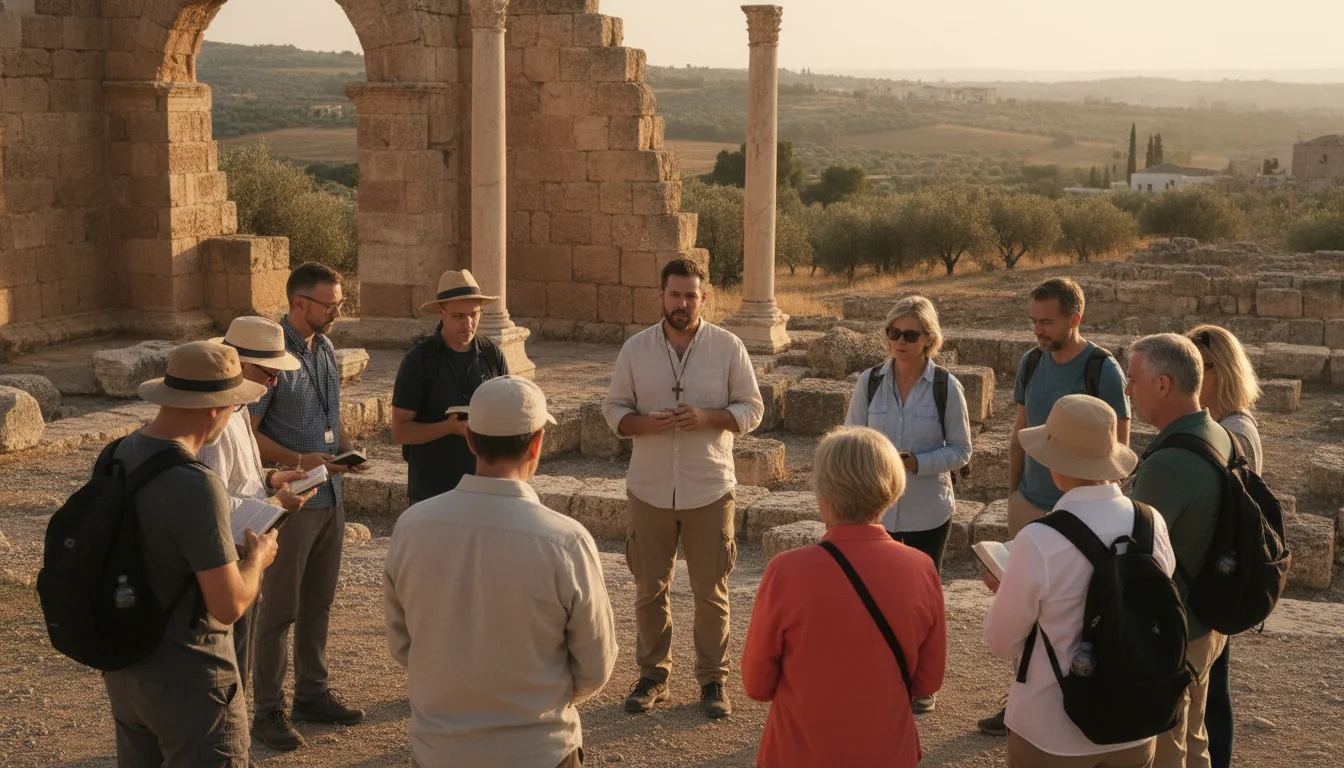
The question I get most often from first-time group leaders is not about hotels or flights. It is quieter than that. A pastor will pull me aside near the end of a planning call and ask, almost embarrassed, “When we are actually standing there, at the tomb or on the water or in the ruins, what am I supposed to say?” That is the real weight a leader carries. The logistics can be handed to an operator. The spiritual moment cannot. Your people are not signing up to see rocks. They are trusting you to open the place up for them.
I have built heritage journeys for more than forty years, and I have watched hundreds of leaders learn how to lead devotionals at biblical sites. The ones who do it well are almost never the most polished speakers. They are the ones who prepared, who chose their moments, and who let the place do the heavy lifting. This guide is for you, the organizer and the shepherd, the person who plans the trip and then has to stand up and lead it. Let me walk you through the parts that matter.
What Leading a Devotional On Site Actually Means
A devotional at a biblical site is not a lecture and it is not a full sermon. It is a short, focused moment where you read the text that belongs to that place, connect it to the ground under your feet, and give your group room to respond. Five to twelve minutes is usually the whole thing. The location supplies the emotion. Your job is to point at it.
The mistake I see leaders make is treating every stop like a chance to preach. You will visit a dozen sites in a day sometimes. If you deliver a twenty-minute message at each one, your group will be exhausted by lunch and numb by the third afternoon. Choose your anchor moments. On most trips there are three or four places that carry real spiritual weight for your community. Those get a prepared devotional. The rest get a verse read aloud and a moment of quiet. Restraint is part of the craft.
As the organizer, this is a planning decision as much as a spiritual one. Before you leave home, look at your itinerary and mark which stops you will build a devotional around. Do not decide this on the coach at 8 a.m. Match the site to the passage, match the passage to what your congregation has been walking through, and you will arrive ready instead of scrambling. If you are still shaping the trip itself, our guide to planning a group pilgrimage covers how the itinerary comes together so you have room to plan the spiritual side alongside the logistics.
How to Prepare Sermons for a Holy Land Trip
Some leaders do want to preach a fuller message once or twice on the trip, often at a Sunday service in Jerusalem, at the Garden Tomb, or at a shared evening gathering. Preparing a sermon for a Holy Land trip is different from preparing one for home, and here is why.
At home, you bring the place to the text. On the road, the place is already there, and it will overpower anything you try to layer on top of it. So prepare less, not more. Pick one passage tied to where you are standing. Read it slowly. Say the two or three things that the location makes newly true, and then stop. A sermon at Capernaum does not need three points and a poem. It needs you to read the calling of the disciples on the shore where it happened and let your people feel the distance close.
A few practical habits I give every leader:
- Write your on-site messages before you leave home, then carry them printed. Wifi is unreliable and your phone will die. Paper does not.
- Keep each message to one page. If it does not fit on one page, you are preaching your study notes, not the moment.
- Read the passage aloud in advance, standing up, out loud, timed. What reads fine on a screen runs long in the open air.
- Build in silence. The most powerful thing you will do at some sites is stop talking and let people sit with it.
For a Jewish heritage group, the same principle holds with different texts. A leader standing at Masada or in the Old City is teaching Torah and history into the ground it happened on. The discipline is identical: less commentary, more presence, let the place carry the weight.
If you are still deciding when to travel, timing shapes the mood of these moments. Our guide to the best time for a group trip to Israel walks through the seasons and the holidays so you can plan your teaching around the calendar.
How to Lead Worship on a Heritage Tour
Worship on a heritage tour is one of the most moving things your group will do together, and it is also the thing leaders overplan. You do not need a band. You do not need sound equipment. You need a few songs your people already know by heart, sung in a place that makes the words land differently.
Here is how to lead worship on a heritage tour without it becoming a production:
- Pick songs everyone knows. This is not the moment to introduce new material. “It Is Well,” “How Great Thou Art,” “Amazing Grace,” and a handful of hymns and choruses your congregation sings weekly will carry every group.
- Sing a cappella and lean into it. Voices in a stone church, on a hillside, or by the water do not need instruments. The acoustics of these places were built for the human voice.
- Ask one confident singer in your group ahead of time to help start each song. A leader who is not musical does not have to carry the pitch alone.
- Keep a small printed songbook or a shared sheet. People forget verses, and fumbling for lyrics breaks the moment.
Some of the most sacred singing I have ever heard happened with no plan at all: a group standing in a garden, someone quietly starting a familiar hymn, and everyone joining in. As the leader, your job is to create the space and the permission, not to perform. Choose the site, gather the group close, name the moment in a sentence, and then let them sing.
How to Lead Communion Abroad
Communion at a biblical site is often the emotional peak of an entire trip, and leading communion abroad takes a little planning that first-time leaders do not always expect. This is very much an organizer’s task, because the logistics have to be handled before you ever raise the cup.
First, the elements. You cannot count on finding bread and juice where you are going, and carrying wine across borders and into some sites is a problem you do not want. My standard advice: bring individual prepackaged communion sets (the sealed wafer-and-juice cups) from home in your checked luggage. They are light, they clear customs without trouble, and they solve the sanitation question for a large group in one move. Buy them before you leave. Do not plan to source them locally.
Second, the setting. Talk to your operator about where communion is permitted. Many sites welcome it, some have designated areas, and a few do not allow it at all. This is exactly the kind of thing a good operator arranges quietly in advance so you are not negotiating with a site guard in front of your group. When you are choosing who to travel with, ask how they handle worship and communion access. Our guide on how to choose a faith tour operator covers the questions that separate the operators who understand this from the ones who just move buses.
Third, the moment itself. Keep the liturgy simple and familiar to your tradition. Read the words of institution from First Corinthians 11 or the Gospel account, distribute the elements, and give people space. At a place like the Garden Tomb or the Upper Room, you will not need to add much. The site preaches the sermon. You just hold the bread and the cup and let your people remember.
What to Say at the Empty Tomb
Of every question leaders ask me, this is the one they are most nervous about, so let me speak to it directly. What do you say at the empty tomb?
Less than you think.
The empty tomb, whether you stand at the Garden Tomb or the Church of the Holy Sepulchre, is a place where your words matter less than your restraint. The temptation is to fill the silence, to explain, to make a grand statement worthy of the moment. Resist it. The most powerful thing I have watched leaders do at the tomb is read the resurrection account, Matthew 28 or John 20, in a clear, unhurried voice, and then say almost nothing.
If you want a frame, here is what works. Gather your group close so everyone can hear. Say one honest sentence about why you are here and what this place means. Read the text aloud. Then invite a moment of silence, or a familiar song, or communion if you have planned it there. Close with a short prayer of gratitude and let people linger. Some will weep. Some will want to be alone. Some will want to touch the stone. Your job is to open the door and then step back, not to narrate their encounter for them.
I have seen seasoned pastors freeze at the tomb because they built up the pressure to say something extraordinary. Do not do that to yourself. The extraordinary thing already happened here. You are only pointing at it.
Building the Devotional Plan Into Your Itinerary
Let me close the loop on the organizer’s side, because leading well on site starts with planning well at home. When you are laying out the trip, treat the spiritual moments as fixed points, not afterthoughts. Decide which three or four sites carry your anchor devotionals. Note where you want worship. Pick your communion location and confirm it with your operator. Assign your song-starter and print your songbooks. Pack the communion sets. Write your messages and print them.
None of this is complicated, but it is the difference between a leader who is present with his people and a leader who is stressed and improvising. The whole reason the trip is built the way it is, with the ground handled and often with the leader traveling free at fifteen paying travelers, is to free your attention for exactly this. You are not the trip’s logistics manager once you are on the ground. You are its shepherd. Let the operator carry the buses, the hotels, and the site access so you can carry the moments that only you can lead. If you are still building your list of what to prepare, our church group planning checklist puts the practical pieces in order.
FAQ: Leading Devotionals and Worship at Biblical Sites
How long should a devotional at a biblical site be?
Five to twelve minutes at your anchor stops, and often just a read verse and a moment of quiet at the rest. Read the text tied to the place, connect it in two or three sentences, and leave room for silence. Long messages at every site wear a group out fast. Choose a few moments to prepare fully and keep the others short.
Do I need to prepare full sermons for a Holy Land trip?
Usually one or two, not more. Most on-site moments are short devotionals, not sermons. When you do preach a fuller message, prepare less than you would at home, because the location carries most of the weight. Write it before you leave, keep it to one page, and read the passage aloud on your feet to time it.
How do I handle communion at a biblical site abroad?
Bring sealed prepackaged communion sets from home in your checked luggage, since sourcing bread and juice locally for a group is unreliable. Confirm with your operator which sites permit communion and where, so it is arranged before you arrive. Then keep the liturgy simple and familiar to your tradition.
What should I say at the empty tomb?
Less than you expect. Gather your group close, say one honest sentence about why you are there, read the resurrection account aloud, and then give people silence. The place does the work. Your role is to open the moment and step back, not to narrate everyone’s experience.
Can I lead worship without being musical?
Yes. Pick songs your congregation already knows by heart, sing a cappella, and ask one confident singer in your group ahead of time to help start each song. Bring a printed songbook so no one fumbles for lyrics. You create the space and the permission. You do not have to carry the tune alone.
If you are planning a heritage journey and want a partner who handles the logistics so you can focus on leading your people, look at how the group heritage tours come together, and read our guide on how pastors afford to lead a trip if the cost side is still on your mind.
Contact us and we will help you build an itinerary with room for the moments that matter most.