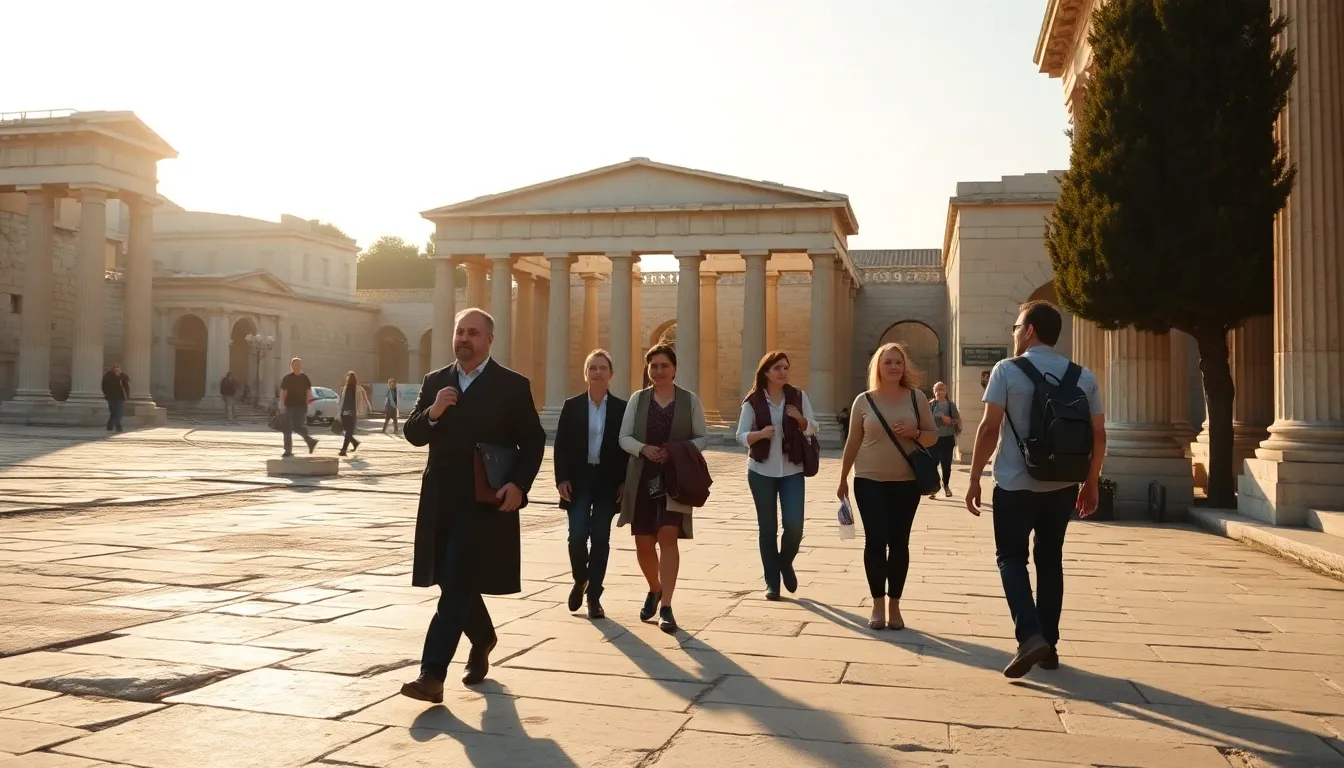
The first time a pastor asks me how he is supposed to afford to lead a trip to Greece, I know the conversation is about to get easier, not harder. He is bracing for me to tell him the leader pays his own way and somehow finds the budget. Instead I tell him that with fifteen people, his seat is covered. There is usually a pause. Then the real planning starts, because the question was never whether he wanted to go. It was whether he could justify the cost to himself and to his board. The free-leader model takes that question off the table.
I have built heritage journeys for more than forty years, and I want to walk you through exactly how this works for Greece, what it covers, where the numbers come from, and how to build a group that actually reaches fifteen. No vague promises. Just the structure.
What “Travels Free” Actually Means
When we say the group leader travels free with fifteen or more participants, we mean the leader’s full trip cost is covered. That is flights, hotel accommodation, ground transportation, site entry fees, and the group meals that are built into the itinerary. The leader joins the trip at no personal cost.
This is not a discount or a partial credit. It is a complimentary spot built into the economics of a group booking. The way it works is simple once you see it. A group of fifteen paying participants generates enough margin within the trip’s costing to absorb one additional traveler. That traveler is you, the leader. You are the reason the group exists, so the model is built around your seat being the free one.
For a congregation, this changes the entire shape of the decision. You are no longer asking your church or synagogue to send the pastor or rabbi on an expensive trip. You are organizing a journey your people pay into, and your participation is part of how it is structured.
Where the Fifteen Comes From
People sometimes ask why the number is fifteen and not ten or twenty. The honest answer is that fifteen is the point where a group trip becomes economically self-supporting at the quality level we build at.
Below fifteen, the fixed costs of a trip, the guide, the coach, the local operators, the coordination, get spread across too few travelers. The per-person price climbs, and there is no room to carry a complimentary seat without raising everyone’s cost. At fifteen, those fixed costs are shared widely enough that the structure holds and the leader’s seat fits inside it.
Above fifteen, the math only gets friendlier. A group of twenty-five or thirty has more room in it, which is why larger groups sometimes unlock a second benefit, a reduced or complimentary spot for a co-leader or spouse. If you are building toward a bigger group, that is worth asking about early.
What Happens With Ten to Fourteen
Smaller groups are absolutely possible. We run trips for ten to fourteen people regularly. They simply do not qualify for the free-leader benefit, because the economics I described above do not yet support it. In that range, the leader pays a participant’s price like everyone else, or the group absorbs a small premium to cover the leader’s seat by agreement.
If you are close to the line, say you have twelve committed and three maybes, my advice is always to start the planning conversation anyway. Interest tends to firm up once people see real dates and a real itinerary. I have watched many groups cross from thirteen to seventeen in the final two months simply because the trip became concrete.
Why This Matters More in Greece Than People Expect
Greece is not the cheapest heritage destination to build well, and that is exactly why the free-leader model matters here.
A good Pauline itinerary or a serious Jewish heritage route in Greece is not a single hotel in Athens with day trips. It moves. It runs from Thessaloniki and Philippi in the north down to Athens and Corinth, or out to Rhodes and Ioannina, with coaches, local guides, and ground operators in smaller cities who know how to get a group meaningful access. That coordination costs money. When the leader’s seat sits on top of all that as a personal expense, a lot of pastors and rabbis quietly decide the trip is not feasible.
Remove that one expense and the trip becomes feasible again. I have seen it happen often enough to know the free seat is not a nice-to-have. For many leaders, it is the difference between a trip that happens and a trip that stays an idea. If you want to see how the full route comes together, our guide for pastors and rabbis lays out the itinerary options, and the Apostle Paul footsteps guide walks the Christian route site by site.
How to Build a Group That Reaches Fifteen
This is the part leaders worry about most, so let me be practical about it. For a step-by-step planning framework, our complete guide for group leaders walks through the whole arc from first interest to departure.
Start With Your Core, Not Your Whole Congregation
You do not need to recruit fifteen strangers. You need to find the eight to ten people in your community who already want to go, then let them bring others. Every heritage trip I have run started with a small core of committed travelers. Couples come together. Friends bring friends. Bible study groups travel as a unit. Fifteen is reachable when you start from the people leaning in rather than the whole membership list.
Give People a Real Reason and a Real Date
Vague interest does not fill a group. A specific journey on specific dates does. When you can tell your congregation “we are walking Paul’s route from Philippi to Corinth next May, eight days, here is what we will see,” people can decide. Open-ended “we might do a Greece trip someday” never converts. Tie the trip to something your community is studying or preaching through and the interest sharpens.
Plan Far Enough Ahead
Six to nine months is the sweet spot for a group of fifteen to thirty. That gives people time to budget, request time off, and commit. It also gives you time to build interest, which is the real work. Larger groups, or trips timed around Orthodox Easter or the Jewish holidays, want nine to twelve months. Earlier planning is not just logistics. It is recruiting runway.
The Leader’s Real Job Once the Money Is Handled
Here is what I most want leaders to hear. When the free-leader model takes your personal cost off the table, it also frees up your attention. You are no longer the trip’s accountant. You are its shepherd.
That is the point. Your role on a heritage journey is to guide your people through a spiritual and educational experience, to read Acts 16 aloud at the river outside Philippi, to lead a moment of reflection at the Holocaust memorial in Thessaloniki, to be present for your community in the places that move them. The operator’s job is to make everything else invisible. The free seat is part of how we keep your focus where it belongs.
FAQ: The Free Group-Leader Benefit in Greece
How many participants do I need for the group leader to travel free?
Fifteen. With fifteen or more paying participants, the group leader’s full trip cost is covered, including flights, hotels, ground transportation, and site entry fees. Below fifteen, the trip is still possible but the leader pays a participant’s price.
Does the free seat cover everything, or just the flight?
It covers the leader’s full trip on the same terms as a participant: international flights, hotel accommodation, ground transportation, included site entries, and the meals built into the itinerary. Personal spending and optional add-ons are the leader’s own.
Can a co-leader or my spouse also travel free?
Not automatically at fifteen, but larger groups create room. Groups of around twenty-five or thirty can sometimes unlock a reduced or complimentary second seat for a co-leader or spouse. If that matters to you, raise it early so we can build toward it.
What if I can only gather twelve people?
We run trips for ten to fourteen, so the journey can still happen. It just will not include the free-leader benefit, since the economics that fund the complimentary seat start at fifteen. Many groups that begin at twelve reach fifteen before departure, so it is worth planning anyway.
How far ahead should I start to reach a group of fifteen?
Six to nine months for fifteen to thirty travelers, and nine to twelve for larger groups or holiday-timed trips. The lead time is as much about recruiting your group as it is about booking. Concrete dates and a real itinerary are what move people from interested to committed.
If you are weighing whether a Greece trip is realistic for your community, the free-leader math is usually the thing that tips it. You can see how the group experience works on our group heritage tours page, look at the full route on our Greece heritage page, or read how we build church group tours to Greece from the ground up.
Contact us and we will help you run the numbers for your group and your dates.