Every so often a group leader tells me, “We want to see all of it. We have the time. Don’t make us choose.” This itinerary is for them. Most of my Greece routes are about trimming, about deciding what to leave out so the trip stays focused. This one is the opposite. It is the full sweep, the route I build when a congregation gives me twelve days and the freedom to do Greece properly: the whole arc from Macedonia in the north, through the heart of the country, down into the Peloponnese, and out to the island of Patmos. Nothing essential cut, and still room to breathe.
I want to be honest about what this is. Twelve days is not a long trip by accident. It is the length it takes to follow Paul’s full journey, honor the Jewish heritage layered alongside it, see the great natural and monastic wonders like Meteora, and finish at Patmos where John received the Revelation. It moves, but it never sprints, because the whole point of having twelve days is that you do not have to. This is the complete Greece heritage journey, the one I would take my own family on.
Here is the full route.
Days 1 and 2: Athens
You begin in the capital. Day one is for landing and settling, with a gentle evening walk through the Plaka and a first look up at the Acropolis. No heavy sites on arrival.
Day two is your ancient and heritage grounding. The Acropolis and the Parthenon in the soft morning light, then the ancient Agora where Paul walked and debated. The Areopagus, Mars Hill, where Paul preached to the philosophers about the “unknown god,” gets its own time, and our guide to the Areopagus in Athens goes deeper. For interfaith and Jewish groups, the Jewish Museum of Greece and the two Athens synagogues, Romaniote and Sephardic facing each other, connect to a Jewish presence here that runs back more than 2,300 years.
Day 3: Corinth and the Peloponnese Edge
Drive south to Ancient Corinth, about ninety minutes, with the Corinth Canal as a stop on the way. Corinth is where Paul stayed eighteen months and wrote two of his most important letters. You see the bema where he stood before the proconsul Gallio, the temple of Apollo, and the Acrocorinth above. Reading First Corinthians on site, in exactly the divided, cosmopolitan kind of city the letter describes, is one of the trip’s anchor moments. You overnight in the Peloponnese or back in Athens depending on how we route the next day.
Day 4: Delphi
A day for the ancient Greek spiritual world, which deepens everything else. Delphi was the center of the ancient Greek religious imagination, the home of the Oracle, set on a dramatic mountainside. Standing here, your group understands the spiritual landscape Paul walked into when he addressed the Greeks. It is a departure from the strictly biblical thread, but it makes the encounter at the Areopagus richer, and the setting alone, the temple of Apollo against the slopes of Parnassus, stays with people.
Day 5: Meteora
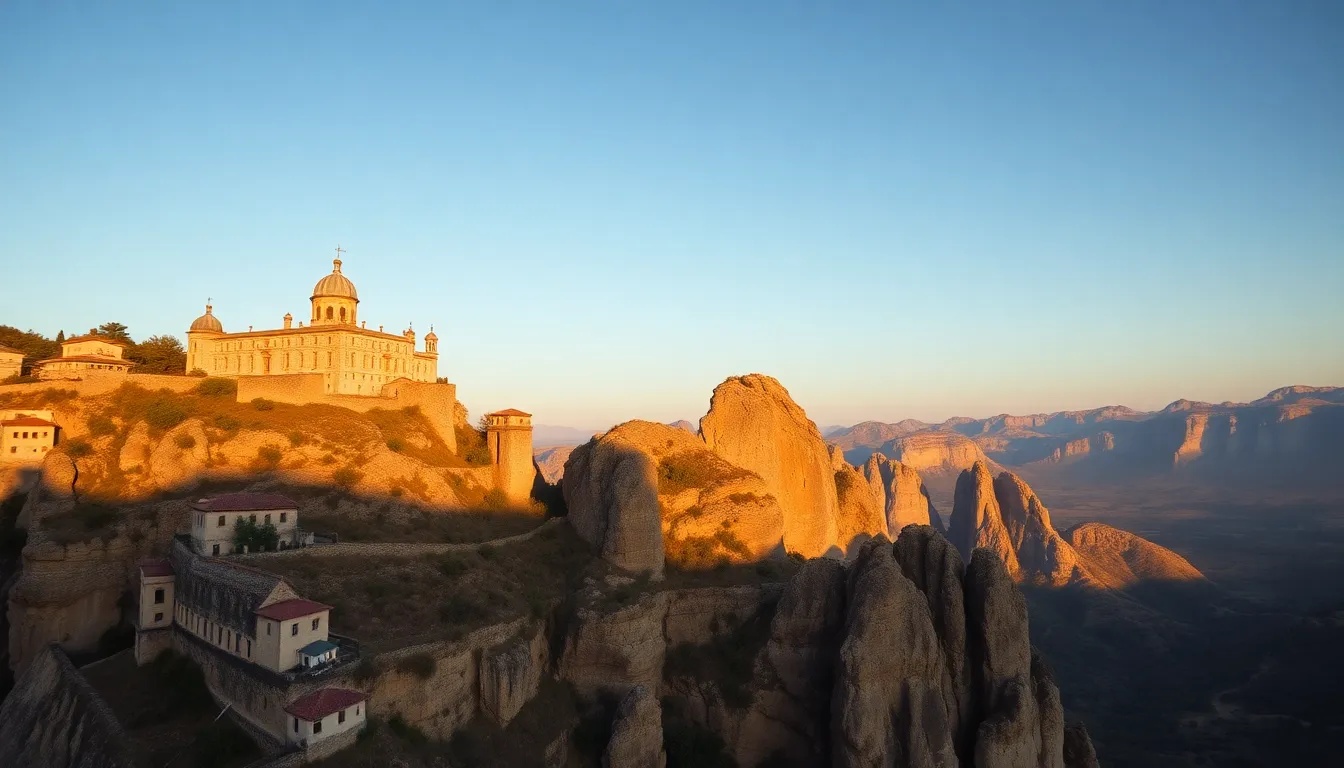
North toward the monasteries of Meteora, one of the most extraordinary sights in Greece. Six Eastern Orthodox monasteries sit atop sheer rock pillars rising hundreds of feet from the plain, built when monks sought solitude and safety in the heights. For centuries the only way up was by rope ladder or a net hauled by hand, and that history is part of what your group feels standing at the base looking up. Today there are carved steps, and visiting one or two of the monasteries, climbing to chapels covered in centuries-old frescoes, gives your group the living Orthodox Christian tradition that carried the faith through the Byzantine centuries and into the present.
I find Meteora does something specific for a heritage group. The Pauline sites are about the first century, and they can feel distant. Meteora is a faith still being practiced, monks still living the contemplative life on those rocks, and it reminds people that the story they are tracing did not stop. It is a natural and spiritual high point, and the drive there, climbing into the plain of Thessaly with the pillars appearing on the horizon, is part of the reward.
Days 6 and 7: Thessaloniki and Berea
Continue north to Thessaloniki, the second great city of the trip, and give it two days.
Paul preached in the synagogue here and wrote First and Second Thessalonians to this community. Visit the Rotunda and Hagios Demetrios, both early churches still in use. Thessaloniki was also the Jerusalem of the Balkans, the largest Sephardic community in the world, and the Jewish Museum, the Monastir Synagogue, and the Holocaust memorial at Liberty Square tell a story that thrived for five hundred years and was destroyed in eighteen months. It is hard material, and I ask leaders to prepare their groups. Our Jewish heritage in Greece guide goes deeper. On the second day, drive to Berea, the modern Veria, where the noble-minded Bereans “searched the scriptures daily,” and walk the old Jewish quarter of Barbouta by the river.
Day 8: Philippi and Kavala
A full day on the Macedonian sites where Paul first reached Europe.
Philippi is the first place in Europe where the gospel was preached and the first European church was planted. Walk the forum, the basilicas, the traditional prison where Paul and Silas sang at midnight before the earthquake, and the riverside baptistery where Lydia, a seller of purple cloth and the first recorded European convert, was baptized. Many groups hold a short service or renewal at that riverside, and it is consistently the most moving stop of the entire trip. There is no grand cathedral there, just the water and the memory, and somehow that plainness is what reaches people. I have watched congregations that had held it together through everything else go quiet at that river.
Nearby, Kavala, ancient Neapolis, is the harbor where Paul actually stepped off the boat into Europe after the vision at Troas, when a man of Macedonia begged him, “Come over and help us.” Standing at the same water he crossed closes the loop on how the gospel arrived on the continent, and it ties the northern leg back to the crossing your group will make later toward Patmos.
Day 9: Travel and the Aegean
A transfer day toward the eastern Aegean for the island leg, with margin built in. Depending on the season, this routes through Thessaloniki or Athens toward the ferry or flight to Patmos. I am honest that this is the day with the most logistics, so we keep it unhurried and let the group rest. The crossing itself carries meaning, the same Aegean waters that connected the early churches.
Days 10 and 11: Patmos
Two days on the island where the New Testament closes. Patmos is where John was exiled and received the Revelation. The Cave of the Apocalypse, where tradition says the vision came, and the fortified Monastery of Saint John crown the island. After eleven days following Paul’s churches and the Jewish and Orthodox heritage layered through Greece, arriving at the place where the final book was written gives the trip a sense of completion that is hard to put into words. I keep one of the two days lighter, time by the harbor, a slow meal, so the group can absorb everything they have seen.
Day 12: Return and Departure
The final day handles the journey home, routing back through Athens or the nearest gateway. I save margin for a closing moment, a chance for the group to name what they are carrying before the airport pulls everyone back into logistics. Twelve days, the full sweep, north to south and out to the islands. The complete Greece heritage journey.
For groups with less time, this route divides cleanly into shorter trips. The Pauline core stands alone as our 7-day Footsteps of Paul itinerary, and the classic version is our 10-day heritage itinerary for Greece.
FAQ: A 12-Day Complete Greece Heritage Itinerary
What makes this the complete Greece itinerary?
It includes every essential layer without rushing: Paul’s full journey from Athens and Corinth through Macedonia, the Jewish heritage of Athens, Thessaloniki, and Veria, the ancient spiritual world at Delphi, the Orthodox monasteries of Meteora, and the island of Patmos where John received the Revelation. Most Greece trips cut something. With twelve days, you do not have to, and you still travel at a humane pace.
Is this trip for Christian groups, Jewish groups, or both?
It works for all three. The Pauline sites and Patmos serve Christian groups, the Jewish heritage in Athens, Thessaloniki, and Veria serves Jewish groups, and interfaith groups find that the shared history deepens both traditions. We adjust the emphasis to your congregation, expanding the Jewish sites or the Pauline ones depending on who you bring.
Why include Meteora and Delphi if the focus is biblical heritage?
Because they make the biblical sites richer. Delphi shows the ancient Greek spiritual world Paul stepped into at the Areopagus, and Meteora carries the living Orthodox Christian tradition that preserved the faith through the Byzantine centuries. They are also two of the most beautiful places in Greece, and twelve days gives you room to include them without cutting anything essential.
Is twelve days too much walking for older travelers?
Not with good pacing, which is the whole advantage of a longer trip. We build in rest days, structure the walking around the group you bring, and take the few sites with uneven ground, the Areopagus, the Acrocorinth, the Meteora steps, slowly or with flatter alternatives. With Heritage Tours, the group leader travels free when you bring fifteen or more participants, which helps pastors and rabbis bring a full congregation.
When is the best time of year for this itinerary?
Late spring, May to June, and early fall, September to October, are ideal. The walking sites are comfortable, the mountain drives to Meteora are clear, and the ferry crossing to Patmos is smoother before or after the summer peak. Our guide to the best time to visit Greece breaks the seasons down in detail.
If you want to give your congregation the whole of Greece, I would be glad to help you shape it. This is the route I build when there is time to do it right, and it rewards every day you give it. See how we structure these trips on our Greece heritage page, or learn how the group experience works on our group heritage tours page.
Contact us whenever you are ready to start planning.