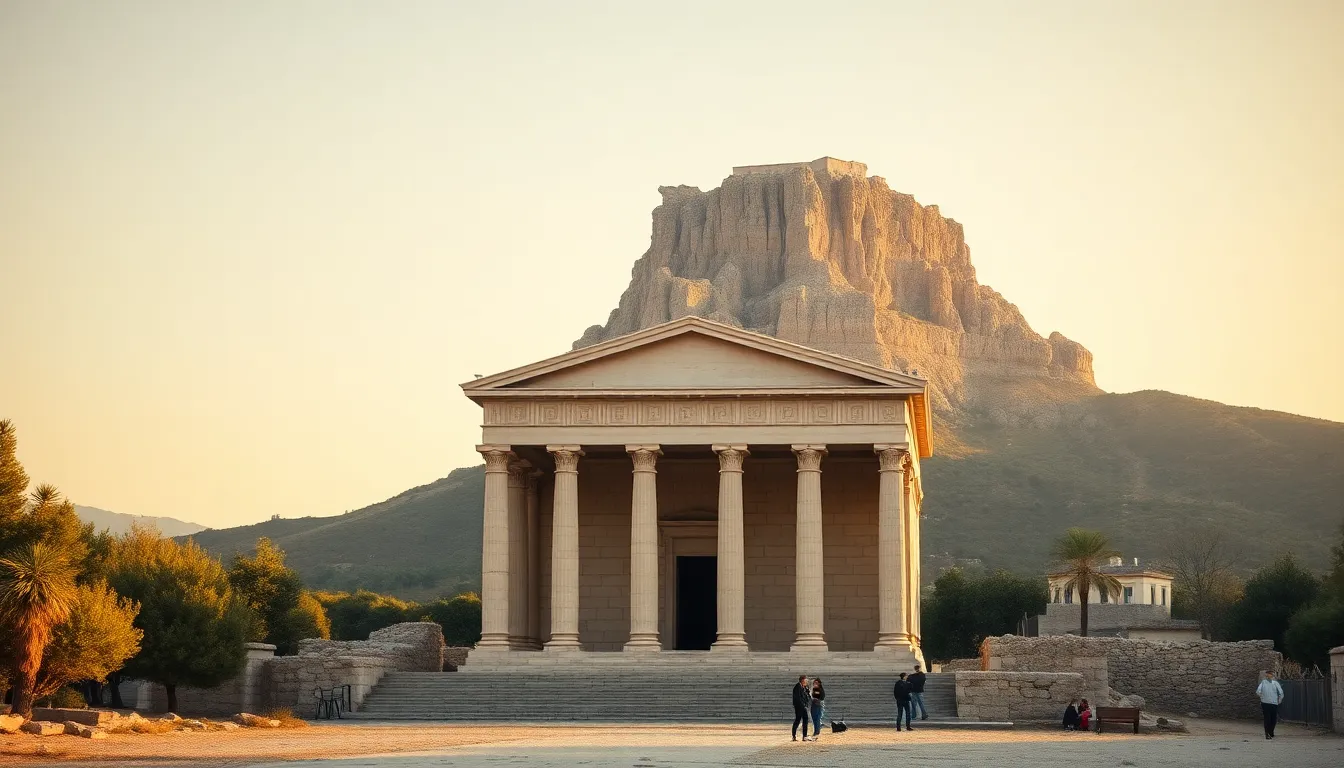
Not every group can give a week to Greece, and I have stopped treating that as a problem. Some of the best trips I have led were five days, built around one tight region, with no time wasted on long transfers. If your congregation can only get away for a short stretch, or if Greece is one leg of a larger Holy Land trip, the Athens and Corinth loop is the answer. It is the heart of Paul’s work in Achaia, it sits in a compact corner of the country, and you never have to fly internally or sit on a coach for half a day.
This itinerary is for Pauline groups with a clear focus and a tight calendar. You fly in and out of Athens, you base yourself there or near Corinth, and you go deep on a small number of sites rather than skimming many. Mars Hill, the Acropolis, Ancient Corinth, and the bema where Paul stood before Gallio. Five days, no padding, and every site close enough to do justice.
Here is how I would run it.
Day 1: Arrive in Athens
Day one is for landing and settling. Athens has the strongest international connections in Greece, so this is the natural entry point. I keep the first evening easy: check in, then a slow walk through the Plaka with the Acropolis lit above you. Dinner together to set the tone. No sites, no long talks, just enough to let your people feel they have arrived.
If the group lands early with energy to spare, the Roman Agora and the Tower of the Winds make a gentle, low-commitment first look at the ancient city. But there is no need to push. The week is short, but it is not so short that day one has to carry a site.
Day 2: Ancient Athens
Today you give your group the ancient city, because it frames everything Paul encountered.
In the morning, the Acropolis and the Parthenon while the light is soft and the crowds are thin. These are extraordinary on their own, and they are also the visual world Paul stood inside when he spoke at the Areopagus. Then the ancient Agora, where Paul walked and debated daily with whoever happened to be there, exactly as Acts describes.
In the afternoon, the Acropolis Museum gives your group the context that makes the stones legible, and it is a good indoor option if the day is hot. The top floor, with its glass walls facing the Parthenon, lets people connect what they hold inside to what stands on the hill, and that connection is half the value of a heritage day. I read from Acts 17 somewhere on the Agora before we leave, so that tomorrow at Mars Hill the sermon is already in people’s ears.
If your group includes Jewish or interfaith members, Athens also holds one of the oldest continuous Jewish communities in Europe, with records reaching back more than 2,300 years, and the two synagogues facing each other on the same street, Romaniote and Sephardic, make a meaningful short stop. It is a reminder that Paul did not preach into a vacuum. The cities he visited had established Jewish communities, and he spoke in their synagogues first.
Day 3: Mars Hill and the Areopagus
This is the day the trip turns from sightseeing into something else.
The Areopagus, Mars Hill, is the rocky outcrop below the Acropolis where Paul addressed the philosophers of Athens. He pointed them from their own altar “to an unknown god” toward the God who made the world, and the speech is one of the most important in the New Testament. Your people stand where Paul stood, the same temples above them, and they understand in their bodies what he was up against and what he was offering. I give this site its own full treatment in our guide to the Areopagus in Athens.
One practical note worth saying out loud to your group: the rock is smooth, worn slick by centuries of feet, and it can be slippery. For older members, this is a place to slow down and use the metal stairs rather than scrambling up the stone. We give the morning to Mars Hill and keep the afternoon light, so the day’s weight is the sermon, not the schedule.
Day 4: Corinth
Corinth is the destination, and it is the right place for the trip to peak.
The drive from Athens runs about an hour and a half along the coast. On the way, the Corinth Canal makes a good short stop, a striking slice through the rock and a chance to stretch before the main site. At Ancient Corinth, your group walks the marketplace where Paul worked as a tentmaker for eighteen months, longer than he stayed anywhere else in Greece. The bema is still there, the raised platform where Paul was brought before the proconsul Gallio, a detail that helps date the entire New Testament timeline. You can see the temple of Apollo, the agora, and the Acrocorinth towering above.
When you read First Corinthians on site, the letter’s worries about a divided, distracted, cosmopolitan church make complete sense, because you are standing in exactly that kind of city. Corinth in Paul’s day was a boomtown, a Roman colony rebuilt on the ruins of the old Greek city, full of traders, sailors, and competing temples. The factions and the showing off that Paul writes against were not abstractions. They were the daily air of the place. For Jewish groups, the synagogue inscription found at Corinth confirms the very community Paul was engaging with, a small archaeological detail that makes the text concrete.
For groups with energy, a short climb toward the Acrocorinth gives a view over the whole isthmus, both seas visible at once, though the ground is uneven and it is entirely optional. Ending the day at Corinth gives your group the feeling of completion, the mature church at the end of the arc. They began the week with the philosophers at Athens and finish with the working congregation Paul poured eighteen months into, and that contrast is the lesson the trip leaves them with.
Day 5: Departure or Extension
Most groups fly home from Athens on day five. If your flight is later in the day, there is room for a gentle final morning: a return to a site that moved someone, a slow coffee in the Plaka, time for the gifts people forgot to buy. If the flight is early, day four’s evening becomes the farewell, and that is fine. The trip has already done its work.
If your group has a sixth or seventh day, this route extends cleanly. Add Delphi for the ancient Greek spiritual context, or push north toward Berea, Thessaloniki, and Philippi to trace the full second missionary journey. Our 7-day Footsteps of Paul itinerary picks up exactly where this one leaves off, and our 10-day heritage itinerary for Greece shows the complete picture.
FAQ: A 5-Day Athens and Corinth Itinerary
Is five days really enough for a heritage trip to Greece?
For a focused Athens and Corinth loop, yes. You cover the heart of Paul’s work in Achaia, the Areopagus, the Agora, and Ancient Corinth, without any internal flights or long transfers. Five tight days on one region beat a rushed week spread across the whole country. It also works well as the Greece leg of a larger Holy Land trip.
Why focus only on Athens and Corinth?
Because they sit close together in the same corner of the country and together they tell a complete Pauline story. Athens is where Paul reasoned with the philosophers at Mars Hill, and Corinth is where he settled for eighteen months and wrote two of his most important letters. A short trip that goes deep on these two beats one that skims a dozen sites.
Can older travelers handle this itinerary?
Yes, with sensible pacing. The two spots with uneven ground, the Areopagus rock and the Acrocorinth, are easy to take slowly or admire from a flatter vantage point, and the rest of the route is manageable. We structure the walking around the group you bring so no one is left out of the meaningful moments.
Does the group leader free offer apply to a short trip?
It does. With Heritage Tours, the group leader travels free when you bring fifteen or more participants, whatever the length of the trip. For a pastor pricing out a five-day journey for the congregation, that changes the budget early, so it is worth factoring in from the first conversation.
When is the best time of year for this itinerary?
Late spring, May to June, and early fall, September to October, are ideal. The walking sites are comfortable and the summer crowds have thinned. Athens in particular can be hot in July and August, so the shoulder seasons make the open-air sites far more pleasant. Our guide to the best time to visit Greece goes deeper on the seasons.
If a short, focused trip is what your congregation needs, I would be glad to help you build it. The region is compact, the sites are real, and five days is plenty when the route is right. See how we structure these trips on our Greece heritage page, or learn how the group experience works on our group heritage tours page.
Contact us whenever you are ready to start planning.