Greece Offers Two Different Heritage Journeys, and Sometimes Both at Once
Greece is unusual among heritage destinations because it holds two distinct journeys of profound meaning, one Jewish and one Christian, and they intersect in the same cities. Understanding this is the first step to planning well.
For a Jewish congregation, Greece means Thessaloniki, Rhodes, and Ioannina. It means the Sephardic civilization that once dominated the eastern Mediterranean, the Romaniote tradition that predates it by a thousand years, and the near-total destruction of both during the Holocaust.
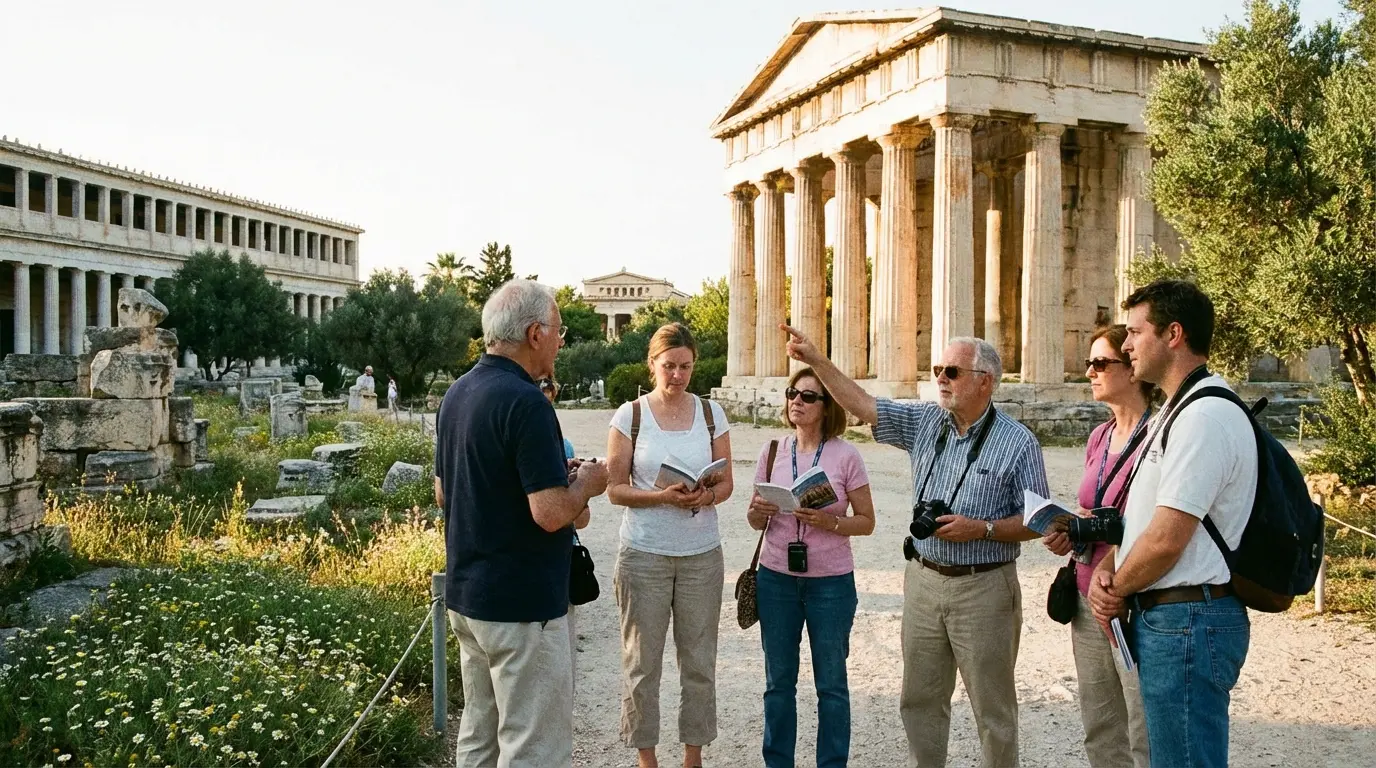
For a Christian congregation, Greece means Paul’s missionary route. Athens, Corinth, Thessaloniki, Philippi, Berea. It means standing where the Apostle preached, where the early church took root, and where two of the most studied epistles in the New Testament were addressed.
For interfaith groups or communities that draw from both traditions, Greece offers something almost no other destination can: the chance to walk both paths in the same trip, in the same cities.
As someone who has been building heritage journeys for more than forty years, I want to share what I know about planning this trip well, no matter which tradition your community calls home.
For Jewish Groups: Building Around Thessaloniki, Rhodes, and Ioannina
The Jewish heritage itinerary in Greece centers on three cities, each representing a different chapter of Jewish life in the Diaspora.
Thessaloniki is the anchor. Before the war, it was roughly half Jewish, one of the great Sephardic centers of the world. The Jewish Museum, the Monastir Synagogue, and the Holocaust memorial sites need at least two full days to experience properly.
Rhodes adds the island dimension. La Juderia, one of the best-preserved Jewish quarters in Europe, and the Kahal Shalom Synagogue, the oldest in Greece still in active use, are deeply moving. A day and a half on Rhodes is well spent.
Ioannina, in the mountains of northwestern Greece, is where the Romaniote Jewish tradition, entirely separate from the Sephardic world, has survived for over two thousand years. It takes some effort to get there. It is worth it.
What Jewish Groups Often Underestimate About Greece
The most common thing I hear from rabbis after a Greece trip is that they did not expect the history to be this deep. Greece is not Israel. It is not Poland. But the Jewish story here is enormous, and it is almost unknown. The Sephardic civilization of Thessaloniki alone is one of the great stories of the Diaspora, and most congregants will be encountering it for the first time. That means the leader’s role as educator and guide becomes especially important. Plan for that.
The other thing to know is that these sites are not heavily touristed. You will not be competing with crowds. You will often have a synagogue or memorial site to yourselves. That changes the quality of the experience in ways that are hard to overstate.
For Christian Groups: Following Paul’s Footsteps
Paul’s second missionary journey through Greece is one of the best-documented travel routes in the ancient world, and the places he visited are remarkably well-preserved.
Athens and Corinth vs. Thessaloniki and Philippi: Choosing Your Route
This is the first decision a Christian group leader needs to make, and it is worth thinking about carefully.
The southern route, Athens and Corinth, gives you the Areopagus where Paul delivered his famous sermon, the ancient marketplace of Corinth where he worked and preached, and the bema where he stood before Gallio. This route connects powerfully to Acts 17 and 18 and is ideal for groups studying Paul’s engagement with the Greco-Roman world.
The northern route, Thessaloniki and Philippi, takes you to the cities where Paul established his earliest European congregations. In Philippi, you walk the ruins of the Roman colony where Lydia was baptized and where Paul was imprisoned. In Thessaloniki, you visit the early Christian churches and connect with the community Paul addressed in his epistles.
Most groups of seven days or more can do both. But if your time is limited, choosing the route that connects to what your congregation is studying or preaching through will make the trip far more meaningful than trying to cover everything.
For Interfaith or Mixed Groups: Where the Two Traditions Overlap
Thessaloniki is the single most important city in Greece for interfaith heritage groups, and the reason is simple: both traditions have deep roots there.
Paul came to Thessaloniki and preached in the synagogue. The Jewish community he engaged with had been there for centuries. He wrote two epistles to the Thessalonian church he planted. Meanwhile, the Sephardic Jewish community that later grew in Thessaloniki became one of the largest and most significant in the world.
For a group that includes both Jewish and Christian members, visiting Thessaloniki together creates a shared encounter with history that is genuinely rare. Both communities can see their own tradition reflected in the same city, and the conversation that emerges from that shared experience is one of the most valuable things a heritage journey can offer.
Group Size, the Free Leader Benefit, and How the Math Works
If you are a spiritual leader considering a Greece heritage trip for your congregation, the financial structure matters. Here is how it works.
Group leaders travel free with fifteen or more participants. That means if you bring a group of fifteen from your congregation, your flights, hotels, ground transportation, and site entry fees are covered. You travel at no personal cost.
For a congregation, this changes the calculation. The leader does not need to justify the personal expense. The group shares the cost of a professionally built itinerary. And the leader is free to focus entirely on guiding the spiritual and educational experience rather than managing travel expenses.
Groups typically range from fifteen to forty participants. Smaller groups of ten to fourteen are possible but do not qualify for the free leader benefit. If you are unsure whether your community can fill a group of fifteen, it is worth starting the conversation early, and the complete guide for group leaders walks through how to build interest and structure the planning from the first announcement. Many leaders are surprised by the interest once the destination and purpose are clear.
What to Look for in a Tour Operator for Greece
Greece is not a simple destination to plan well. Athens is straightforward. But building an itinerary that includes Thessaloniki, Rhodes, Ioannina, or the northern Pauline sites requires local knowledge, reliable ground operators, and the ability to customize.
Here is what matters when evaluating a tour operator for a faith-based group trip to Greece.
First, do they understand the difference between a Jewish heritage itinerary and a Christian heritage itinerary in Greece? These are not the same trip. If an operator offers one standard Greece package for all groups, that is a signal they do not understand the destination at the level your community deserves.
Second, do they have ground operators in the smaller cities? Anyone can book a hotel in Athens. Arranging meaningful access to the synagogue in Ioannina or coordinating a group visit to Nea Anchialos requires relationships on the ground.
Third, do they build around the leader? Your role as pastor or rabbi is to guide your community through a spiritual experience. The operator’s job is to make everything else invisible. If the planning process feels like you are doing the operator’s work for them, something is wrong.
At Heritage Tours, we have been doing this for decades, and Greece is a destination we know deeply. Many leaders who plan a Greece journey also lead church group trips to Israel, and the two pair naturally over time. If you are considering this journey, we would welcome the conversation.
Frequently Asked Questions for Group Leaders
What is the best Greece heritage tour route for a Jewish group? The core route for a Jewish heritage group is Thessaloniki (two to three days), Rhodes (one to two days), and Ioannina (one day). Athens can be included as a starting or ending point with a visit to the Jewish Museum of Greece. This itinerary covers all three of Greece’s distinct Jewish traditions: Sephardic Thessaloniki, Sephardic Rhodes, and Romaniote Ioannina.
Is Paul’s missionary route in Greece suitable for a Christian church group? Very much so. The route from Philippi to Thessaloniki to Athens to Corinth follows Paul’s second missionary journey and connects directly to Acts 16 through 18 and the epistles to the Thessalonians, Corinthians, and Philippians. The archaeological sites are well-preserved and deeply meaningful for congregations studying the New Testament.
How many people do I need for the group leader to travel free? Fifteen participants. With a group of fifteen or more, the group leader’s full travel costs, including flights, hotels, ground transportation, and site entry, are covered.
Can a mixed Jewish-Christian group visit Greece together? Yes, and Thessaloniki is where this works best. The city holds both one of the most important Jewish heritage stories in Europe and a foundational early Christian community established by Paul. Groups with members from both traditions often find that sharing this city creates a depth of dialogue that would not happen at a single-tradition destination.
How far in advance should I book a Greece group heritage tour? Six to nine months is ideal for groups of fifteen to thirty. Larger groups or trips timed around specific dates, such as Orthodox Easter or the Jewish holidays, should plan nine to twelve months ahead. Earlier planning also gives the leader more time to build interest within the congregation.