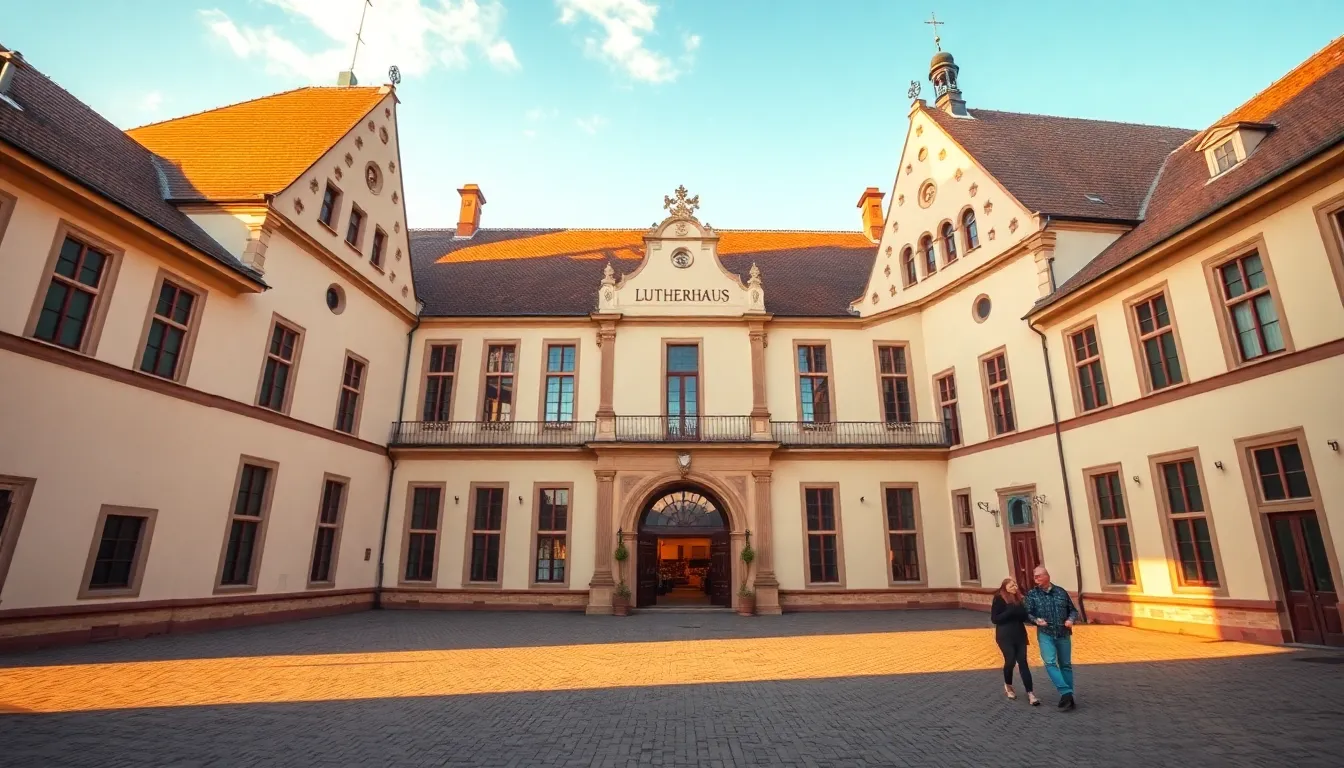
There is a moment that happens in almost every group I bring to the Lutherhaus. We walk into the wood-paneled living room where Luther ate his meals and talked late into the night with his students, and someone, usually one of the quieter members of the group, will say, “He actually lived here. This was his kitchen table.” That is the gift of the Luther House. The Castle Church gives you the moment the Reformation was announced. The Luther House gives you the man who lived it out, day after day, as a husband, a father, a teacher, and a believer wrestling with God.
I have led faith groups through Wittenberg for years, and I tell every pastor and educator the same thing: do not treat the Luther House as a quick stop. It is the largest museum of Reformation history anywhere in the world, and it deserves the heart of your day. Let me walk you through it the way I walk a group, so you can plan the visit well and know what to point your people toward.
What the Lutherhaus Actually Is
The building began life as an Augustinian monastery, the very monastery Luther entered as a monk after his arrival in Wittenberg. When the monastic community dissolved during the Reformation, the Elector of Saxony gave the building to Luther as a private home. He lived here for the rest of his life, and after he married Katharina von Bora, a former nun, in 1525, the old monastery became a bustling family household.
That history is worth pausing on with a group. The same building that housed Luther as a celibate monk later housed Luther the married father of six. It became a center of hospitality, with students, refugees, visiting scholars, and orphaned relatives all coming and going. Katharina ran the household, managed the finances, brewed beer, farmed land, and kept the whole operation afloat while Luther wrote and taught. The Luther House is as much her story as his, and good group leaders make sure that comes through.
Today the building is the world’s largest museum dedicated to the history of the Reformation, holding an enormous collection of original documents, artworks, and personal objects. It is a UNESCO World Heritage Site, and it is the place where the abstract theology of the Reformation becomes a human life you can walk through.
What to See Inside
The museum is large, and a group can easily spend two to three hours here without rushing. These are the spaces I make sure my groups do not miss.
The Lutherstube
The Lutherstube, the family living room, is the heart of the house and the highlight for most groups. This is the wood-paneled room where Luther held the long, freewheeling conversations later collected by his students and published as the “Table Talk.” The tiled stove, the original paneling, the table, all of it survives. I always slow my groups down here. This is the room where the human Luther comes closest. Standing in it, you understand that the Reformation was not produced in a lecture hall alone. It was talked through over meals, in this room, with students and family present.
The Original Manuscripts and Early Printings
The museum holds an extraordinary collection of original documents, including Luther’s own writings and early printed editions of his German Bible translation. For educators especially, this is gold. You can show your group the physical objects through which Reformation ideas actually spread: the printed page, the German Scripture, the pamphlets that carried Luther’s arguments to ordinary readers. I cover the story of how Luther came to translate the New Testament in my guide to Wartburg Castle, where that translation was done, and seeing the early printed Bibles here brings that story full circle.
The Cranach Artworks
Lucas Cranach the Elder, Wittenberg’s great painter and Luther’s close friend, is well represented in the museum. His portraits of Luther, Katharina, and the leading Reformers gave the movement its visual identity, and his workshop produced images that spread across Germany alongside the printed word. For a group, the Cranach portraits make the cast of characters real. These are not abstract names. They are faces.
The Indulgence Chest and Reformation Artifacts
Among the museum’s most striking objects is an indulgence chest, the kind of strongbox used to collect the payments that so troubled Luther. Standing in front of it, the abstract theological dispute over indulgences becomes concrete. This is the object the whole controversy turned on. I find groups grasp the 95 Theses far more clearly after they have seen what an indulgence sale actually involved.
How I Lead a Group Through the House
A few practices from years of doing this, offered in case they help your planning.
Give It the Time It Needs
The single most common mistake I see is under-scheduling the Luther House. Groups arrive with forty-five minutes left in the day and rush through the world’s largest Reformation museum. Plan for two to three hours, and put it at a point in your day when your group still has energy. I usually place it in the afternoon, after the Castle Church and the Town Church, so the house pulls the whole story together.
Tell Katharina’s Story
Most of your group will arrive knowing Luther and knowing almost nothing about Katharina von Bora. The Luther House is the place to change that. Her management of the household, her business sense, her role in turning a former monastery into a model of Protestant family life, all of it reframes how a group understands the Reformation’s effect on ordinary life. Marriage, family, and household became theological statements, and Katharina embodied that.
Connect It Back to the Town
The Luther House does not stand alone. It is the third leg of the Wittenberg story, alongside the Castle Church where the 95 Theses were posted and the wider town where Luther preached and taught. I frame it for groups as the place where everything they have seen comes home, literally, to the house where Luther lived all of it out.
Practical Notes for Group Leaders
The Lutherhaus sits at the eastern end of Wittenberg’s historic core, a short walk from the market square and the other Luther sites. The museum is well organized for visitors and does not rush people through, which is exactly why you should not over-schedule the rest of your day around it. Allow two to three hours. The building has multiple floors and exhibition spaces, so check accessibility in advance if your group includes members with mobility needs.
For pastors and educators planning a Reformation trip, it is worth knowing that with Heritage Tours the group leader travels free with fifteen or more participants. For a church or school building a Wittenberg-centered journey, that changes the planning conversation in a real way and makes the trip easier to fill.
You can see how the Luther House fits into a full Reformation route on our Germany destination page, and our Germany spiritual sites overview maps the wider landscape of faith sites across the country. To understand how the group-leader experience works, take a look at our group heritage tours.
FAQ: The Luther House Museum
What is the Luther House in Wittenberg?
The Lutherhaus is the former Augustinian monastery where Martin Luther lived as a monk and, later, as a married man with his wife Katharina von Bora and their children. Today it is the largest museum of Reformation history in the world and a UNESCO World Heritage Site, holding original manuscripts, early Bible printings, Cranach artworks, and personal objects from Luther’s household.
How long should a group spend at the Luther House?
Plan for two to three hours. It is a large museum with multiple floors and an extensive collection, and it does not rush visitors. Groups that allow only forty-five minutes end up missing most of what makes the visit meaningful. I usually place it in the afternoon, after the Castle Church and Town Church, so it ties the day’s story together.
What are the highlights inside the Luther House?
The Lutherstube, the wood-paneled family living room where Luther held his “Table Talk” conversations, is the highlight for most groups. Other key sights include original manuscripts and early printed Bibles, Cranach portraits of Luther and the Reformers, and an indulgence chest that makes the dispute behind the 95 Theses concrete.
Who was Katharina von Bora, and why does she matter at the Luther House?
Katharina von Bora was a former nun who married Luther in 1525 and ran the large household at the Luther House. She managed the finances, the farm, and the constant flow of students and guests. Her story reframes how a group understands the Reformation’s impact on family and daily life, and the Luther House is the best place to tell it.
Is the Luther House suitable for groups with mobility needs?
The museum is well organized but spans multiple floors and exhibition spaces in a historic building. Check accessibility arrangements in advance if your group includes members with mobility needs, so you can plan the route through the house accordingly.