Germany as Sacred Ground, More Than One Story
When people think of Germany and faith, they usually think of one thing. If they are Jewish, they think of the Holocaust. If they are Christian, they think of Martin Luther. Both are right, but both are incomplete.
Germany is where Ashkenazi Jewish civilization was born. It is where the Protestant Reformation split the Christian church. It is where the 20th century forced every faith tradition to confront what happens when a society abandons its moral foundations. These are not three separate stories. They happened in the same towns, on the same streets, sometimes in the same buildings.
A faith group that visits Germany and sees only one of these layers misses the others. And the others are what make the trip stay with you.
For Jewish Groups: Synagogues, Cemeteries, and the Sites of Remembrance
The New Synagogue, Berlin
The New Synagogue on Oranienburger Strasse was Berlin’s grandest Jewish house of worship when it opened in 1866. It survived Kristallnacht partly because a local police officer intervened, but Allied bombing during the war destroyed most of the building. What stands today is a partial reconstruction, its golden dome visible from blocks away.
Inside, the permanent exhibition traces Berlin’s Jewish community from its peak through destruction and into the slow, complicated present. For a rabbi leading a group, this is not a museum visit. It is a conversation about what it means for Jewish life to return to a place where it was nearly erased.
Worms Synagogue and the Rashi Chapel, Scholarship That Shaped Judaism
The synagogue in Worms is one of the oldest in Europe, dating to 1034. The Rashi Chapel, attached to the synagogue complex, is where Rabbi Shlomo Yitzchaki studied in the 11th century. His commentaries on the Torah and Talmud remain foundational to Jewish learning today.
Standing in the Rashi Chapel is a quiet experience. The room is small, stone-walled, and simple. But for Jewish groups, knowing that one of the tradition’s greatest minds worked in this room gives it a weight that larger, grander sites cannot match. The old Jewish cemetery in Worms, with headstones dating to the 11th century, is steps away.
Holocaust Memorials as Sacred Space
Berlin’s Memorial to the Murdered Jews of Europe is not a synagogue or a cemetery, but it functions as sacred space. The 2,711 concrete pillars create a disorienting, solemn landscape. There are no instructions for how to walk through it. The underground Information Center beneath it holds the names and brief biographies of known victims.
The Sachsenhausen concentration camp memorial, north of Berlin, and Dachau, near Munich, are places where the ground itself carries memory. These are not tourist attractions. They are places of witness. For a spiritual leader, the question is not whether to include them but how to prepare your group for what they will feel there.
For Christian Groups: The Reformation Trail and Beyond
Lutherstadt Wittenberg, Where the Church Changed Forever
On October 31, 1517, Martin Luther posted his 95 Theses on the door of the Castle Church in Wittenberg. Whether he actually nailed them or simply mailed them to his bishop is a matter of historical debate. What is not debatable is that this small town in eastern Germany became the birthplace of the Protestant Reformation.
The Lutherhaus, where Luther lived and taught, is now the world’s largest museum dedicated to the Reformation. The Town Church of St. Mary’s, where Luther preached, still holds services. For a pastor leading a Protestant group, standing in these spaces is a return to the source.
Cologne Cathedral, A Thousand Years of Christian Architecture
Cologne Cathedral took over 600 years to build. Its twin spires rise 157 meters above the Rhine, and for centuries it was the tallest structure in Europe. Inside, the Shrine of the Three Kings has drawn Christian pilgrims since the 12th century.
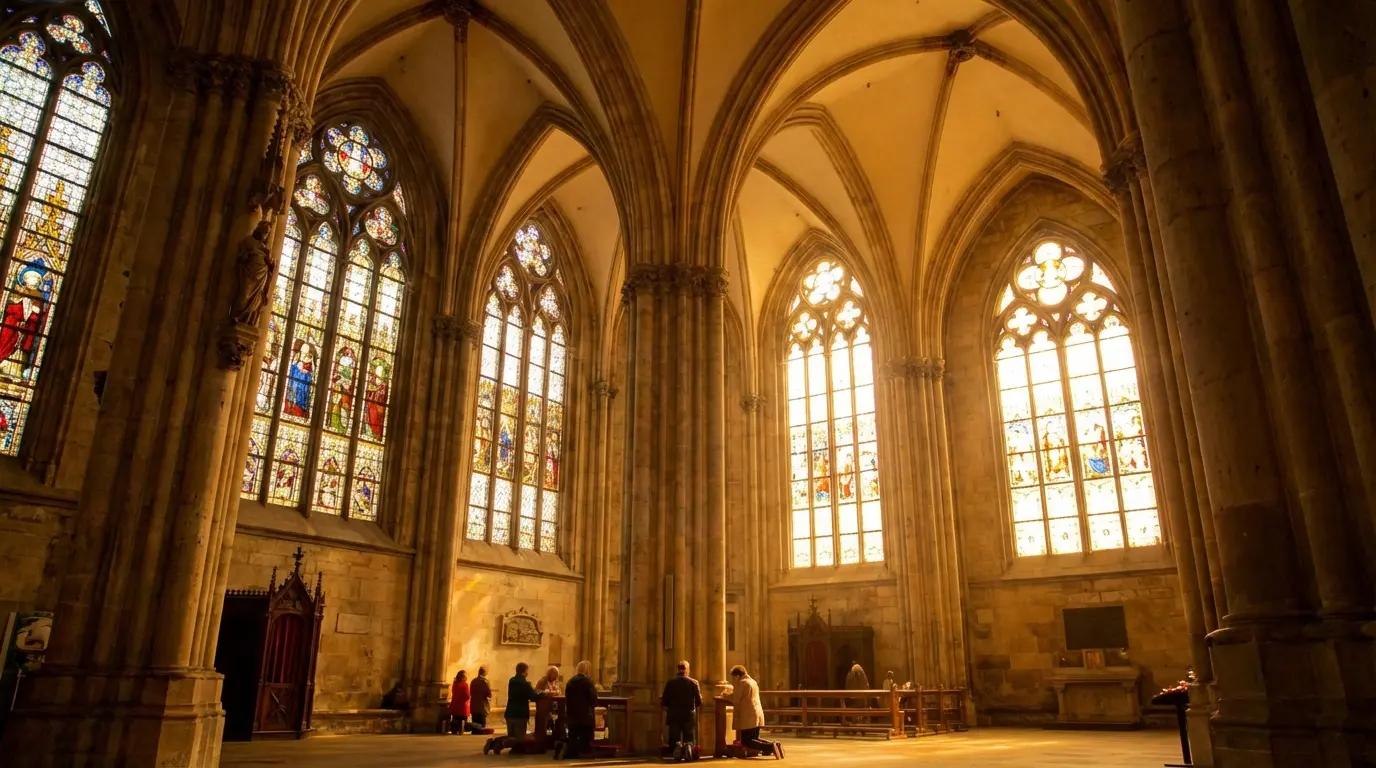
For Christian groups, Cologne Cathedral is a place where architecture itself becomes theology. The sheer scale of the building, the light through the stained glass, the knowledge that generations of builders gave their lives to something they would never see completed. A group that visits in the early morning, before the tour crowds arrive, will feel the weight of the place.
Rothenburg ob der Tauber and the Medieval Christian World
Rothenburg is the most intact medieval town in Germany, and it offers Christian groups a window into the world that Luther was born into. The St. James Church contains the famous Holy Blood Altar by Tilman Riemenschneider, one of the great works of late medieval religious art.
Walking Rothenburg’s walls and streets gives a group the physical context for understanding medieval Christian life in a way that no textbook can.
Sites That Speak to Both Traditions
The Topography of Terror, A Universal Witness to Human Choices
Built on the site where the Gestapo and SS had their headquarters, the Topography of Terror is not about one faith tradition. It is about what happens when a state decides to destroy human dignity systematically. The exhibition is clear, factual, and unflinching.
For interfaith groups, or for any group that includes both Jewish and Christian members, this is the site where shared reflection happens most naturally. The questions it raises belong to everyone: How did ordinary people participate? What does resistance look like? What is the responsibility of faith communities when governments turn violent?
How to Frame These Sites Spiritually for Your Group
If you are a rabbi or pastor planning to bring your community to Germany, you already know that this is not a regular trip. The sites listed above are not checkboxes. Each one asks something of the people who visit it.
My advice, after twenty years of guiding groups through these places: do not try to visit them all. Choose the sites that speak to your community’s story. Give each one enough time for your group to sit with what they see. Build in moments for conversation, for prayer if that is part of your tradition, for silence if it is not.
The most powerful heritage trips I have seen are the ones where the spiritual leader slowed down. Where they let a site do its work instead of rushing to the next one.
If you are beginning to plan a heritage trip to Germany for your congregation, we would welcome the chance to help you think through which sites matter most for your group. Start with our Germany destination page and go from there.
Frequently Asked Questions
What is the most spiritually significant Jewish site in Germany?
For many Jewish groups, the Worms Synagogue and Rashi Chapel hold the deepest significance because they connect to a living intellectual tradition, not only to destruction. The ShUM cities of the Rhine Valley (Worms, Speyer, Mainz) represent the birthplace of Ashkenazi Jewish life and scholarship.
Is Lutherstadt Wittenberg worth a full day for a Christian group?
Yes. The Lutherhaus museum alone takes two to three hours to appreciate properly. Add the Castle Church, the Town Church, and the Luther Garden, and a full day passes easily. For Protestant groups especially, this is not a site to rush.
How do Holocaust memorial sites fit into a spiritual journey?
They fit because they demand the questions that faith exists to answer. Why do people do this to each other? Where was God? What is our responsibility now? A spiritual leader who frames the visit around these questions, rather than treating it as a history lesson, gives their group a way to process what they see.
Can a mixed Jewish and Christian group share a meaningful Germany itinerary?
Absolutely. In fact, some of the most powerful trips we have organized have been interfaith. The sites themselves tell an intertwined story. Jewish and Christian history in Germany are not parallel lines. They cross, and the places where they cross are where the deepest conversations happen.
What is the Rashi Chapel in Worms and why does it matter?
The Rashi Chapel is a small study room attached to the Worms Synagogue, named for Rabbi Shlomo Yitzchaki, known as Rashi, who studied there in the 11th century. Rashi’s commentaries on the Torah and Talmud are still used by Jewish students and scholars worldwide. The chapel matters because it is one of the few surviving physical links to the golden age of Jewish scholarship in medieval Europe.