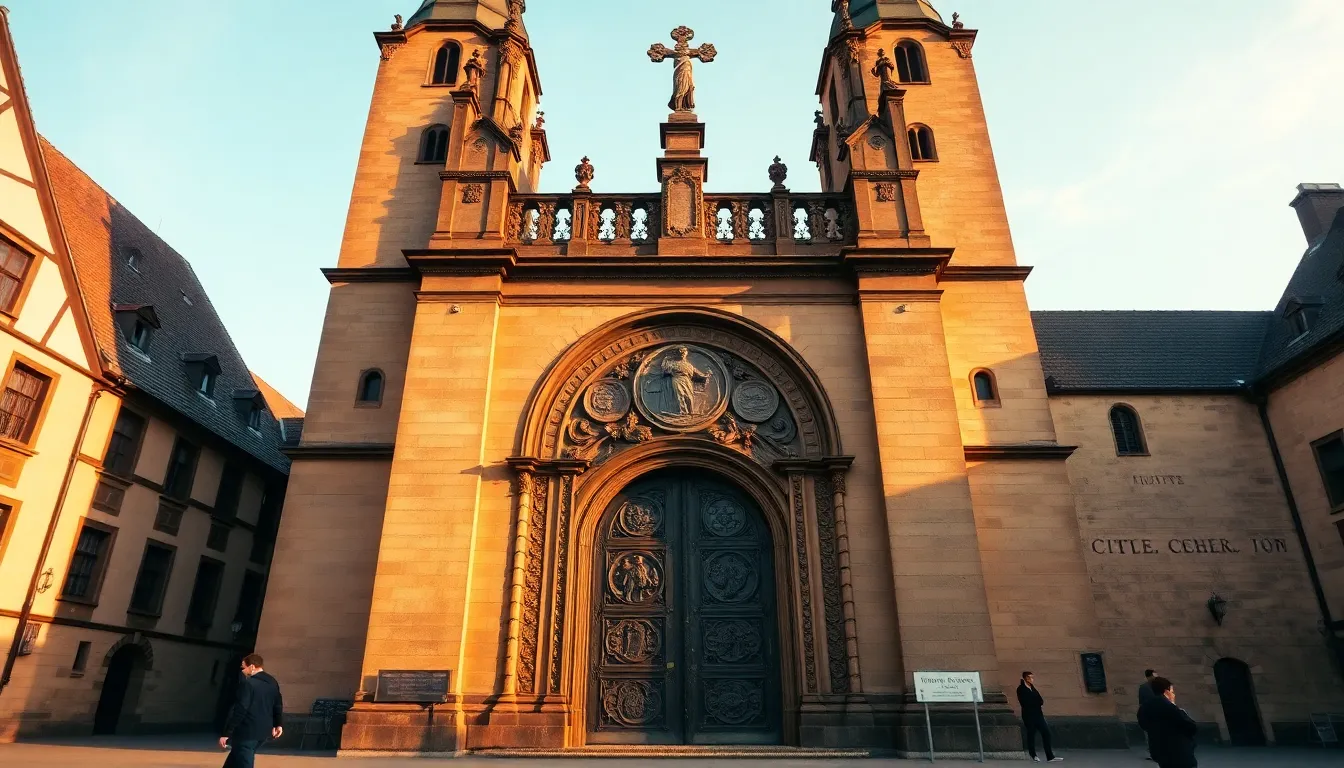
People come to the Castle Church in Wittenberg expecting a door. They have seen the image their whole lives: a monk with a hammer, a sheet of paper, a defiant blow against the church. So when I bring a group to the Schlosskirche and we stand in front of the bronze doors, I usually start by clearing a few things up. The truth of what happened here is more interesting than the legend, and it tells your group something real about how the Reformation actually began.
I have led faith groups through this church many times, and it never loses its weight. This is the place where, on October 31, 1517, an obscure theology professor posted ninety-five points for academic debate and, without intending to, lit the fuse on a movement that split Western Christianity. If your congregation’s story runs through the Reformation, this is one of the few places on earth where you can stand at the exact origin point.
Let me give you the history straight, walk you through what to see inside, and share how I prepare a group so the visit lands the way it should.
What Actually Happened in 1517
Start with the door, because that is what everyone asks about. In Luther’s time, the wooden north door of the Castle Church served as the university’s notice board. Scholars posted announcements there, including invitations to academic disputations. When Luther posted his 95 Theses, in Latin, he was doing something ordinary: proposing a formal debate among scholars on a specific question.
The question was indulgences. The church was selling certificates that promised to reduce the punishment due for sins, both for the living and for souls believed to be in purgatory. A Dominican friar named Johann Tetzel was running an aggressive sales campaign nearby, with proceeds going partly toward the rebuilding of St. Peter’s Basilica in Rome. Luther, reading Scripture closely as a professor, had become convinced this practice misled ordinary believers and contradicted the gospel. His theses argued that forgiveness comes from God’s grace, not from a purchased certificate.
Here is the part that matters for understanding why Wittenberg changed history. Luther expected an academic debate. What he got was a printing revolution. Within weeks, his Latin theses were translated into German, printed, and distributed across the country. A scholarly notice became a public movement faster than anyone, Luther included, could control. The historical debate over whether he physically nailed the paper or mailed it first to his archbishop is real, but it misses the larger point: the press, not the hammer, is what made October 31, 1517 a turning point.
The Building You See Today
The church Luther knew is not entirely the church you visit now. The original Castle Church was badly damaged during the Seven Years’ War in the 18th century, and a fire destroyed the famous wooden Theses Door. The building was reconstructed and restored over the following centuries, with major work completed in the late 1800s for the anniversary celebrations of the Reformation.
So when I bring a group, I am honest with them: you are not looking at the original 1517 door, and the interior has been reshaped over time. That honesty matters. A heritage trip built on inflated claims does not serve a congregation. What you are standing in is the authentic site, faithfully rebuilt, holding the actual graves of the Reformation’s founders. That is more than enough.
The Theses Door
The bronze doors installed in 1858 carry the full Latin text of the 95 Theses cast into the metal. They were a gift commissioned to mark the site’s significance. I gather my groups here first, outside, and tell the story of 1517 before we go in. It helps people separate the legend from the history, and it sets the tone for a thoughtful visit rather than a photo stop.
The Graves of Luther and Melanchthon
Inside, near the pulpit, you will find the grave of Martin Luther, who died in 1546, marked by a bronze plaque set into the floor. Across from him lies Philipp Melanchthon, his closest colleague, the brilliant young scholar who organized Reformation theology into a coherent system and drafted the Augsburg Confession. Standing between these two graves is, for many groups, the emotional center of the whole Wittenberg visit. I always build in quiet time here. Some pastors read Scripture, some lead a short prayer, some simply let the group stand in silence. The site rewards stillness.
The Tower and the Interior
The Castle Church tower rises over the town and bears the inscription of Luther’s hymn “A Mighty Fortress Is Our God,” which gives the building much of its symbolic power. The tower can be climbed for a view over Wittenberg, though the stairs are steep and narrow, so I set expectations with my groups before anyone commits to the climb. Inside, statues and memorials to Reformation figures line the church, and the overall effect is less a typical place of worship and more a monument to the movement that began at its door.
How I Bring a Group Through It
A few practices I have learned over many visits, shared in case they help your planning.
Tell the Story Outside First
Do not walk a group straight inside. Stand at the bronze door and explain what really happened in 1517 before anyone forms the wrong impression. Groups that understand the academic origin of the theses, and the role of the printing press, come away with a far richer sense of the Reformation than groups who only absorb the hammer-and-nail legend.
Give the Graves Time
The graves of Luther and Melanchthon deserve more than a passing glance. This is where I build in a pause, whether for reading, prayer, or silence. Rushing this moment wastes the most powerful part of the visit.
Pair It with the Town’s Other Sites
The Castle Church is one stop on a story that runs the length of Wittenberg’s main street. It pairs naturally with the Town Church where Luther preached and the wider Wittenberg story, and with the Luther House where he lived. I always frame the Castle Church as the announcement of the Reformation, the Town Church as where it was lived out in worship, and the Luther House as where the man behind it comes into focus. That framing gives a group a clear arc through the day.
Practical Notes for Group Leaders
The Castle Church sits at the western end of Wittenberg’s historic core, an easy walk from the train station and from the town’s other Luther sites. Mornings are best for a quieter visit; outside the major anniversary years, you can often have the interior nearly to yourselves before the day-tour groups arrive. Allow at least an hour, more if your group wants time at the graves and a climb up the tower.
For pastors and educators weighing a Reformation pilgrimage, it is worth knowing that with Heritage Tours the group leader travels free with fifteen or more participants. For a church building a trip around Wittenberg and the Luther sites, that makes the planning conversation with your congregation considerably easier.
You can see how the Castle Church fits into a full Reformation route on our Germany destination page, and our Germany spiritual sites guide maps the wider landscape of faith sites across the country. To understand how the group-leader experience works, take a look at our group heritage tours.
FAQ: The Castle Church and the 95 Theses
Did Luther really nail the 95 Theses to the Castle Church door?
Historians debate it. The church’s north door served as the university notice board, so posting theses there was the normal way to invite academic debate. Some accounts say Luther nailed the document; others suggest he first sent it to his archbishop. What is certain is that the theses were posted at the Castle Church on October 31, 1517, and that the printing press, not the act of posting, turned them into a movement.
Is the original Theses Door still there?
No. The original wooden door was destroyed by fire in the 18th century. The bronze doors you see today were installed in 1858 and carry the full Latin text of the 95 Theses cast into the metal. The site is authentic; the door is a later memorial.
Who is buried in the Castle Church?
Martin Luther and Philipp Melanchthon are both buried inside the church, near the pulpit. Luther died in 1546 and Melanchthon in 1560. Standing between their graves is, for many faith groups, the most moving part of a Wittenberg visit.
What were the 95 Theses actually about?
They challenged the sale of indulgences, certificates that claimed to reduce the punishment due for sins. Luther argued that forgiveness comes through God’s grace, not through purchased certificates, and that the practice misled ordinary believers. He intended an academic debate, but the printing press spread the arguments across Germany within weeks.
How long should a group plan to spend at the Castle Church?
At least an hour. That allows time to hear the story at the bronze door, spend quiet time at the graves of Luther and Melanchthon, and take in the interior. Groups wanting to climb the tower should add more time and know that the stairs are steep and narrow.