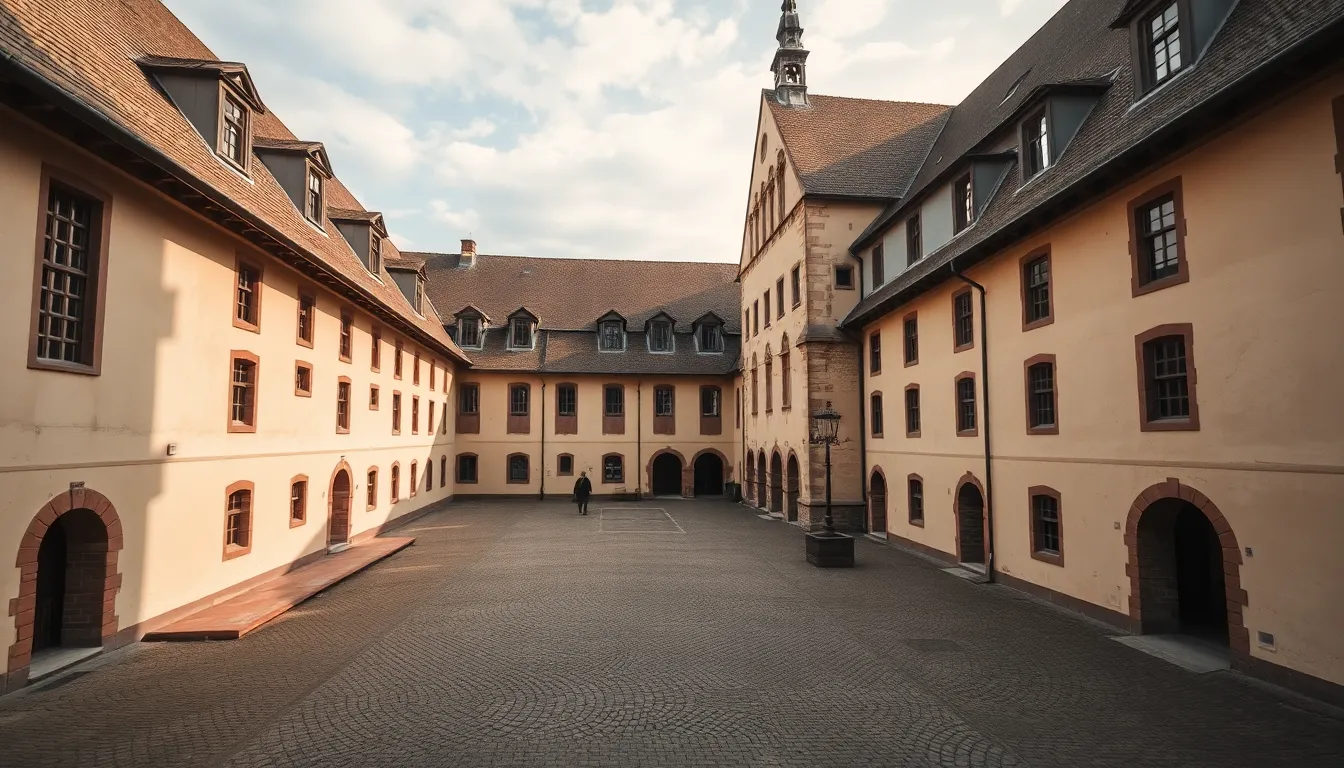
There is a part of Luther’s story that the famous sites tend to skip, and it is the part I most want my groups to understand. Before the 95 Theses, before Wittenberg, before he was a Reformer at all, Luther was a frightened young law student caught in a thunderstorm who cried out in terror, “Help me, Saint Anne, and I will become a monk.” He kept that vow. He walked into the Augustinian Monastery in Erfurt, gave up his promising legal career, and spent years as a monk wrestling with a question that would eventually reshape Christianity: how can a sinful person ever be right with a holy God?
Erfurt is where that wrestling happened. I bring faith groups here, and I tell pastors and educators that this is the missing piece. The public Luther, the bold Reformer who defied the church, only makes sense once you have stood in the monastery where the private Luther nearly broke under the weight of his own conscience. This is the cradle of the Reformation, the place where the question that produced it was first asked.
Let me give you the history, walk you through the sites, and explain how I plan an Erfurt visit.
The Thunderstorm and the Vow
In July 1505, Luther was a young man on a clear career path. He had completed his master’s degree and was studying law at the University of Erfurt, one of the most important universities in Germany at the time, at his father’s insistence. Then, traveling near the village of Stotternheim, he was caught in a violent thunderstorm. A bolt of lightning struck near him and threw him to the ground. Terrified for his life and his soul, he cried out to Saint Anne and vowed to become a monk.
Two weeks later, against his father’s furious objections, he entered the Augustinian Monastery in Erfurt. He gave up law. He gave up the life his family had planned. For a group, this moment is worth lingering on, because it shows that the Reformation did not begin with a confident reformer. It began with a young man in genuine spiritual dread, making a desperate promise and then keeping it at great personal cost.
Luther’s Years as a Monk
Inside the monastery, Luther threw himself into the religious life with an intensity that alarmed even his fellow monks. He fasted, prayed, confessed his sins for hours, and punished his body, all in a furious effort to make himself acceptable to God. And it did not work. The harder he tried, the more aware he became of his own failings. He later wrote that he came to hate the God he could never satisfy.
He was ordained a priest in Erfurt Cathedral in 1507. The story goes that at his first Mass, overwhelmed by the thought of standing before a holy God, he nearly could not continue. This is the spiritual crisis that drove everything that came later. The question that tormented Luther in the Erfurt monastery, how a sinner can stand before God, is the exact question his eventual answer, justification by faith alone, was meant to resolve. The Reformation was, at its root, one anxious monk’s resolution of a problem that nearly destroyed him.
I make sure my groups understand this connection. When they later stand at the Castle Church in Wittenberg where the 95 Theses were posted, I want them to remember the monastery in Erfurt, because the theology that exploded in Wittenberg was forged in the monk’s cell here.
What to See in Erfurt
Erfurt is one of the best-preserved medieval cities in Germany, largely spared the wartime destruction that flattened so many German towns. For a faith group, that means the streets Luther walked are genuinely the streets you walk. These are the sites I prioritize.
The Augustinian Monastery
The Augustinerkloster, the Augustinian Monastery, is the heart of an Erfurt visit. This is where Luther lived as a monk, and the complex, including the church, the cloister, and the cell areas, remains a working religious site and a place of pilgrimage. Standing in the quiet of the cloister, a group can feel the world Luther was trying to live up to. The monastery offers tours and has long been a center for reflection and ecumenical encounter. I always build in time here for stillness. After hearing the story of Luther’s spiritual struggle, simply standing where it happened does more than any commentary I could add.
Erfurt Cathedral
The Erfurt Cathedral, the Mariendom, rising on its hill above the city alongside the Church of St. Severus, is where Luther was ordained a priest in 1507. It is a magnificent Gothic structure and one of the most striking cathedral settings in Germany, reached by a broad flight of steps from the square below. For a group, standing where Luther was ordained, knowing the spiritual dread he carried to the altar, makes the cathedral far more than an architectural marvel.
The Merchants’ Bridge and the Medieval City
The Kramerbrucke, the Merchants’ Bridge, is one of Erfurt’s signature sights, a medieval bridge lined with inhabited shops and houses, one of very few of its kind in Europe. While not a Luther site directly, it gives a group the texture of the prosperous medieval city Luther knew as a student. I use a walk across it and through the old town to help groups picture the world Luther stepped out of when he entered the monastery.
How I Plan an Erfurt Visit
A few practical notes from leading groups here, shared to help your planning.
Tell the Thunderstorm Story First
Do not let your group reach the monastery without knowing the vow that brought Luther to it. The whole site depends on that story. I tell it early, often before we even arrive, so that when we walk into the cloister, the group understands they are standing in the place where a terrified young man kept a desperate promise.
Frame Erfurt as the Beginning
Erfurt is chronologically the start of Luther’s spiritual journey, and I always frame it that way for groups. It pairs naturally with Eisenach, where Luther went to school as a boy, which comes even earlier, and it sets up everything that follows in Wittenberg and at the Wartburg, where he later translated the Bible. Presenting Erfurt as the beginning of the arc helps a group see the Reformation as a life unfolding, not a single dramatic event.
Build In Quiet Time at the Monastery
The Augustinian Monastery is still a place of prayer and reflection, and it rewards a slower pace. I always reserve time for the group simply to sit in the cloister or the church. Pastors often lead a short devotion here. The contrast between Luther’s anxious striving and the peace he eventually found in grace is a theme that lands powerfully in this exact setting.
Practical Notes for Group Leaders
Erfurt is the capital of Thuringia and a well-connected rail hub, reachable by direct train from Frankfurt, Berlin, and other major cities, which makes it an excellent base for a Reformation route through central Germany. From Erfurt, both Eisenach and the Wartburg are a short train ride away, so many groups use Erfurt as a hub for the whole Thuringian leg. The historic center is compact and walkable, with the monastery, the cathedral, and the Merchants’ Bridge all within easy reach. The main physical demand is the steps up to the cathedral. Allow at least half a day for the Luther sites in Erfurt, more if you want unhurried time at the monastery.
For pastors and educators planning a Reformation pilgrimage, it helps to know that with Heritage Tours the group leader travels free with fifteen or more participants. For a church building a Thuringia-based trip through the Luther sites, that makes the planning conversation with your congregation considerably easier.
You can see how Erfurt fits into a full Reformation route on our Germany destination page, and our Germany spiritual sites overview maps the wider landscape of faith sites across the country. To understand how the group-leader experience works in practice, take a look at our group heritage tours.
FAQ: Erfurt and Luther the Monk
Why did Luther become a monk in Erfurt?
In July 1505, Luther was a young law student caught in a violent thunderstorm near Erfurt. Terrified, he vowed to Saint Anne that he would become a monk if his life was spared. Two weeks later, against his father’s wishes, he entered the Augustinian Monastery in Erfurt, giving up his legal career. That vow is where his religious life began.
What did Luther do during his years in Erfurt?
He lived as an Augustinian monk, throwing himself into fasting, prayer, and confession in an intense effort to make himself right with God. He was ordained a priest in Erfurt Cathedral in 1507. His failure to find peace through religious striving drove the spiritual crisis that eventually led to his Reformation insight of justification by faith alone.
Can you visit the monastery where Luther lived?
Yes. The Augustinerkloster, the Augustinian Monastery, remains a working religious site and a place of pilgrimage. The church, cloister, and grounds can be visited, and the monastery offers tours. It is a center for reflection and ecumenical encounter, and it rewards groups who build in quiet time rather than rushing through.
Where was Luther ordained a priest?
Luther was ordained in Erfurt Cathedral, the Mariendom, in 1507. The cathedral, a striking Gothic structure on a hill above the city, is reached by a broad flight of steps. For a faith group, standing where Luther was ordained, knowing the spiritual dread he carried to the altar, gives the site real weight.
Where does Erfurt fit in a Reformation itinerary?
Erfurt comes near the start of Luther’s spiritual journey, the place where he became a monk and was ordained. It pairs with Eisenach, where he went to school as a boy, and sets up the later sites at Wittenberg and the Wartburg. Erfurt is also a well-connected rail hub, which makes it an ideal base for the whole Thuringian leg of a Reformation trip.