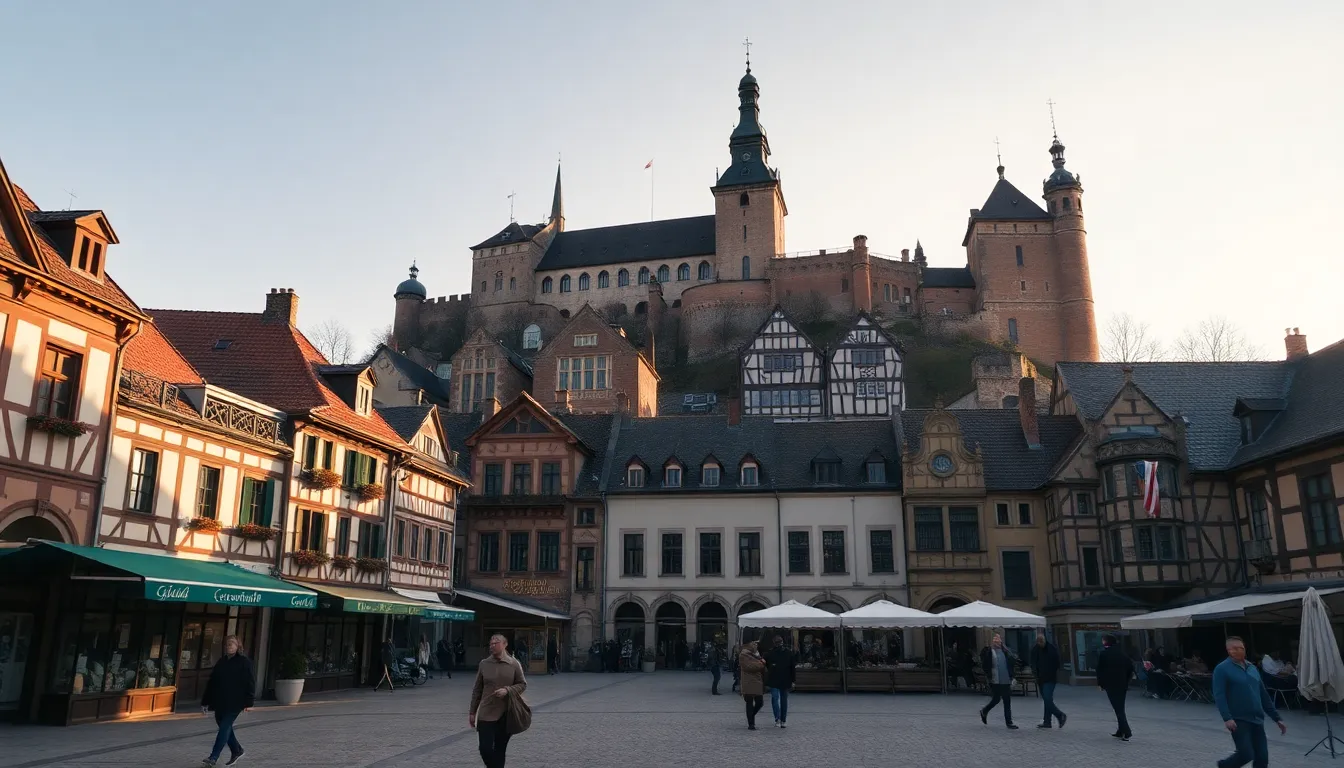
Most groups come to Eisenach for the Wartburg. The castle on the hill above town is the headline, and rightly so. But I always tell pastors and educators not to treat Eisenach itself as a parking lot for the castle. The town has its own story, and it is one of the most human chapters in Luther’s whole life. This is where he came as a teenage schoolboy, far from home, sang for his supper in the streets, and was taken in by a family that showed him kindness when he had little. Long before he was a Reformer, Luther was a boy in Eisenach. That story, told well, changes how a group sees the man.
I have led faith groups through this corner of Thuringia for years, and Eisenach paired with the Wartburg makes one of the richest single days on any Reformation itinerary. You get Luther’s boyhood, his Bible translation, and, because this is also the birthplace of Johann Sebastian Bach, the way Reformation faith flowed forward into some of the greatest sacred music ever written. Let me walk you through it.
Luther the Schoolboy
Luther arrived in Eisenach around 1498, at roughly fifteen, to attend the Latin school of St. George. His family had connections in the area, and Eisenach offered a better education than what was available closer to his home in Mansfeld. These were formative years. He studied grammar, rhetoric, and music, and he sang in the church choir, an experience that gave him a lifelong love of music that later shaped Protestant worship.
There is a well-known tradition that the young Luther, like many poor students of the time, sang in the streets for bread and was taken in by a local woman, Ursula Cotta, and her family, who gave him a place at their table. Whether every detail of the Cotta story holds up to scrutiny, it reflects something true about Luther’s Eisenach years: he was a young student of modest means, dependent on the kindness of others, finding his footing. I tell this story to groups because it grounds the towering Reformer in a recognizable human experience. Every educator in the group has known a student like the young Luther.
He later called Eisenach “my beloved town.” That affection is part of what makes the place worth visiting on its own terms.
What to See in Eisenach
The town is compact and walkable, with its medieval market square at the center and the Wartburg rising on the hill above. These are the sites I make sure my groups see.
The Lutherhaus Eisenach
Eisenach has its own Luther House, the half-timbered home connected to the family that housed him during his school years. It is one of the oldest and best-preserved half-timbered houses in Thuringia, and today it holds a modern museum focused on Luther, the Bible, and the power of translation. It pairs beautifully with the Wartburg, where Luther actually did his New Testament translation, because here in town the museum explores why translating Scripture into the language of the people mattered so much. For a group, seeing the boyhood town and the translation theme together makes the whole arc click.
The Bach House and the Bach Connection
Eisenach is the birthplace of Johann Sebastian Bach, born here in 1685. This is no footnote for a faith group. Bach was a devout Lutheran whose music was, in his own understanding, an act of worship. He signed many of his works “Soli Deo Gloria,” to God alone be the glory. His cantatas, his Passions, his chorales took Reformation theology, the same convictions Luther fought for, and carried them into sound. The Bachhaus museum in Eisenach tells his story and regularly features live demonstrations on historic instruments.
I always frame the Bach connection for groups as the Reformation’s long echo. Luther insisted that ordinary people should sing the faith in their own language, and he wrote hymns himself, including “A Mighty Fortress Is Our God.” Two centuries later, in the same town where Luther went to school, Bach was born to turn that conviction into music that still fills churches and concert halls worldwide. For a congregation, that thread from Luther to Bach is genuinely moving.
The Market Square and St. George’s Church
The heart of old Eisenach is its market square, ringed by historic buildings and anchored by the Church of St. George, where Luther sang in the choir as a boy and where, much later, members of the Bach family served as musicians. The church ties the two great Eisenach stories together in a single building. Standing in it, a group can hold both: the schoolboy who sang here, and the musical dynasty that worshiped here.
The Wartburg Above the Town
No account of Eisenach is complete without the Wartburg, the castle on the ridge that defines the town’s skyline. It is where Luther, years after his schooldays, hid as an outlaw and translated the New Testament, and it is a UNESCO World Heritage Site with nearly nine centuries of history. I cover the castle in full in my guide to the Wartburg and Luther’s Bible translation, so I will keep it brief here, but the key point for planning is this: Eisenach and the Wartburg belong together. Most groups visit the town in the morning and the castle in the afternoon, or the reverse, and treat the two as one combined day. That is how I plan it, and it works.
How I Structure the Day
A few practical notes from many trips through Eisenach, offered to help your planning.
Town in the Morning, Castle in the Afternoon
I usually start in town while everyone is fresh, covering the Lutherhaus, the Bach House, the market square, and St. George’s Church. Then we head up to the Wartburg in the afternoon. The climb to the castle is easier to take on after a relaxed morning in town than first thing, especially for groups with older members.
Lean Into the Music
If your group includes musicians, or simply people who love sacred music, build time at the Bach House and ask about live instrument demonstrations. The connection between Luther’s theology of congregational singing and Bach’s sacred music is one of the most rewarding threads on the whole Reformation route, and Eisenach is the one place where you can tell it in full.
Connect Eisenach to the Wider Arc
Eisenach sits in the middle of Luther’s life story. The beginning runs through Erfurt, where he became a monk, and the public turning point runs through Wittenberg, where the Reformation began. I make sure groups understand where Eisenach fits in that arc, so the schoolboy story and the Wartburg translation read as two chapters of one life.
Practical Notes for Group Leaders
Eisenach sits on the main rail line through Thuringia, reachable by train from Frankfurt, Erfurt, and other hub cities, which makes it a natural stop on a Reformation route through central Germany. The historic core is compact and walkable. The one demanding element is the climb to the Wartburg, which involves a shuttle and a stretch on foot, so plan that part carefully for groups with mobility needs. Allow a full day for Eisenach and the Wartburg combined.
For pastors and educators planning a Reformation pilgrimage, it is worth knowing that with Heritage Tours the group leader travels free with fifteen or more participants. For a church or school building a Thuringia-based trip, that makes the planning conversation with your congregation a good deal easier.
You can see how Eisenach fits into a full Reformation route on our Germany destination page, and our Germany spiritual sites overview maps the wider landscape of faith sites across the country. To understand how the group-leader experience works, take a look at our group heritage tours.
FAQ: Eisenach and Luther
What is Eisenach’s connection to Martin Luther?
Luther attended the Latin school of St. George in Eisenach as a teenager, around 1498, and sang in the church choir there. He later called it “my beloved town.” Years afterward, as a condemned outlaw, he hid at the Wartburg Castle above Eisenach and translated the New Testament into German. The town holds both his boyhood story and his Bible translation.
Is Eisenach worth visiting beyond the Wartburg?
Yes. The town has its own Lutherhaus museum focused on the Bible and translation, the market square and St. George’s Church where Luther sang as a boy, and the Bachhaus, birthplace museum of Johann Sebastian Bach. For a faith group, Eisenach in the town plus the Wartburg above it makes one of the richest days on a Reformation itinerary.
Why does Bach matter on a Reformation trip?
Johann Sebastian Bach was born in Eisenach in 1685 and was a devout Lutheran who understood his music as worship, signing works “to God alone be the glory.” His sacred music carried Reformation theology, including Luther’s conviction that people should sing the faith in their own language, into some of the greatest church music ever written. The Luther-to-Bach thread is one of the most moving on the route.
How much time should a group spend in Eisenach?
Plan a full day for Eisenach and the Wartburg together. I usually spend the morning in town, covering the Lutherhaus, the Bachhaus, the market square, and St. George’s Church, then head up to the Wartburg in the afternoon. Treating the town and castle as one combined day gives a group the complete picture.
How do you reach Eisenach?
Eisenach is on the main rail line through Thuringia and is reachable by train from Frankfurt, Erfurt, and other hub cities, which makes it a practical stop on a Reformation route through central Germany. The historic center is walkable; the main physical demand is the climb up to the Wartburg, which uses a shuttle and a final stretch on foot.