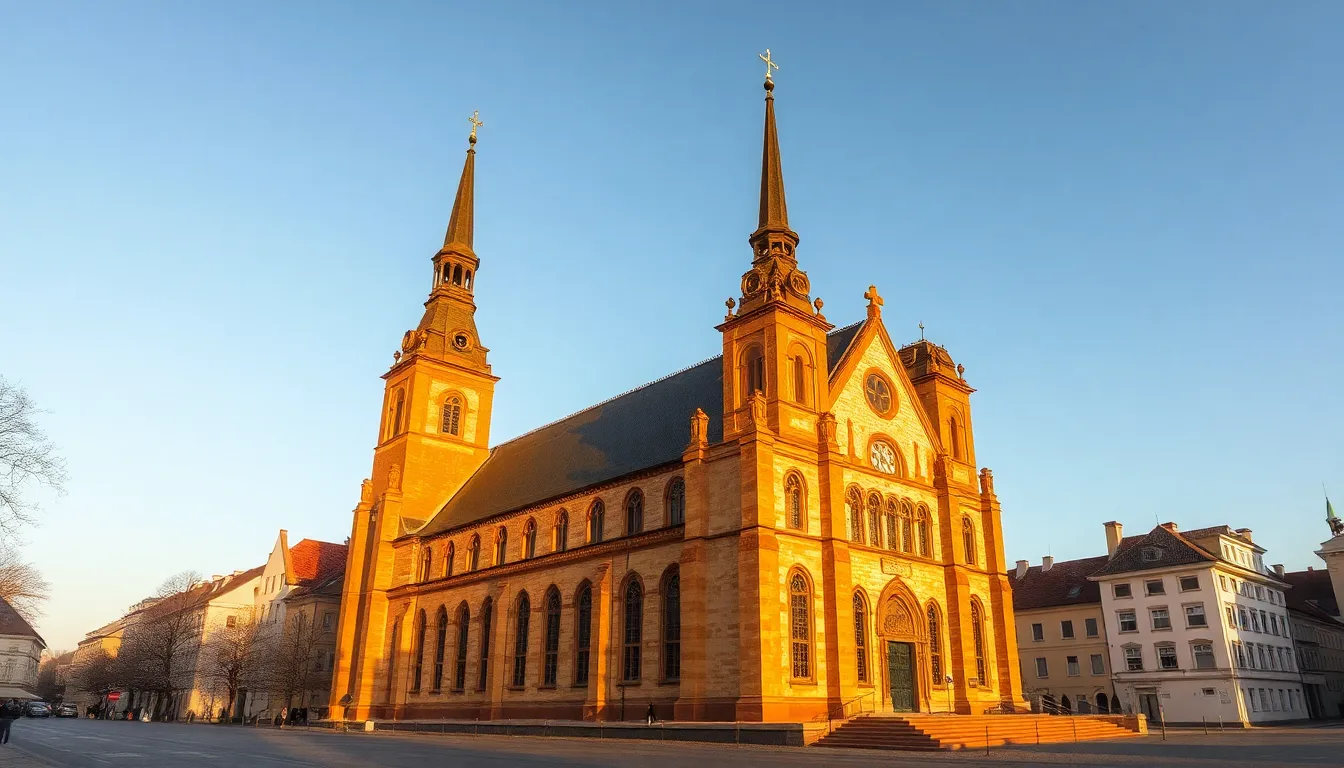
Most groups I bring to Germany want Luther, and Luther deserves the attention. But there is a site that gets skipped far too often, and skipping it leaves a hole in the story. Augsburg is where the Reformation grew up. It is where loose protest became a written confession of faith, and where, twenty-five years later, an exhausted empire finally agreed that Protestants had a legal right to exist. If Worms is the moment of courage, Augsburg is the moment of definition and the moment of survival.
I tell pastors this: your people have probably heard “the Augsburg Confession” their whole lives without knowing what it is or where it came from. Bringing them to the city where it was presented, and explaining what actually happened, fills in a piece of their own tradition they have been carrying around half-understood. That is a gift you can give a group, and Augsburg is a beautiful city to give it in.
Two Augsburg Moments You Need to Separate
People blur two different events that both happened in Augsburg, twenty-five years apart. Keep them straight for your group and the whole thing snaps into focus.
The first is the Augsburg Confession of 1530, the founding statement of Lutheran faith. The second is the Peace of Augsburg of 1555, the political settlement that let Protestants and Catholics coexist legally in the empire. One is a confession of belief. The other is a treaty about power. Together they tell how the Reformation went from a movement under threat to a recognized faith.
The Augsburg Confession, 1530
By 1530, the Reformation was nearly thirteen years old and the empire was divided and tense. Emperor Charles V, back in Germany after years away, called a diet at Augsburg and asked the Protestant princes to explain, in writing, exactly what they believed. He wanted clarity, and perhaps reconciliation.
Luther himself could not attend. He was still under the imperial ban from Worms and remained at the Coburg fortress nearby, close enough to advise but unable to appear. So the task of drafting fell to Philipp Melanchthon, Luther’s brilliant and more diplomatic colleague. Melanchthon produced a careful, irenic document, twenty-eight articles laying out the Lutheran position, written to emphasize common ground with the old church where it honestly existed and to state the differences plainly where it did not.
On June 25, 1530, the Augsburg Confession was read aloud before the emperor and the assembly, in German, so everyone present could understand it. The Protestant princes signed it, putting their names and their territories on the line. It became the defining statement of Lutheran belief and remains a foundational confessional document for Lutheran churches worldwide to this day.
I want group leaders to feel the weight of that date, June 25, 1530. This is not Luther shouting at a church door. This is sober men of rank saying, in writing, before the most powerful man in Europe: this is what we believe, and we will not pretend otherwise. The Confession turned a protest into a church.
The Peace of Augsburg, 1555
The Confession did not end the conflict. It hardened the lines. The following decades brought war between Catholic and Protestant forces in the empire. Finally, in 1555, exhausted and unable to crush the Protestant princes by force, the empire reached a settlement at another diet in Augsburg.
The Peace of Augsburg established the principle later summarized in Latin as cuius regio, eius religio, “whose realm, his religion.” Each prince could decide whether his territory would be Catholic or Lutheran, and subjects were generally expected to follow their ruler’s choice or emigrate. It was not religious freedom in the modern sense. Calvinists and other groups were left out, and individuals had little personal choice. But it was the first time the empire legally accepted that Protestantism would not be stamped out. For your group, the point is simple and large: this is where the Reformation won the legal right to survive.
The Sites in Augsburg
Augsburg is one of Germany’s oldest cities, founded by the Romans, and its historic center is rich and walkable. A few sites carry the Reformation story directly.
St. Anne’s Church
St. Anne’s Church, the Annakirche, is the essential Reformation stop in Augsburg. It was here, at the Carmelite monastery attached to St. Anne’s, that Luther stayed in 1518 when he was summoned to Augsburg to be questioned by Cardinal Cajetan, the papal legate. That confrontation, two years before Worms, was an early turning point. Luther again refused to recant, and he had to slip out of the city to avoid arrest.
St. Anne’s later became Protestant and today houses a museum on the Reformation, sometimes called the Lutherstiege, the Luther staircase. For a group, it is the place to anchor the whole Augsburg story. You can stand where Luther faced Cajetan and trace the road from that early questioning to the Confession of 1530.
The Town Hall and the Golden Hall
Augsburg’s Renaissance Town Hall, built shortly after the Reformation period, is one of the great secular buildings of its age, and its Golden Hall is spectacular. While the Confession itself was presented at the bishop’s palace, the Town Hall gives groups a sense of the wealth and civic confidence of the city where these diets were held. Augsburg in this era was one of the richest cities in Europe, home to the Fugger banking family, and that wealth is part of why imperial diets met here.
The Fuggerei
If your schedule allows, the Fuggerei is worth seeing and ties neatly into a faith conversation. Founded in 1521 by Jakob Fugger as housing for the needy, it is one of the world’s oldest social housing complexes still in use. The token annual rent has barely changed in five centuries, and residents are asked to pray for the founders. It is a striking example of charity and faith expressed in stone, in the same city and the same era as the Confession.
Visiting Augsburg as a Group
Augsburg sits in Bavaria, on the so-called Romantic Road, and pairs well with a southern Germany itinerary. Plan most of a day. Center your visit on St. Anne’s Church and the Reformation museum, add the Town Hall and Golden Hall, and include the Fuggerei if time allows.
Augsburg deepens any Reformation journey because it shows the movement maturing. It pairs naturally with Worms, where Luther made his stand, and with Eisleben, his birthplace, and it fits within the broader Reformation pilgrimage route. For the wider map of Germany’s sacred sites, see our Germany spiritual sites guide.
My teaching tip: at St. Anne’s, walk your group through the three Augsburg moments in order. The 1518 questioning by Cajetan, the 1530 Confession, the 1555 Peace. Early threat, formal definition, eventual survival. Told that way, in the city where all three happened, the Reformation stops being only about one dramatic monk and becomes the story of how a faith was confessed, contested, and finally allowed to live.
FAQ: The Augsburg Confession
What is the Augsburg Confession?
The Augsburg Confession is the founding statement of Lutheran faith, presented to Emperor Charles V at the Diet of Augsburg on June 25, 1530. Drafted mainly by Philipp Melanchthon, it lays out the Lutheran position in twenty-eight articles. It remains a foundational confessional document for Lutheran churches worldwide.
Why did Luther not present the Augsburg Confession himself?
Luther was still under the imperial ban issued at Worms in 1521, which made him an outlaw, so he could not safely attend the Diet of Augsburg. He stayed at the nearby Coburg fortress, advising by letter, while Philipp Melanchthon drafted and the Protestant princes presented the Confession.
What was the Peace of Augsburg?
The Peace of Augsburg, signed in 1555, was the political settlement that legally allowed Catholic and Lutheran territories to coexist in the Holy Roman Empire. It established the principle that each prince could determine the religion of his own territory. It was not full religious freedom, but it was the first legal recognition that Protestantism would survive.
What is the main Reformation site to see in Augsburg?
St. Anne’s Church, the Annakirche, is the key stop. Luther stayed at its attached monastery in 1518 when he was questioned by Cardinal Cajetan. The church later became Protestant and now houses a Reformation museum, making it the natural place to anchor a group visit.
How does Augsburg fit into a Reformation tour?
Augsburg shows the Reformation maturing from protest into a defined and legally recognized faith. It pairs well with Worms, Eisleben, and Wittenberg, and it sits in Bavaria on the Romantic Road, making it convenient for a southern Germany itinerary. Plan most of a day for the city.
Augsburg is the chapter most groups have never been taught, and watching people connect “the Augsburg Confession” to a real place is one of the quiet joys of guiding here. If you want help working it into your itinerary, I would be glad to talk it through. Group leaders travel free with fifteen or more participants. Start with our Germany destination page, see how our group heritage tours work, and contact us when you are ready.