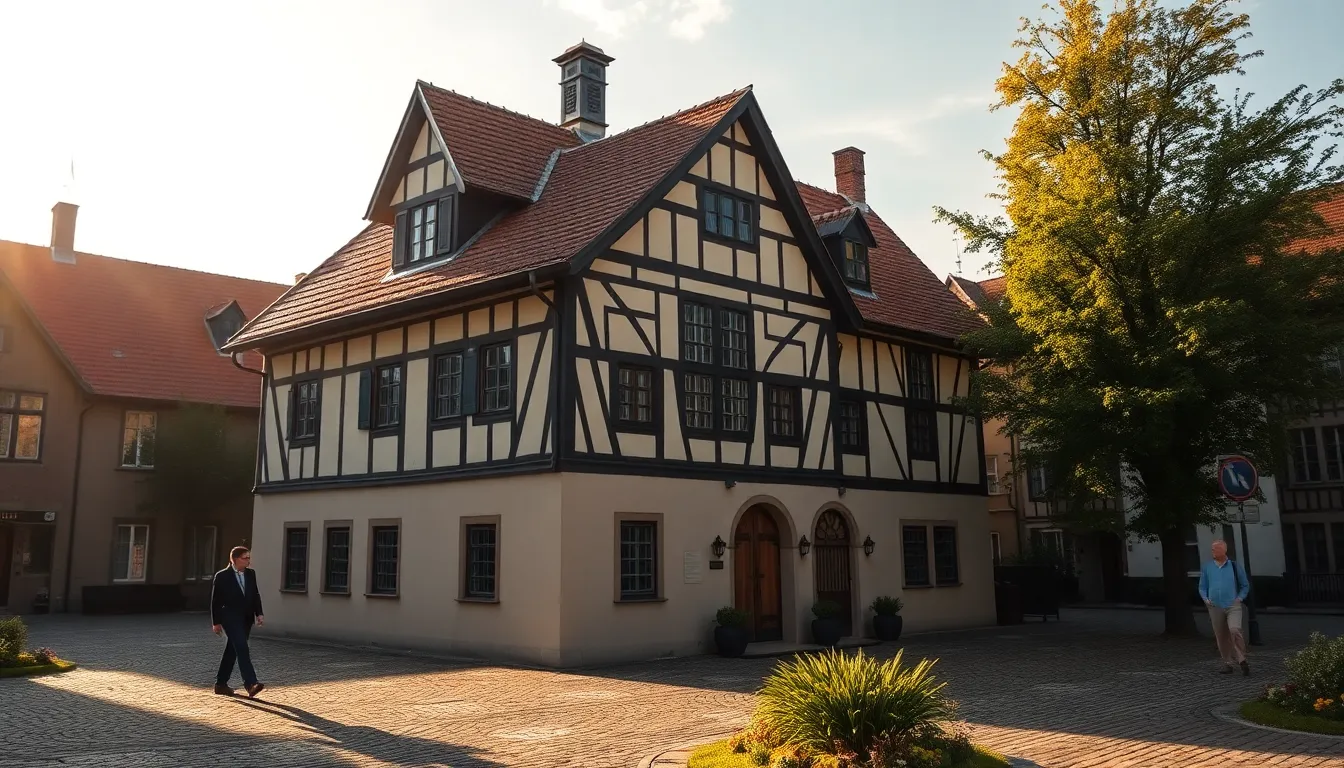
There is a strange and moving fact about Eisleben that I always save for the group until we are standing in the town. Martin Luther was born here in 1483. And he died here in 1546. The man who changed the course of Western Christianity entered and left the world in the same small mining town in Saxony-Anhalt, sixty-two years apart. Most people who built movements like his are scattered across the map. Luther’s life is bracketed by one place.
When I tell a group that, you can see them recalculate what Eisleben is. Not a footnote between the bigger sites. A bookend. The town holds both his beginning and his end, and walking from the house where he was born to the house where he died is, for a faith group, one of the quietest and most powerful things you can do in Germany.
Why Eisleben Matters in the Luther Story
Eisleben sits in the Mansfeld region, copper-mining country. Luther’s father, Hans Luder, was a miner who worked his way up to part-owner of smelting operations. The family was not wealthy at first and not peasant either, somewhere in the striving middle. That background matters. Luther’s later understanding of work, of ordinary callings, of God’s grace reaching common people, grew partly out of where he came from.
The family moved to nearby Mansfeld when Martin was an infant, so he was not raised in Eisleben. But Eisleben, together with Mansfeld, formed the world of his childhood, and the town carried his birth as a point of pride long before he was famous. Today both the Birth House and the Death House are part of the UNESCO World Heritage listing of Luther Memorials, and they anchor any serious Reformation itinerary.
Born in 1483, Baptized the Next Day
Luther was born on November 10, 1483. He was baptized the following morning, November 11, the feast day of Saint Martin of Tours, which is how he got his name. That baptism took place at the Church of Saints Peter and Paul in Eisleben, and the church still stands. For a group, this is a meaningful stop. The man who would reshape Christian teaching on baptism, grace, and faith was himself baptized as an infant the day after he was born, in a font you can see today. The church has been developed in recent years as a center on the theme of baptism, which fits the place perfectly.
The Luther Birth House
The Birth House, Luthers Geburtshaus, is the oldest Luther memorial in Germany. People began treating it as a place of remembrance not long after his death. A fire damaged the original in 1689, and the building was reconstructed, so what you see is not untouched from 1483. But the site is authentic and the museum inside is excellent.
The exhibition walks through late medieval daily life, the world of a mining family, childhood and schooling in Luther’s era, and the religious atmosphere that shaped a boy who would grow up terrified of judgment and hungry for grace. For group leaders, this is the value of the Birth House. It is not about relics. It is about understanding the ordinary world that produced an extraordinary life. I find it helps younger travelers especially. They see that Luther was a real child in a real family, not a stained-glass figure.
What to Point Out to Your Group
Spend time on the section about Luther’s anxieties as a young man. The fear of death and damnation that drove him into the monastery, the famous thunderstorm vow when he cried out to Saint Anne and promised to become a monk, the years of spiritual struggle. The Birth House sets up the whole arc. If your group understands the frightened young Luther here, the breakthrough of grace later in the story means far more. I usually frame it as: this is where the question started. The answer came later, at Wittenberg and in the Scriptures.
The Luther Death House
A short walk away stands Luthers Sterbehaus, the Death House. Here the story closes. In February 1546, Luther traveled to Eisleben, despite poor health, to mediate a dispute between the counts of Mansfeld. He was old, tired, and unwell. He preached his last sermons in the town. On the night of February 17 into the early hours of February 18, 1546, he died.
I should be honest about one historical wrinkle, because your sharper travelers may ask. For a long time a particular house was identified as the exact place of his death, and the museum was built around it. Later research suggested he may actually have died in a different building nearby. The museum today handles this honestly and uses the house to tell the story of his final days and of how the Reformation movement faced the death of its founder.
The Account of His Final Hours
What gives the Death House its weight is the documented account of Luther’s last hours. His friends were with him. He was asked, in a question that mattered enormously to a movement built on his teaching, whether he would die firm in the faith and doctrine he had preached. He answered yes. His last written words, found on a slip of paper, were a humble line: “We are beggars. This is true.” After a lifetime of arguing that salvation comes by grace and not by human achievement, he died insisting on his own emptiness before God.
I read that line to groups in the Death House. It is the whole Reformation in five words. For a pastor, it is hard to find a better closing image of Luther than a man who spent his life telling people they could not earn God’s favor, admitting at the end that he was a beggar too.
Visiting Eisleben as a Group
Eisleben is compact. The Birth House, the Death House, St. Andrew’s Church where Luther preached his final sermons, and the baptism church of Saints Peter and Paul all sit within an easy walk of the market square, where a statue of Luther stands. You can do the town well in half a day.
My strong recommendation is to walk it in order, the way his life ran. Start at the Birth House. Then the baptism church. Then move through the town toward the Death House. Walking the arc of a life from beginning to end, on foot, in one morning, is something a bus tour cannot give you. Group leaders tell me this walk stays with people.
Eisleben fits naturally with the other Luther sites. It pairs especially well with Worms, where Luther made his stand, and it is a key stop on the broader Reformation pilgrimage route. For the wider picture of Germany’s sacred sites, see our Germany spiritual sites guide.
FAQ: Eisleben and Luther
Was Martin Luther born and died in the same town?
Yes. Luther was born in Eisleben on November 10, 1483, and died in Eisleben on February 18, 1546. He was not raised there, since the family moved to nearby Mansfeld when he was an infant, but the town holds both his birth and his death, which makes it a unique stop on any Reformation journey.
What is there to see in Eisleben for a faith group?
The main sites are Luther’s Birth House, his Death House, the Church of Saints Peter and Paul where he was baptized, and St. Andrew’s Church where he preached his last sermons. All are walkable from the market square. A half day covers the town well.
Is Eisleben a UNESCO site?
Yes. The Birth House and Death House in Eisleben are part of the UNESCO World Heritage listing of Luther Memorials in Eisleben and Wittenberg, recognized for their connection to the Reformation.
What were Luther’s last words?
The documented account records his final written words on a small slip of paper: “We are beggars. This is true.” It captures his core teaching, that people stand empty before God and are saved by grace. For groups, it is one of the most powerful things to read aloud in the Death House.
Why did Luther die in Eisleben if he lived in Wittenberg?
He had traveled to Eisleben in early 1546 to help settle a dispute between the local counts of Mansfeld. He was elderly and in poor health, and he died there during the visit. His body was later returned to Wittenberg and buried in the Castle Church.
If you want Eisleben to be more than a quick stop between the bigger names, I can help you build it into a Luther route that follows the arc of his life. Group leaders travel free with fifteen or more participants. Start with our Germany destination page, see how our group heritage tours work, and contact us when you are ready to talk it through.