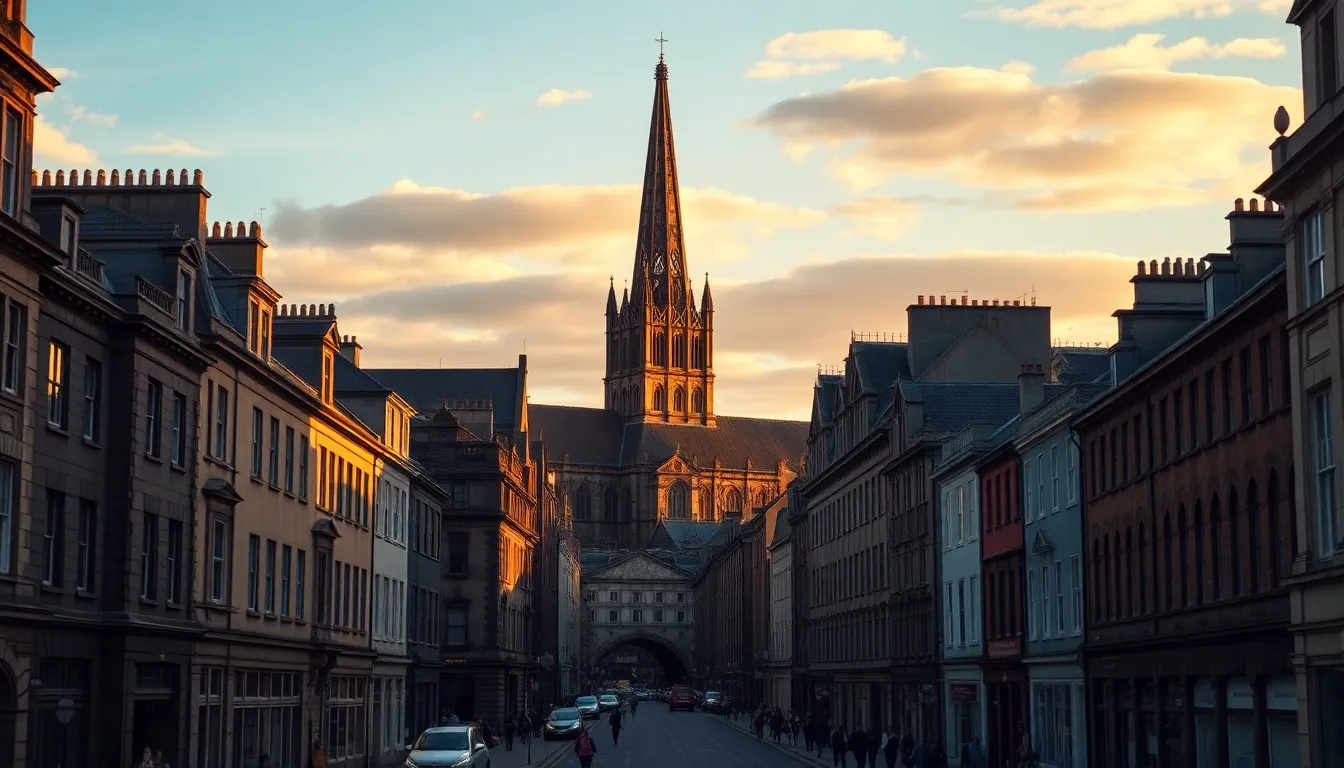
There is one shape on the Edinburgh skyline that I always point out to a group before we get close. About halfway down the Royal Mile, above the grey roofs, sits a stone crown. Not a spire, not a dome, but an open crown of flying buttresses, eight of them, holding up a central tower as if the building is wearing it. That is St Giles’, and once your people have seen the crown, they will spot it from half the city.
When we walk through the door, I tell them the one thing that surprises most visitors. St Giles’ is called a cathedral, but since the Reformation it has not been one in the strict sense. A cathedral is the seat of a bishop, and Presbyterian Scotland did away with bishops. The proper name is the High Kirk of Edinburgh. The “cathedral” title stuck from two short Episcopal periods and from long habit, and nobody minds it now, but it is worth explaining, because the whole story of this building is the story of how Scotland chose its own way of being a church.
Let me walk you through St Giles’ the way I would on the ground.
A Church on the Royal Mile for 900 Years
There has been a church on this site since at least the early twelfth century. The dedication is to Saint Giles, a hermit saint popular across medieval Europe and patron of Edinburgh. The building your group walks into is mostly medieval, with work spanning the fourteenth and fifteenth centuries, though heavy Victorian restoration in the nineteenth century reshaped much of what you see.
The crown steeple is the part everyone remembers. It was completed around 1500, one of only a handful of crown spires that survive in Scotland, and it is the single most photographed feature of the church. I always give a group a minute outside to look up at it before we go in. The open crown is a piece of late-medieval engineering worth slowing down for.
Inside, the space is darker and more solid than people expect. The columns at the heart of the building are medieval and massive. This is not a soaring French Gothic cathedral. It is a strong, plain, Scottish kirk, and that plainness is part of the point.
John Knox and the Scottish Reformation
The reason most faith groups come to St Giles’ is John Knox.
Knox was the driving voice of the Scottish Reformation, and in 1559 he became minister of St Giles’. From this pulpit he preached the reformed faith to the city that decided the country’s direction. In 1560 the Scottish Parliament met nearby and voted to break Scotland from Rome and establish a reformed, Presbyterian church. Knox was at the centre of that, and St Giles’ was his base.
I tell groups to stand still in the nave and picture it. The Reformation in Scotland was not a slow cultural drift. It arrived as a decision, argued from this building, in a specific decade, by a man whose sermons people walked miles to hear. Knox died in 1572 and was buried in the kirkyard. The exact spot is now under the car park behind the church, marked by a small plaque in parking space twenty-three. I usually take a group to see it, because the contrast says something true. The man who reshaped a nation’s faith lies under an unmarked patch of tarmac, and he would have approved of the lack of fuss.
If your people want the wider story of how the reformed faith took root here, it connects directly to our guide on the Scottish Reformation and John Knox, which traces the key sites beyond Edinburgh.
The Jenny Geddes Stool
There is one moment in St Giles’ history that congregations love, and I never skip it.
In 1637, King Charles I tried to force a new prayer book on the Scottish church, an English-style liturgy that many Scots saw as Rome by another name. On the twenty-third of July, as the Dean began to read from it in St Giles’, a woman named Jenny Geddes is said to have picked up her folding stool and thrown it at his head, shouting words to the effect of, “Dare you say the Mass in my ear?”
The stool-throwing set off a riot that spread out of the church and across Scotland. Within months the National Covenant was signed, and the country was on the road to open conflict with the crown over how it would worship. Whether Jenny Geddes was one real woman or a name attached to a wider protest, the story holds. A bronze plaque and a sculpted stool inside St Giles’ mark the spot. For a group, it is a vivid way into a hard truth: ordinary people here were willing to fight over how they prayed. That is the heart of the Covenanter story, which we follow in detail along the Covenanters heritage trail.
The Thistle Chapel
In a building built on plainness, the Thistle Chapel is a deliberate exception, and your group will feel the shift the moment they step into it.
Tucked into the southeast corner, the Thistle Chapel was added in 1911 for the Order of the Thistle, Scotland’s senior order of chivalry. It is small, no bigger than a side room, and it is carved from floor to ceiling. Dark oak, stone vaulting, the stalls of the knights with their heraldic crests above, and if you look closely, a carved stone angel playing the bagpipes. I tell groups to find it. It always gets a smile.
The contrast with the rest of the kirk is the lesson. St Giles’ spent four hundred years stripping ceremony out of worship, and then in one corner, in the twentieth century, it built something intricate and rich for the nation’s knights. Both things are Scotland. The plain kirk and the carved chapel sit a few steps apart, and you can talk to your group about both without contradiction.
How Groups Visit St Giles’
Plan for around forty-five minutes to an hour inside. That gives time for the crown steeple from outside, the nave, the Knox connections, the Jenny Geddes stool, and the Thistle Chapel, without rushing. If your group is tied to the Reformation story, that is your spine: walk them from the pulpit area to the Geddes plaque to Knox’s grave outside, in that order, and the history lands as a sequence rather than a list.
The building is a working place of worship with a regular pattern of services, so check the day’s schedule before you arrive. Groups are welcome, but larger parties should get in touch in advance so a visit does not clash with a service or a private event. There is a small group rate and the option of a guided tour. For a faith group I usually recommend the guided option, because a local guide brings the Covenanter and Reformation detail to life better than a leaflet.
St Giles’ is one stop on a rich Edinburgh day, and it sits naturally alongside the wider spiritual sites of the United Kingdom and our broader picture of travel in the United Kingdom. If you are building a Scotland itinerary with a Reformation and early-church thread, St Giles’ pairs beautifully with Iona Abbey in the west and Melrose Abbey in the Borders, and there are quieter stops worth knowing in our roundup of hidden heritage sites.
When we run St Giles’ as part of a managed group trip, the leader travels free with fifteen or more participants, which makes it straightforward for a pastor or educator to bring a congregation or class without carrying the cost personally.
Practical Access
Location. St Giles’ stands on the High Street, the central stretch of the Royal Mile, between Edinburgh Castle at the top and Holyrood at the bottom. It is one of the easiest landmarks in the city to reach on foot.
Opening. It is open to visitors most days, with hours that vary by season and are adjusted around services. Always check the current week before you commit a group.
Entry and donation. Entry is free, with a suggested donation that helps maintain the building. There is a separate small charge for photography permits and for some guided tours. Budget a few pounds per person if your group wants to take photos freely.
Accessibility. The main floor is broadly accessible and largely step-free at the principal entrance, which matters for older congregations. The Thistle Chapel has a small step or two, so flag that for anyone with mobility needs.
For more on shaping a faith trip across the country, our group tour planning page lays out how we put these days together.
FAQ: St Giles’ Cathedral
Is St Giles’ actually a cathedral? Not in the strict sense. A cathedral is the seat of a bishop, and Presbyterian Scotland did away with bishops at the Reformation. The proper name is the High Kirk of Edinburgh. The “cathedral” title comes from two brief Episcopal periods and long habit, and it has stuck even though there is no bishop’s seat here.
What is the connection to John Knox? John Knox became minister of St Giles’ in 1559 and preached the reformed faith from here during the years Scotland broke from Rome in 1560. He is the central figure most faith groups come to see. He is buried in the old kirkyard, now the car park behind the church, marked in parking space twenty-three.
What is the Jenny Geddes story? In 1637, when a new English-style prayer book was read in St Giles’, a woman named Jenny Geddes is said to have thrown her folding stool at the Dean in protest. The riot that followed helped trigger the National Covenant and the conflict between Scotland and the crown over worship. A plaque and a sculpted stool mark the spot inside.
How much time should a group plan for? Allow forty-five minutes to an hour. That covers the crown steeple from outside, the nave, the Knox and Geddes connections, and the Thistle Chapel without rushing. Larger groups should contact St Giles’ in advance and consider a guided tour.
Is there an entry fee? Entry is free, with a suggested donation. There are small separate charges for photography permits and for some guided tours. For a faith group I usually recommend the guided option for the Reformation and Covenanter detail.
St Giles’ is one of those stops where the history is not behind glass. It is in the pulpit, the plaque on the floor, the grave under the tarmac, and the stone crown over the street. If you are planning a Scotland trip for your congregation or class and want St Giles’ set within a wider Reformation and heritage route, get in touch and we will build the day around your group.