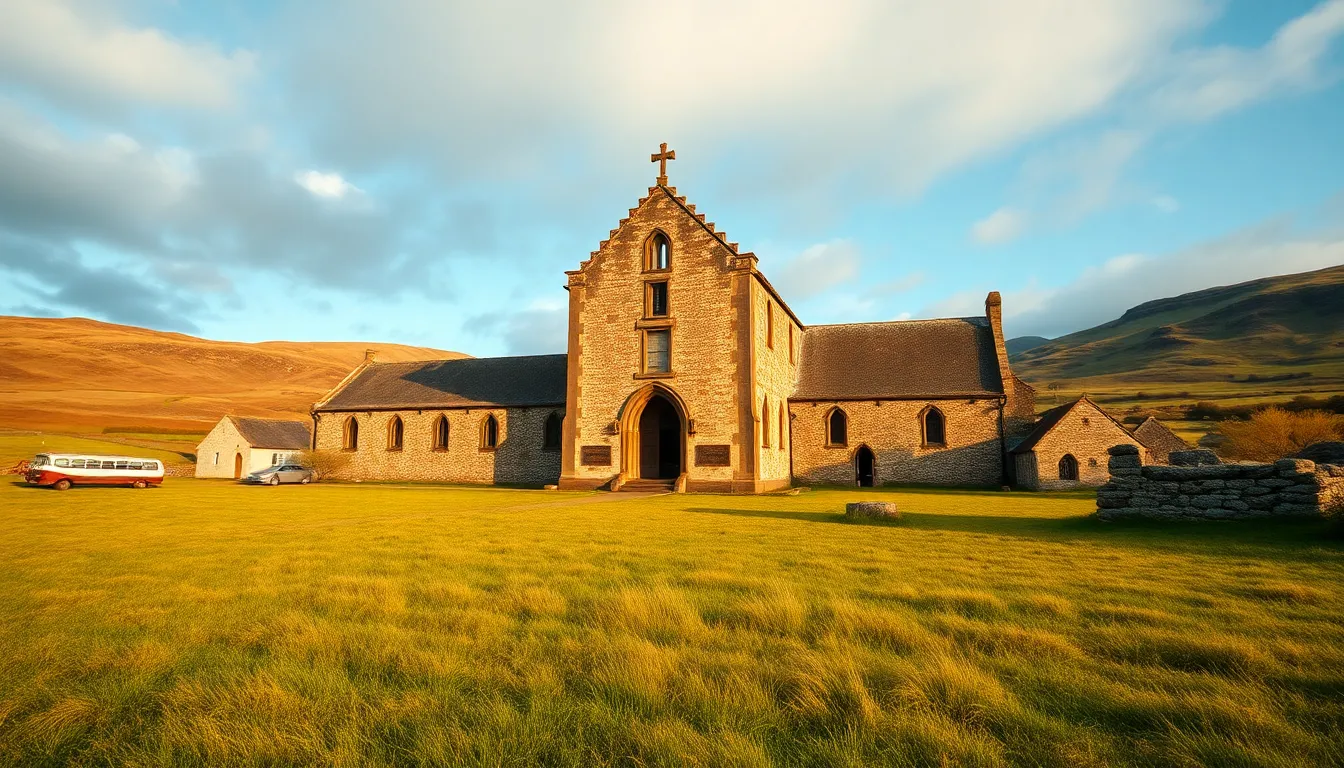
I have brought a lot of groups to a lot of holy places, and most you arrive at by coach, walk into, and walk out of an hour later. Iona is not like that. To stand inside Iona Abbey you have to earn it a little. You cross to the Isle of Mull, drive the long single-track road across that island, then board a small ferry for the last short crossing to Iona itself. By the time the abbey comes into view, low and grey against the green machair and the bright water, a group has already started to slow down.
That slowing is the point. People have been making this exact journey for more than fourteen centuries, for the same reason your group is coming. This is one of the cradles of Christianity in these islands, the place where Columba landed from Ireland in 563 and built a community that sent the faith across Scotland and into northern England. I want to give you the real picture, the history and the faith significance, but also the practical side a group leader actually needs.
St Columba and the Founding in 563
The story starts with a man leaving Ireland. Columba, or Colum Cille in Irish, was a prince of the Uí Néill and a trained monk. In 563 he sailed from Ireland with twelve companions and settled on Iona, a small island off the southwest tip of Mull. Tradition says he chose it partly because it was the first place from which he could no longer see his beloved Ireland, a self-imposed exile that gave his mission its edge.
What he founded was a monastery, and from it the conversion of much of Scotland was directed. Columba and his successors trained monks, copied scriptures, and sent missionaries across the Highlands and the islands. This tiny island, a few miles long, became one of the most influential religious centers in early medieval Europe. Kings sought its blessing, and the Gospel that reached much of northern Britain was passed, hand to hand, from here.
Columba died on Iona in 597, and his life was recorded a century later by Adomnán, the ninth abbot, in a biography that is still one of our best windows into the early Celtic church. If you want to walk further in his story, I have written a companion piece on Iona and Celtic Christianity groups find useful for evening reflection.
The Book of Kells Connection
Here is a detail that always lands well with a group, especially anyone who has seen the Book of Kells in Dublin. Many scholars believe that famous illuminated manuscript, one of the great treasures of medieval art, was begun here on Iona around the year 800, in the monastery’s scriptorium.
The reason it ended up in Ireland is darker. Iona’s wealth and exposed position made it a target. Viking raids battered the island from 795 onward, and in 806 a raid killed sixty-eight members of the community. After repeated attacks, the monks moved their most precious possessions, the Book of Kells very likely among them, to the safer monastery at Kells in Ireland. So the manuscript that draws crowds in Dublin today may well have been first inked by candlelight on the island your group is standing on.
Reilig Odhrain: The Burial Place of Kings
Just south of the abbey lies a small, ancient graveyard called the Reilig Odhrain, the burial ground of Oran, beside the simple stone chapel that is the oldest intact building on the island. This is where the kings were laid.
Tradition holds that the Reilig Odhrain is the resting place of many early kings of Scotland, Ireland, and Norway. The exact count is debated, but the burial of Scottish kings on Iona is well attested. Macbeth, the real king behind Shakespeare’s play, is among those said to lie here, along with Duncan, the king he succeeded. For a faith group this is a quiet, sobering stop. Powerful men chose this small island to be buried on because they believed it was holy ground, the closest a king could get to standing in line with the saints.
MacLeod’s 1938 Restoration and the Iona Community
For centuries the abbey you visit today was a ruin. The Reformation ended monastic life on Iona in the sixteenth century, and the buildings fell into decay. What changed everything was a Church of Scotland minister named George MacLeod.
In 1938, MacLeod founded the Iona Community and set out to rebuild the ruined monastic buildings. His idea was radical. He brought together unemployed craftsmen from the shipyards of Glasgow and young trainee ministers, and had them rebuild the abbey side by side, manual labor and prayer together. The restored abbey you walk through is the fruit of that work. It is not a museum reconstruction. It is a living place of worship and the home of an ecumenical Christian community that continues today, drawing people from around the world for retreat and reflection.
I always make sure groups understand this. Iona is not a dead ruin you observe from behind a rope. It is an active community, and there may well be a service happening while you are there that your group is welcome to join. If your group responds to that living, prayerful character, you may also appreciate St Giles’ Cathedral in Edinburgh, where Scotland’s Reformation story still echoes through a working church.
How Groups Visit Iona
Let me be straight about the logistics, because Iona takes real planning and a group leader who walks in blind will struggle.
Getting There by Ferry via Mull
Iona has no direct connection from the mainland. The journey runs in stages, and it is part of the experience:
- From Oban on the mainland, take the CalMac ferry to Craignure on the Isle of Mull. This crossing is about 45 minutes and carries vehicles.
- Drive across Mull to Fionnphort on the far southwest tip. This is roughly 35 miles on a winding single-track road with passing places, and it takes well over an hour. Allow more time than the distance suggests.
- From Fionnphort, take the short passenger ferry across the Sound of Iona to the island. This crossing is only about ten minutes.
The Iona ferry is foot passengers only for visitors. Private cars are not permitted on the island without a permit, which works in your favor, because Iona is small and walkable. Your coach stays at Fionnphort, your group crosses on foot, and from the Iona jetty it is a level walk of about ten minutes to the abbey.
Because of the staging, I plan Iona as a full day from Oban, not a quick stop. The timing has to flex around two ferry schedules and that slow road across Mull, and tides and weather can affect the crossings, so I always build in margin. This is exactly the kind of multi-stage logistics where a leader managing it alone gets stretched thin, and it is one reason groups lean on a planned group tour rather than improvising.
Walking and Time on the Island
Once on Iona, the pace is gentle. The abbey, the Reilig Odhrain, St Oran’s Chapel, the museum, and the medieval crosses are all within easy walking distance of the jetty on mostly level ground. A focused group can see the core sites in two to three hours. I prefer to give a half day so there is room to sit, to join a service, or to walk down to the white beaches in the south where Columba is said to have first landed.
Opening, Access, and Accessibility
The abbey is cared for by Historic Environment Scotland, and there is an admission charge with group rates available. Opening hours are seasonal, generally longer in summer and reduced in winter, with some winter days closed, so confirm dates well ahead. The Iona Community holds regular services in the abbey that visitors may attend.
On accessibility, be realistic. The abbey grounds and main church are largely accessible on level paths, and a wheelchair is available to borrow at the abbey. But the journey itself, two ferries and a long island drive, is demanding, and the older ground around the graves and chapel is uneven in places. For a group with limited mobility, Iona is doable, but it needs careful pacing and honest conversation beforehand.
One more practical note. As your group leader, you travel free when you bring 15 or more participants, which on a staged trip like this takes real pressure off the person carrying the planning.
If Iona has whetted your group’s appetite for Scotland’s older holy places, it pairs naturally with Melrose Abbey in the Borders and with the lesser-known stops in our guide to the hidden heritage sites of the UK.
FAQ: Visiting Iona Abbey with a Group
How long does it take to get to Iona from the mainland? Plan a full day. From Oban it is roughly a 45-minute ferry to Mull, well over an hour driving across Mull to Fionnphort, then a 10-minute passenger ferry to Iona. Two crossings and a slow single-track road mean Iona is never a quick stop.
Can our coach come onto the island? No. Vehicles are not permitted on Iona without a permit, so your coach stays at Fionnphort and your group crosses as foot passengers. From the Iona jetty it is about a ten-minute level walk to the abbey.
Is Iona Abbey still a working church? Yes. After George MacLeod rebuilt the ruined buildings from 1938, the abbey became home to the Iona Community, an ecumenical Christian community that still worships there. Groups are welcome to join services.
Who is actually buried in the Reilig Odhrain? Traditionally it is the burial place of early kings of Scotland, Ireland, and Norway, including Macbeth and King Duncan. The exact number is debated, but the burial of Scottish kings on Iona is well documented.
Is Iona suitable for a group with limited mobility? The abbey and its main paths are largely level and accessible, and a wheelchair can be borrowed on site. The challenge is the journey: two ferries and a long island drive are tiring, and some older ground is uneven. Doable with careful pacing, but set expectations in advance.
Iona is one of those rare places that still does to people what it did to the kings who asked to be buried there. It quiets them, then it stays with them. If you are planning a Scotland itinerary and want to build a day around it, start with our overview of spiritual sites across the UK and our wider United Kingdom destination guide, then get in touch and we will help you shape the crossings and the day on the island around your group.