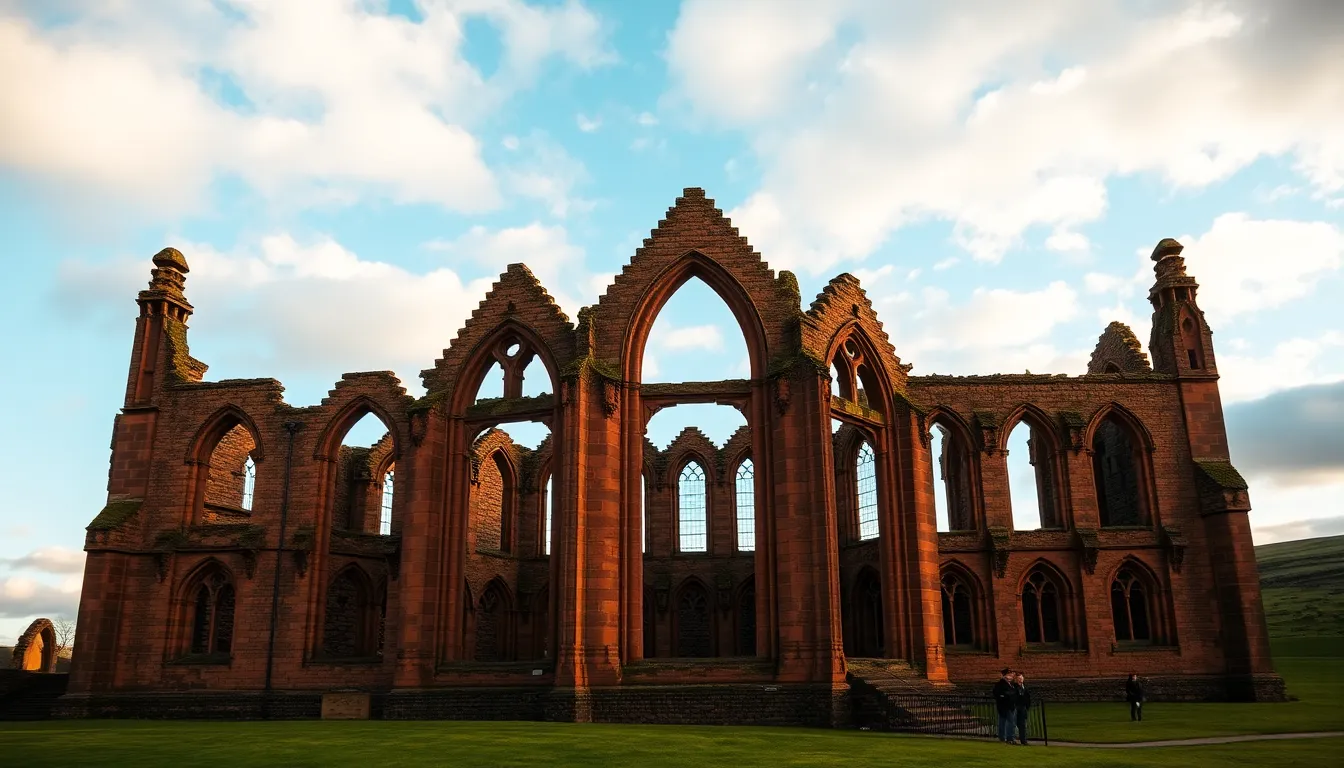
I have stood in a lot of ruins with a lot of groups, and most ask the same first question: what happened here. At Melrose, the question changes. People stand in the roofless choir, look down at a small marked stone in the grass, and ask who is buried under it. The answer is that a king’s heart may rest there, carried halfway across Europe and back before it came home to this quiet corner of the Scottish Borders.
That is the gift of Melrose. It is not just beautiful stone, though it is some of the finest carved stone in Scotland. It is a place where a strange and human story is anchored in the ground under your feet.
A Cistercian Abbey on the Tweed
Melrose Abbey was founded in 1136 by King David I of Scotland, who brought Cistercian monks south from Rievaulx Abbey in Yorkshire to settle it. David was the great founder-king of Scottish monasticism, and Melrose was the first Cistercian house in the country. It sat in the fertile valley of the River Tweed, rich farming and grazing land, and like most Cistercian houses it grew wealthy on wool.
The Cistercians were a reforming order. They sought out remote places, kept their lives plain, and built churches of disciplined beauty. At Melrose that discipline eventually gave way to something more ornate, because the abbey you see today is largely a rebuilding, and the masons who rebuilt it worked at the height of Gothic craft.
Melrose is a community that lasted four centuries, was knocked down more than once, and rebuilt itself each time until history finally caught up with it.
Burned, Rebuilt, and Burned Again
Melrose sat on the frontier between Scotland and England, and that location cost it dearly. Through the long wars between the two kingdoms the abbey was attacked and burned repeatedly. The English army under Richard II damaged it badly in the late fourteenth century, and the Earl of Hertford’s forces wrecked it again in the 1540s during the campaigns known as the Rough Wooing.
So the red sandstone you photograph today is mostly the rebuilding that followed, and it never fully recovered from the later blows. Then came the Reformation. Scottish monasticism was dismantled in the sixteenth century, the monks dispersed, and Melrose passed out of religious use. Part of the nave served as a parish church afterward, which is one reason any of it survived.
When I tell groups this, the roofless walls stop looking like neglect and start looking like a record. The open sky overhead is part of the history.
The Heart of Robert the Bruce
Here is the story that draws most visitors. Robert the Bruce, king of Scots and the victor of Bannockburn, died in 1329. By tradition he had vowed to go on crusade but never managed it in life, so he asked that after his death his heart be removed, embalmed, and carried on crusade in his place.
The task fell to Sir James Douglas, one of Bruce’s most trusted commanders. Douglas set out carrying the king’s heart in a casket. He never reached the Holy Land. In 1330 he was killed in Spain, fighting the Moors at the Battle of Teba in the campaigns of the Reconquista. The story holds that he flung the casket ahead of him into the fighting and charged after it.
The heart was recovered and brought back to Scotland, and buried at Melrose. The rest of Bruce lies at Dunfermline. His heart came here.
What the 1996 Excavation Found
For centuries this was tradition rather than proof. Then in 1996 archaeologists working in the chapter house area uncovered a lead casket. Inside it was a smaller container holding an embalmed heart. A copper plaque found with an earlier dig recorded that a heart had been excavated and reburied on the site in the past.
I am careful with groups here, and I would ask you to be the same. The casket is real and the heart is real. The identification as Bruce’s heart is believed and traditional, consistent with the historical account and the location, but it has not been proven beyond doubt, since there was no way to test it against the man himself. What we have is a genuine medieval embalmed heart, sealed in lead, found exactly where the chronicles said Bruce’s heart was laid.
After study, the casket was reburied in the abbey grounds, and a carved marker stone now sits over the spot. That stone, set into the grass, carries a line drawn from the Bruce legend about a brave heart. Standing groups around it is one of the quieter moments of a Borders visit. You are looking at a small square of turf that holds one of the strangest journeys in medieval history.
The Carved Stone Worth Slowing Down For
Melrose rewards anyone who looks up. The masons covered the building in detailed Gothic carving, much of it placed so high that no visitor below could see it clearly. The medieval understanding was that the work was offered to God whether or not human eyes ever caught it.
The most famous is a pig playing the bagpipes, a small gargoyle high on the roofline that delights every group I have ever brought. There are also angels, plants, faces, and an extraordinary range of decorative stonework, and the great east window is justly admired. I usually carry a printed photo of the bagpipe pig, because it sits high enough that people struggle to spot it, and finding it together is half the fun.
This is a good place to slow a group down. A few unhurried minutes looking up tells you more about the faith and craft of the people who built Melrose than any plaque can.
How Faith Groups Visit Melrose
For a faith group, Melrose works on more than one level. There is the witness of Cistercian devotion, the long discipline of a praying community. There is the visible cost of religious change, written in the ruin itself. And there is the Bruce story, which carries the medieval idea of crusade, vow, and the wish to be carried toward the Holy Land even in death.
I build the visit as a short loop. Gather first in the nave and lay out the history of founding, destruction, rebuilding, and dissolution. Move into the choir and chapter house area for the heart of Bruce and the marker stone. Then walk the exterior with eyes up for the carving. An unhurried group can do all of that in around ninety minutes.
Melrose pairs naturally with the other great ruins nearby, which I cover in the border abbeys guide, and it sits within the wider story I trace in our spiritual sites of the United Kingdom overview. If your itinerary is building toward the cathedrals, it threads well with St Giles’ Cathedral in Edinburgh and the ruined grandeur of St Andrews Cathedral. Groups drawn to the older Celtic Christian roots of Scotland often add Iona Abbey further west.
One small thing that makes a Borders day easier to plan: the group leader travels free when you bring fifteen or more participants. That is often the difference between a pastor or educator wondering whether the trip is possible and actually leading it.
Practical Access
Melrose Abbey is cared for by Historic Environment Scotland, and you buy a ticket to enter. Group rates are available, and pre-booking is wise for any sizeable party so the staff are ready for you.
The abbey sits in the town of Melrose in the Scottish Borders, roughly an hour by coach south of Edinburgh. The Borders Railway runs to nearby Tweedbank, a short hop from the abbey, which makes Melrose reachable even on a lighter logistics day. You can see how it fits a fuller route in our Scottish Borders heritage guide and the United Kingdom destination overview.
The heart marker stone is outdoors in the grounds, on level grass, and easy to gather around. The ruin itself involves uneven ground, worn medieval steps, and some narrow spots, which is normal for a site of this age. The site has a visitor centre, and Historic Environment Scotland can advise on accessibility. I always call ahead when I have someone using a wheelchair, because the older parts of any abbey ruin are rarely fully step-free.
Opening hours are seasonal, so check current times before you fix your day. The town of Melrose is small, pleasant, and well supplied with places to feed a group afterward.
FAQ: Visiting Melrose Abbey
Is the heart of Robert the Bruce really buried at Melrose? A lead casket containing an embalmed heart was found at the abbey in 1996, exactly where chronicles say Bruce’s heart was laid. The identification is believed and traditional and fits the historical record, but it was not proven beyond doubt. A marker stone now sits over the reburied casket in the grounds.
Who founded Melrose Abbey and when? King David I of Scotland founded it in 1136, bringing Cistercian monks from Rievaulx Abbey in Yorkshire. It was the first Cistercian house in Scotland.
Why is the abbey a ruin? Melrose sat on the contested frontier with England and was burned in repeated raids over the centuries, then dismantled at the Reformation in the sixteenth century. The roofless walls you see are largely a rebuilding that never fully recovered.
Where is the bagpipe-playing pig? It is a small carving high on the exterior roofline. It sits high enough that most visitors need it pointed out, so bring a photo to help your group find it.
How do groups get to Melrose from Edinburgh? It is about an hour by coach south of Edinburgh, or you can take the Borders Railway to Tweedbank, which is close to the abbey. Pre-book group tickets with Historic Environment Scotland.
If you are weighing a Borders day into your Scotland itinerary, we plan these routes for groups every season. See how we build group tours, then get in touch and tell us who you are bringing. We will help you stand your people around that small stone in the grass and tell them whose heart may rest beneath it.