There is a kind of quiet that settles over a group when we stand in Greyfriars Kirkyard in Edinburgh and I explain what happened there. The Covenanters are not a famous story outside Scotland and Presbyterian circles, and that is part of why visiting their sites carries such weight. These were ordinary believers, farmers, weavers, ministers, who refused to let the crown dictate how the church would be governed and worship offered, and who paid for that refusal with imprisonment, exile, and death. The proper way to tell their story is with dignity, not drama. They do not need embellishment. The facts are heavy enough.
If you lead a congregation that values conscience, conviction, and the cost of faith, the Covenanter trail in Scotland will mark your people. Let me walk you through who they were and where you stand to remember them.
Who the Covenanters Were
The Covenanters were Scottish Presbyterians of the seventeenth century who bound themselves by covenant to defend their Reformed faith and the right of the church to govern itself free of royal control over worship and church order. The name comes from two great documents. The National Covenant of 1638, signed at Greyfriars Kirk in Edinburgh, and the Solemn League and Covenant of 1643.
To understand them, you have to understand the conflict. The Stuart kings, Charles I and later Charles II, sought to impose bishops and a prescribed form of worship on the Scottish church. The Covenanters held that Christ alone is head of the church, that the king had no right to dictate its government and worship, and that they were bound by covenant before God to resist. This was not a minor liturgical dispute. It was a clash over ultimate authority, and both sides understood it that way.
I tell groups to hold two things together. The Covenanters were Reformed Christians of deep conviction, and they were also caught up in a brutal seventeenth-century political conflict with violence on more than one side. Honoring them well means neither flattening them into pure victims nor excusing the era’s brutality. The dignity is in the truth.
The National Covenant and Greyfriars Kirk
The story has a clear starting point you can stand on. In 1638, in Greyfriars Kirk in Edinburgh, Scots gathered to sign the National Covenant, pledging to defend their Reformed religion. The signing spread across the country in the weeks and months that followed. It was a national act of conscience.
Greyfriars Kirkyard, just off the Grassmarket, is therefore the natural anchor of a Covenanter trail. It is also the site of a later and darker chapter. After the Battle of Bothwell Brig in 1679, a large number of captured Covenanters were held in harsh conditions in an enclosure at Greyfriars over many months. Many died. A memorial in the kirkyard marks the Covenanters who suffered there. Standing in that place, the abstraction of history becomes concrete in a way that stays with people.
The Killing Time
The phrase used for the most intense period of persecution is the Killing Time, roughly the early to mid 1680s, under the later reign of Charles II and during the run-up to the reign of James VII and II. Covenanters who refused to conform and who continued to worship in open-air gatherings called conventicles, often on remote moors and hillsides to avoid the authorities, were hunted, and many were executed, sometimes summarily.
Among the names that groups remember are the two women known as the Wigtown Martyrs, Margaret Wilson and Margaret MacLachlan, who according to long-held tradition were tied to stakes in the Solway tidal flats near Wigtown and drowned by the incoming tide in 1685 for refusing to renounce their Covenanter convictions. A monument near Wigtown commemorates them. As with several martyr accounts from this period, historians debate some details, and I am always honest with groups about where tradition and firm documentation meet. But the broad reality of the persecution is not in doubt, and the memorials are real places of remembrance.
The Martyrs’ Memorials Across the Southwest
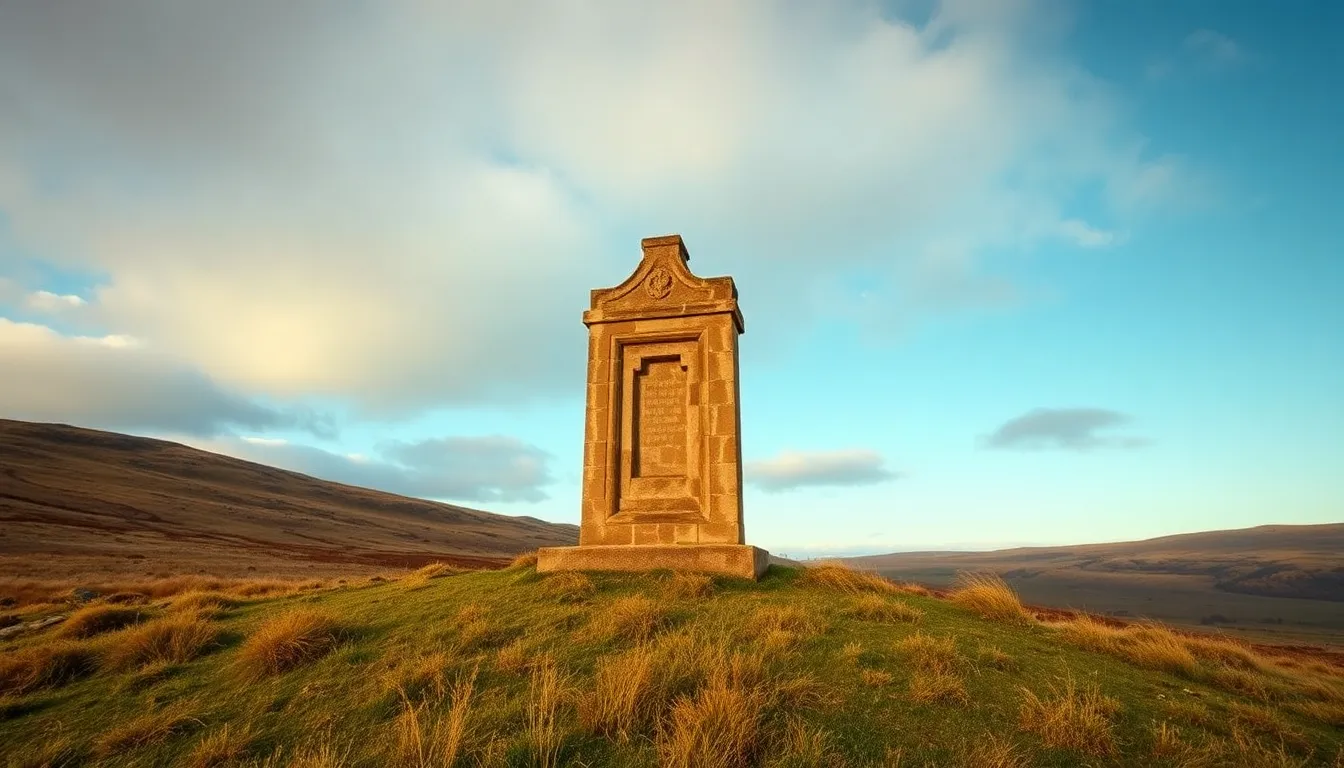
The heart of Covenanter country is the southwest of Scotland: Dumfries and Galloway, Ayrshire, Lanarkshire. Across this region you find martyrs’ graves and memorial stones scattered in country kirkyards and on hillsides, many of them tended for centuries. These are not grand monuments. They are simple stones, often with worn inscriptions, marking where a Covenanter was killed or buried.
For a group, the dispersed nature of these memorials is part of their power. You are not visiting a single museum. You are moving through a landscape that remembers, where a roadside stone marks a man shot for attending a forbidden service. A knowledgeable guide makes this trail, because many of the sites are remote and would be easy to pass without knowing what they are.
I usually build in a deliberate moment of silence or reflection at one of the martyr memorials. These are people who died rather than surrender their conscience, and a group of faith leaders standing quietly in that kind of place often needs no commentary from me at all.
How the Story Resolves
The persecution ended with the political settlement that followed the events of 1688 and 1689, when James VII and II was removed and a new constitutional and religious settlement took shape. In 1690 the Presbyterian government of the Church of Scotland was re-established by law. The cause for which the Covenanters had suffered prevailed, at least in its central aim of a Presbyterian national church free of imposed bishops.
That resolution matters for how you leave the story with a group. The Covenanters are not only a tale of suffering. They are also part of a longer arc in which religious liberty and freedom of conscience were hard-won in Britain, with real consequences for how those ideas later traveled across the Atlantic. Their memory feeds directly into the broader heritage of conscience that many congregations care deeply about.
Building a Covenanter Trail
Edinburgh, with Greyfriars Kirk and Kirkyard, is the usual starting point, and it pairs naturally with the wider Scottish Reformation sites in the city. From there, a deeper Covenanter route runs southwest into Galloway and Ayrshire to the martyr memorials and conventicle sites.
A practical note. The southwest sites are rural and spread out. This is a coach-and-guide trail, not a walkable city route, and weather on the moors can turn quickly, so pack accordingly and keep the pace humane for a mixed-age group.
For the wider landscape, see our United Kingdom spiritual sites hub. The Covenanter story flows directly out of the Scottish Reformation and John Knox, and many groups pair it with the medieval ecclesiastical heart at St Andrews.
FAQ: The Covenanters of Scotland for Faith Groups
Who were the Covenanters?
The Covenanters were seventeenth-century Scottish Presbyterians who bound themselves by covenant to defend their Reformed faith and the right of the church to govern its own worship and order free of royal control. They took their name from the National Covenant of 1638 and the Solemn League and Covenant of 1643. They held that Christ alone is head of the church.
What was the Killing Time?
The Killing Time refers to the most intense period of persecution against the Covenanters, roughly the early to mid 1680s. Those who refused to conform and who worshipped in open-air gatherings called conventicles were hunted, imprisoned, exiled, or executed. Martyr memorials across southwest Scotland mark where many died.
Where does a Covenanter heritage trail begin?
Greyfriars Kirk and Kirkyard in Edinburgh is the usual starting point, both because the National Covenant was signed there in 1638 and because captured Covenanters were later held there in harsh conditions. A deeper trail extends into Dumfries and Galloway, Ayrshire, and Lanarkshire, where many martyrs’ memorials are found.
Are the martyr stories historically reliable?
The broad reality of the persecution is well documented. Some individual martyr accounts, such as certain details of the Wigtown Martyrs, are debated by historians. A good guide is honest about where firm documentation and long-held tradition meet. The memorials themselves are real places of remembrance maintained for centuries.
How should a group approach the Covenanter sites?
With dignity and reflection. These are places where people died rather than surrender their conscience. Many memorials are simple stones in remote settings. Group leaders often build in moments of silence at the martyr sites, and a knowledgeable guide is essential because many locations are easy to miss without context.
If your congregation is drawn to the witness of believers who held conscience above the crown, we can help you trace the Covenanter trail with the care it deserves. Explore our United Kingdom destination page, see how leading a group works on our group heritage tours, or contact us to begin.