Where the Gospel Reached Britain First
Most pastors I work with arrive with a picture of English Christianity in their minds: Canterbury, the cathedrals, the King James Bible. All of that is real and worth seeing. But the faith story of Scotland, Wales, and Northern Ireland is older, wilder, and in many ways closer to the apostolic spirit. The Gospel came to these nations not through grand institutions but through monks in small boats, hermits in stone cells, and preachers who walked the hills.
I have spent years bringing Christian groups here, and what strikes them most is how raw the holiness feels. You are not standing in a polished tourist church. You are standing on a windswept island where a sixth-century monk copied scripture by hand, or on a hillside where, in 1904, an entire nation turned to prayer almost overnight. This is the living edge of Christian history, and these three nations hold it in abundance.
Celtic Christianity: The Faith That Came by Sea
Long before the Reformation, before even the Roman church organized Britain into dioceses, Celtic Christianity took root across the western edges of these islands. It was a faith of monasteries, missionaries, and a deep love of the natural world as God’s creation. For a Christian group, this is some of the most spiritually moving ground in all of Europe.
Iona and Saint Columba
The story begins, for many, on the tiny island of Iona off the west coast of Scotland. In 563, the Irish monk Columba landed here with twelve companions and founded a monastery that would become the spiritual heart of Scottish Christianity. From Iona, missionaries fanned out across Scotland and northern England, carrying the Gospel into pagan lands.
Iona is small, remote, and almost impossibly peaceful. Getting there takes effort, a ferry and then another ferry, but that effort is part of the pilgrimage. Standing in the restored abbey, with the sound of the sea always present, groups understand why this place has drawn pilgrims for nearly fifteen centuries. Our full account of Iona and Celtic Christianity walks through the abbey, the ancient crosses, and the practicalities of getting a group there.
Saint Patrick and Armagh
In Northern Ireland, the Celtic story centers on Patrick, the fifth-century missionary who became the patron saint of Ireland. Patrick made the hill of Armagh the center of his ministry, and to this day Armagh holds two cathedrals bearing his name, one Catholic and one Church of Ireland, facing each other across the city. For a group, Armagh offers a direct encounter with the man whose mission shaped the faith of an entire island. We cover the full story in our guide to Saint Patrick and Armagh.
Saint David and the Welsh Coast
Wales has its own great founding saint. David, who lived in the sixth century, established a monastic community in the remote southwest of Wales at the site that now bears his name, St Davids. The cathedral there sits in a hollow, hidden from raiders who once came by sea, and it remains the spiritual heart of Wales. The story of Saint David and his cathedral is one I return to with every group, because David’s call to “do the little things” still speaks across fourteen centuries.
The Reformation and the Covenanters of Scotland
Jump forward a thousand years and the spiritual landscape of these nations transforms again. The Reformation reached Scotland with particular force, driven by the fiery preaching of John Knox, who returned from exile to lead the Scottish Reformation in 1560. The result was a Presbyterian church that shaped Scottish identity for centuries and reached far across the world through Scottish emigrants.
The most stirring chapter for many Protestant groups is the story of the Covenanters. In the seventeenth century, Scottish Presbyterians signed solemn covenants pledging to defend their form of worship against royal attempts to impose bishops and a prescribed prayer book. When the crown responded with persecution, thousands held to their faith through what became known as the Killing Time, gathering for secret open-air services on the moors and paying for it with their lives.
The memory of the Covenanters is written across the Scottish landscape in monuments, graves, and the windswept hills where they worshipped in defiance. For a group that cares about religious liberty and conscience, this trail is unforgettable. Our Covenanters heritage trail traces the key sites and the stories behind them.
The Welsh Revival of 1904
If there is one chapter of British Christian history that I find Christian groups respond to most powerfully, it is the Welsh Revival of 1904. In the autumn of that year, a young coal miner named Evan Roberts began preaching in his home chapel, and within months the whole nation was caught up in a movement of prayer and repentance unlike anything in living memory.
The numbers are staggering. Over the following year, more than a hundred thousand people are said to have come to faith. Chapels filled to overflowing. Pubs emptied. Court dockets cleared. Coal miners reportedly prayed at the pit face, and the ponies that hauled the coal had to be retrained because they no longer understood commands given without cursing. Whether or not every story is exact, the transformation was real and documented, and its effects rippled out to spark revivals around the world.
For a pastor, walking the chapels and valleys of South Wales where this happened is a chance to stand on ground where the Holy Spirit moved with extraordinary power within living memory of recent generations. Our Welsh Revival trail maps the chapels, the towns, and the story of Evan Roberts in full.
The Cathedrals and Abbeys That Anchor the Story
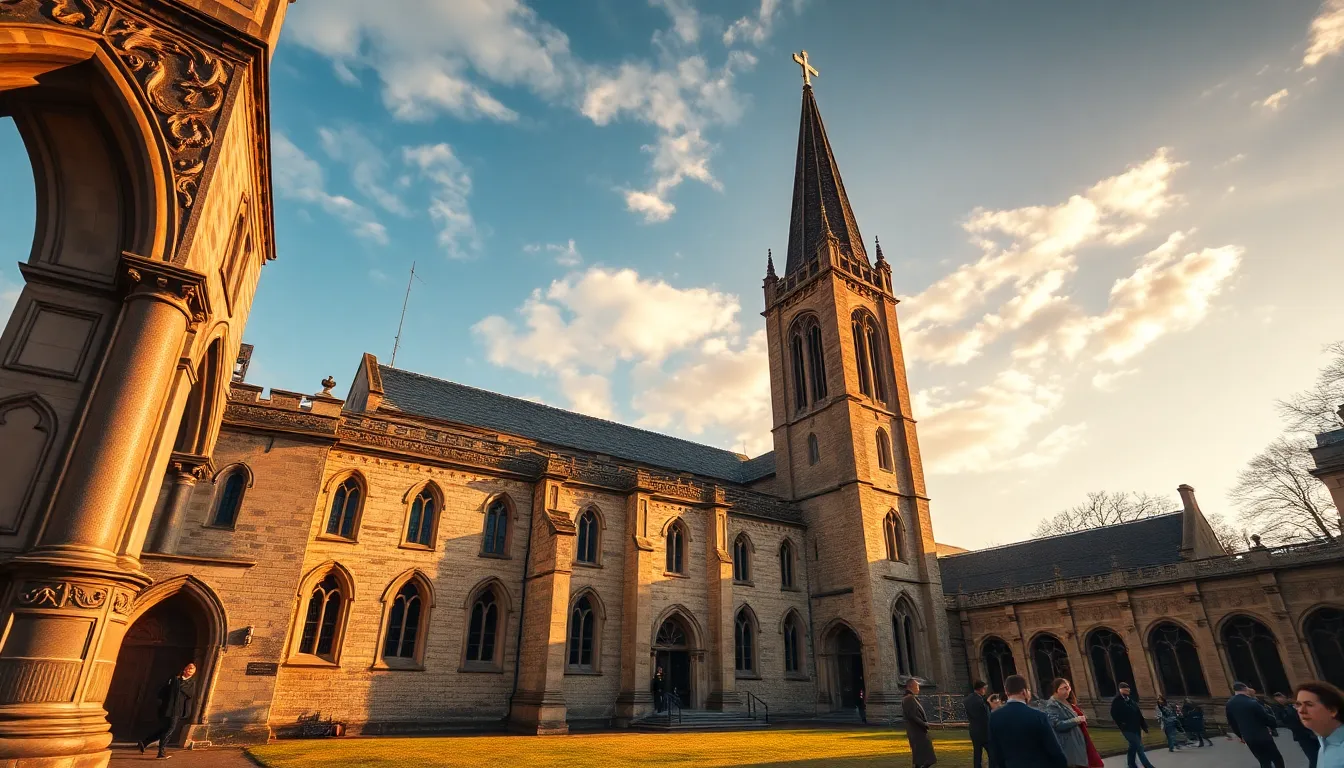
Alongside the islands and the chapels, these nations hold cathedrals and abbeys that carry their own weight for a Christian group. In Scotland, the ruins of Melrose, Dryburgh, and Jedburgh in the Borders speak of the medieval monastic life that flourished before the Reformation swept much of it away. St Giles Cathedral in the heart of Edinburgh stands at the very center of the Scottish Reformation story, the pulpit from which John Knox preached and the church around which the Covenanting movement later rallied.
In Wales, beyond St Davids, the cathedral at Llandaff in Cardiff carries centuries of Welsh Christian history, while the ruined abbey at Tintern, set in the wooded Wye Valley, draws those who want to stand in the quiet shell of a once-great monastery. These are not afterthoughts on a heritage trip. They give a group the architectural and historical backbone that ties the older Celtic story to the Reformation and beyond.
I usually weave one or two of these into an itinerary as anchor points, places grand enough to gather the group and rich enough to teach from. They also provide natural settings for worship, with the kind of acoustics and atmosphere that lift a hymn sung together by a visiting congregation.
Worship on the Road: Making It a Pilgrimage
One thing I tell every pastor is that the difference between a tour and a pilgrimage is worship. These nations give you extraordinary places to gather your people in prayer. A short service in Iona Abbey, a hymn in a Welsh Revival chapel, a moment of silence at a Covenanter’s grave, a reading in the nave at St Davids. These are the moments your group will remember years later, more than any photograph.
I build these into the rhythm of every itinerary rather than leaving them to chance. Some sites require a little advance arrangement to gather a group for worship, which is exactly the kind of detail a heritage operator handles. The goal is simple: to let your people not just see where the faith took root, but to add their own voices to the long line of those who have prayed in these places.
Bringing the Threads Together
What makes these three nations so rich for a Christian group is that the faith story does not sit in a single era. You can stand on Iona where Celtic monks first carried the Gospel by sea, then trace the Reformation and the suffering of the Covenanters, then walk the valleys where revival swept through within the lifetime of people’s grandparents. It is the whole arc of Christian history, from the ancient to the recent, held in one journey.
I usually counsel pastors to choose a focus rather than try to cover everything. A Celtic Christianity itinerary built around Iona, Armagh, and St Davids is one kind of trip. A Reformation and revival itinerary built around the Covenanter trail and the Welsh chapels is another. Both are deeply rewarding, and both leave room for the kind of reflection and worship that turns a tour into a pilgrimage.
If you are weighing one of these for your congregation, I would love to help you shape it. Heritage Tours builds every itinerary around what matters to your specific community, and with 15 or more participants, the group leader travels free. Begin with our United Kingdom heritage destination and our group heritage tours.
FAQ: Christian Heritage Travel to Scotland, Wales, and Northern Ireland
What is Celtic Christianity and where can a group experience it?
Celtic Christianity was the early form of the faith that spread across the western edges of Britain and Ireland through monasteries and missionary monks, beginning in the fifth and sixth centuries. The best places to experience it are Iona in Scotland, founded by Columba in 563, Armagh in Northern Ireland associated with Patrick, and St Davids in Wales associated with the patron saint David. Each holds a strong sense of the ancient and contemplative.
Who were the Covenanters and why do they matter?
The Covenanters were seventeenth-century Scottish Presbyterians who signed solemn covenants pledging to defend their form of worship against royal interference. Many were persecuted and killed during the Killing Time for holding secret open-air services. For Christian groups, their story is a powerful witness to religious conscience and the cost of faith, and it is commemorated across the Scottish landscape.
What was the Welsh Revival of 1904?
It was a remarkable spiritual awakening that began in late 1904 under the preaching of a young miner named Evan Roberts. Within about a year, more than a hundred thousand people are said to have come to faith. Chapels overflowed, communities were transformed, and the revival inspired similar movements around the world. Groups can walk the chapels and valleys of South Wales where it unfolded.
Can I combine Celtic and Reformation history in one trip?
You can, but I usually advise choosing a primary focus so the journey has depth rather than rushing between eras. Scotland alone can hold both Iona and the Covenanter trail, while Wales adds St Davids and the Revival valleys. A good itinerary balances travel time with space for worship and reflection. We help every group find the right shape for their interests and pace.
Is this suitable for a church group of mixed ages?
Yes, with thoughtful planning. Some sites, particularly remote islands like Iona, involve ferries and walking, so itineraries should account for mobility. Many of the chapels, cathedrals, and Covenanter memorials are accessible to all. We design routes that keep the group together and ensure that older members can share fully in the most meaningful moments.