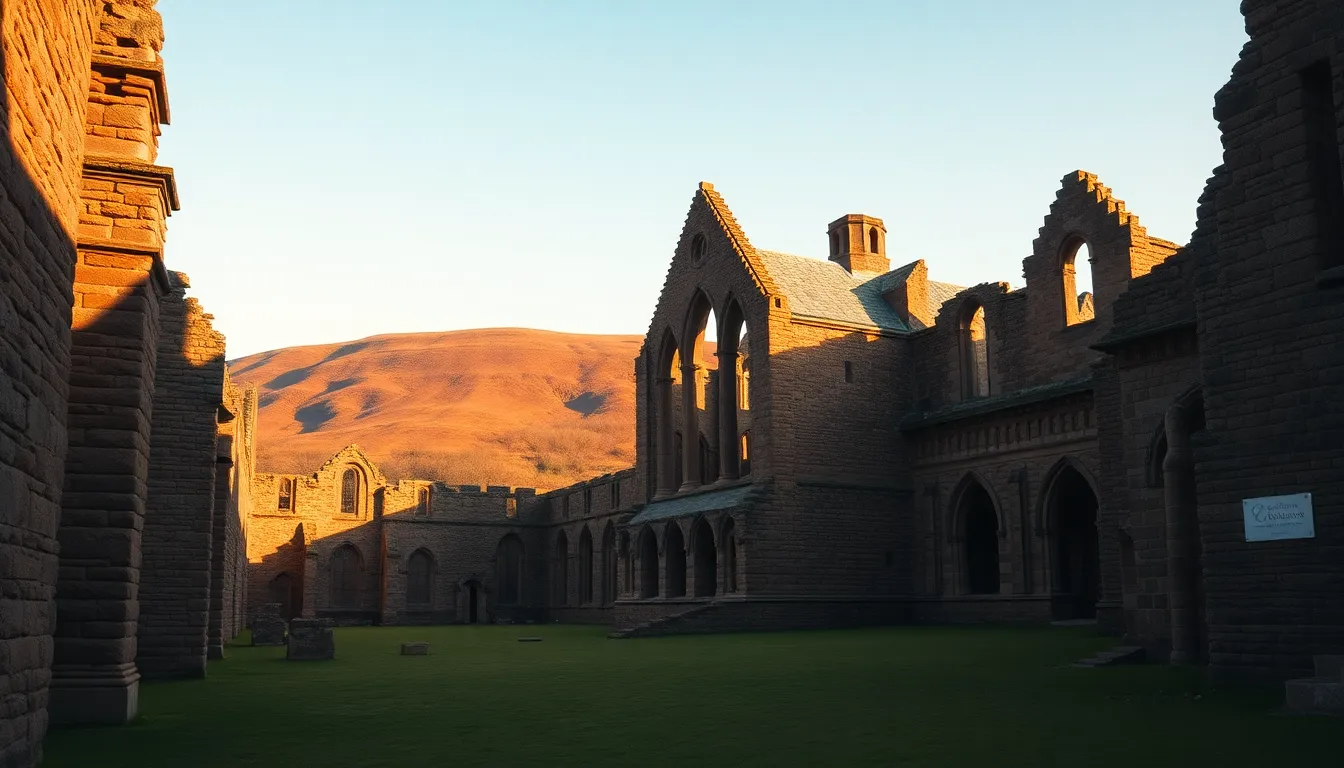
The first time I walked a group into the roofless nave at Melrose, someone asked me why a ruin could feel more sacred than many intact churches. I have thought about that question for years. Part of the answer is that the Border abbeys wear their whole history on their faces. You can read the soaring ambition of medieval monasticism in the carved stone, and you can read the violence and dissolution that ended it in the open sky where a roof should be. For a faith group, that combination is unusually moving. These are not tidy attractions. They are the bones of a way of life that lasted four centuries and then was undone.
The Scottish Borders hold four great medieval abbeys within a short drive of one another. Let me introduce them, because together they tell a story that no single ruin tells alone.
Why the Borders Had So Many Great Abbeys
In the twelfth century, King David I of Scotland founded or supported a remarkable cluster of monasteries in the Borders: Melrose, Dryburgh, Jedburgh, and Kelso among them. This was a deliberate project. David, who had spent time at the English court and absorbed the reforming monastic currents of the age, brought in the great religious orders of the day, Cistercians, Augustinians, Premonstratensians, Tironensians, and planted them in the fertile valley of the River Tweed.
The location was both blessing and curse. The Tweed valley was rich farming country, and the abbeys grew wealthy on wool and land. But the Borders were also the frontier between Scotland and England, and for centuries they were fought over. The same abbeys were burned, rebuilt, and burned again through the long wars between the two kingdoms. The ruins you see today carry the marks of that repeated destruction, layered with the final blow of the Reformation in the sixteenth century, when Scottish monasticism was dismantled.
I give groups this frame at the start, because it explains why these magnificent buildings are roofless. They were not simply abandoned. They were caught between two crowns and then between two ages of the church.
Melrose Abbey: The Jewel of the Borders
Melrose is the most celebrated of the four, and rightly so. Founded by David I in 1136 for the Cistercian order, it became one of the wealthiest and most important monasteries in Scotland. What survives is mostly the work of rebuilding after English destruction, and the carved stonework is extraordinary. Look for the famous carvings high on the building, including the often-photographed bagpipe-playing figure and the wealth of detailed ornament that medieval masons worked into the stone where, in their understanding, only God and the angels would see it closely.
Melrose holds one of the great relics of Scottish history. Tradition holds that the heart of King Robert the Bruce, the king who secured Scottish independence, was buried at Melrose, and a marker in the grounds commemorates the burial of his heart. Groups often find that detail brings the medieval world close. This was not only a house of prayer. It was bound into the life and death of a nation.
For a faith group, the spiritual value of Melrose is in standing inside a Cistercian vision. The Cistercians sought a stricter, simpler monastic life of prayer and labor, and even in ruin the abbey communicates that disciplined reach toward God.
Dryburgh Abbey: The Most Peaceful of the Four
If Melrose is the jewel, Dryburgh is the place of quiet. Set in a loop of the Tweed among ancient trees, Dryburgh was a Premonstratensian house, and its setting is, to my mind, the most contemplative of all the Border abbeys. Many group members tell me Dryburgh is the one that stays with them, precisely because it is less about grandeur and more about stillness.
Dryburgh is also the burial place of Sir Walter Scott, the writer who did so much to shape the romantic image of the Borders, and of Field Marshal Earl Haig. The cloister ruins at Dryburgh are unusually complete in places, so you can stand in the spaces where the monks lived their daily round, the chapter house, the refectory range, and grasp the rhythm of monastic life better than at the grander sites.
I often plan Dryburgh as the reflective heart of a Border abbeys day. It is the place where I give a group time to simply be quiet.
Jedburgh and Kelso: Completing the Picture
Jedburgh Abbey, an Augustinian house, stands tall above the town of Jedburgh, close to the English border. Its great nave survives to a striking height, and because of its frontier position it endured some of the worst of the cross-border wars. Jedburgh gives you the most vertical, soaring sense of what these buildings were.
Kelso Abbey, a Tironensian foundation and once among the largest and grandest of the four, is today the most fragmentary, with only a portion of the great church surviving. Even so, what remains hints at the scale of the original, and Kelso completes the circuit of David I’s twelfth-century monastic project.
Together the four abbeys are sometimes traced as a single Borders Abbeys route, and that is exactly how I recommend a group experience them. No one abbey tells the whole story. The pattern across all four does.
Planning a Border Abbeys Day for Your Group
The four abbeys lie within a compact area of the central Borders, roughly an hour south of Edinburgh, which makes them very manageable as a day trip or as part of a wider Scottish heritage itinerary. A coach and a guide are ideal, since the sites are spread across small towns and the countryside.
A few practical notes. The abbeys are open-air ruins, so weather matters; the Borders can be cold and wet even outside winter, and good footwear and layers make the difference between a rich visit and a miserable one. Pacing also matters. Trying to do all four properly in one day with a mixed-age group can be rushed. Many leaders choose three, with Dryburgh as the reflective anchor, and leave time to absorb each one.
For the wider story, see our United Kingdom spiritual sites hub. The abbeys pair naturally with St Andrews, Scotland’s medieval ecclesiastical heart, and with the Scottish Reformation and John Knox, the movement that brought the monastic age to its close.
FAQ: The Scottish Border Abbeys for Faith Groups
What are the Border abbeys?
The Border abbeys are four great medieval monasteries in the Scottish Borders, Melrose, Dryburgh, Jedburgh, and Kelso, founded or supported by King David I of Scotland in the twelfth century. They belonged to different religious orders, grew wealthy in the Tweed valley, and were repeatedly damaged in the wars between Scotland and England before the Reformation ended Scottish monasticism.
Why are the Border abbeys in ruins?
The abbeys stood on the frontier between Scotland and England and were burned and rebuilt repeatedly during centuries of cross-border conflict. The final blow came with the Scottish Reformation in the sixteenth century, when monasticism was dismantled. The roofless ruins reflect both the warfare and the religious upheaval of those eras.
Which Border abbey is the most worth visiting?
Melrose is the most celebrated, with remarkable carved stonework and the tradition that the heart of Robert the Bruce is buried there. Dryburgh, set in a quiet loop of the River Tweed, is often the most contemplative and is the burial place of Sir Walter Scott. Many group leaders pair the two and add Jedburgh for its soaring nave.
Can you visit all four Border abbeys in one day?
It is possible, since the four sites lie within a compact area about an hour south of Edinburgh, but visiting all four properly with a mixed-age group can feel rushed. Many leaders choose three, often with Dryburgh as a reflective anchor, and allow time to absorb each one rather than racing between them.
Are the Border abbeys suitable for a faith group rather than just a history tour?
Yes. Even in ruin, the abbeys communicate the disciplined monastic vision of prayer and labor that built them, and Dryburgh in particular offers genuine stillness for reflection. Group leaders frequently use the abbeys as places to consider the long Christian past of Britain and the rise and fall of the monastic age.
If your congregation would be moved by the ruined abbeys of the Scottish Borders, we can help you shape a day that gives each one its due. Explore our United Kingdom destination page, see how the leader experience works on our group heritage tours, or contact us to start planning.