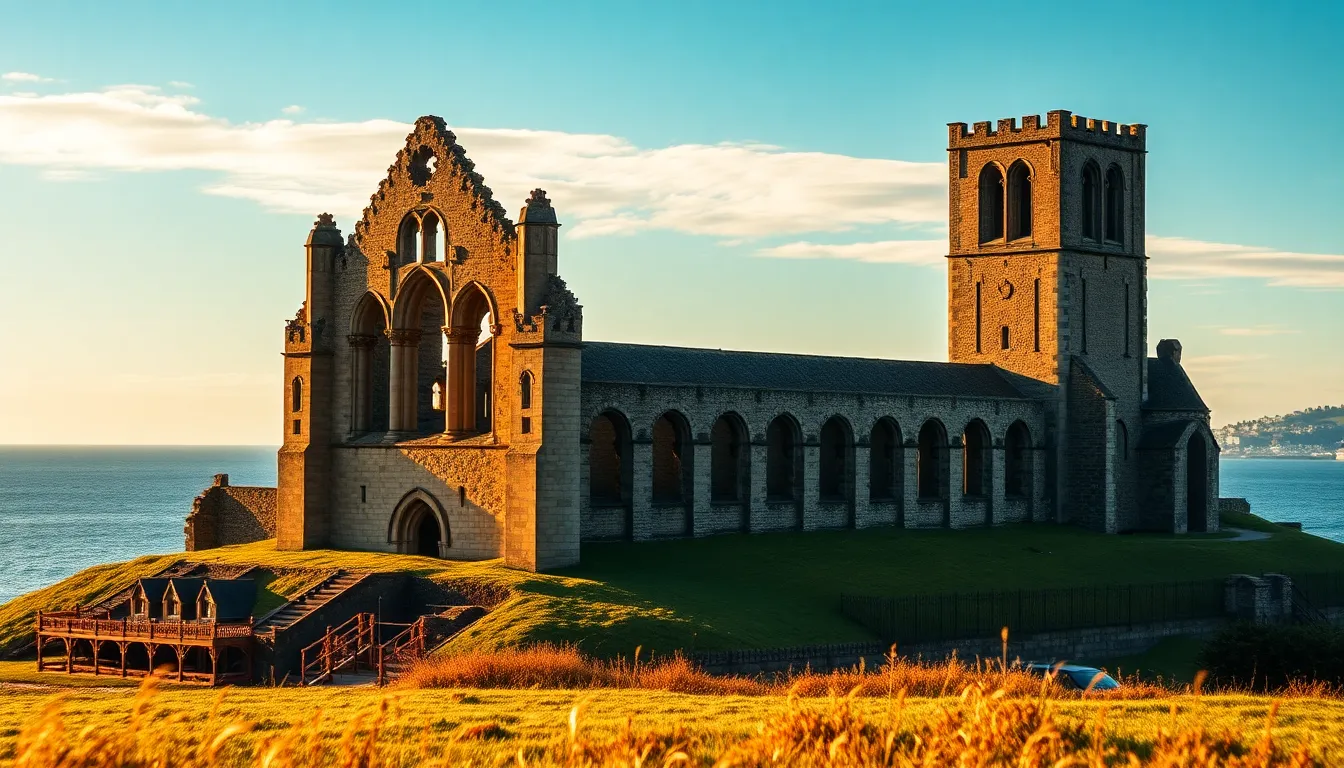
I bring groups to St Andrews expecting them to be impressed, and they usually are, but not in the way they thought. They picture a cathedral. What they find is a skeleton of one, a vast outline of broken walls open to the North Sea sky, with a single tall gable still standing at the east end like a doorway into nothing. The first reaction is almost always the same quiet question: what happened here?
That question is the whole reason this stop is worth your time. St Andrews was once the largest cathedral in Scotland, the heart of the Scottish church, a place pilgrims walked across a continent to reach. Today it is a ruin in a graveyard by the sea, and that gap tells you more about Scottish history than any intact building could. Let me walk you through it the way I would on the ground.
Why a Town in Fife Became Scotland’s Holiest Place
To understand St Andrews you have to start with a legend, and I tell my groups up front that it is a legend, not verified history.
Andrew, the apostle, brother of Simon Peter, was martyred in Greece. Centuries later, the story goes, a monk named Saint Rule, also called Regulus, was warned in a vision to carry some of the apostle’s bones to the ends of the earth for safekeeping. He sailed west, was shipwrecked on the coast of Fife at the spot that would become St Andrews, and built a church there to house the relics.
Whether any bones ever traveled to Scotland is something no historian can confirm, and I am honest about that. What matters is that people believed it, completely, for centuries. That belief turned an obscure stretch of coast into a destination. Pilgrims came in their thousands, a town grew up to serve them, and a university was founded here in 1413, the oldest in Scotland, still woven through the streets around the ruin.
The belief did something larger too. Andrew became the patron saint of Scotland, and the saltire, the diagonal white cross on a blue field, became the Scottish flag, said to recall the X-shaped cross on which Andrew was crucified. When your group later sees that flag anywhere in Scotland, they will know it traces back to this graveyard by the sea.
St Rule’s Tower and the Church Before the Cathedral
Before you reach the cathedral itself, your eye goes to a tall narrow tower standing slightly apart. That is St Rule’s Tower, older than the cathedral around it, part of the earlier church of St Rule built in the early twelfth century to hold the relics, the first real shrine on the site.
The tower is the one part of St Andrews most groups can actually climb, and I recommend it for anyone steady on their feet. It is a tight stone spiral, more than thirty meters up, with worn, steep steps. At the top is the view that explains everything: the full footprint of the ruined cathedral beneath you, the town and university around it, the harbor, and the cold gray North Sea running to the horizon. People stop talking up there. It is the moment the scale of the place finally lands. The climb is narrow with no elevator, so I send the able climbers up in small batches and keep the rest of the group occupied among the graves below.
The Cathedral That Was Scotland’s Largest
Work on the great cathedral began around 1160 and went on for more than 150 years. It was finally consecrated in 1318, in a ceremony attended by King Robert the Bruce, four years after his victory at Bannockburn secured Scottish independence. That date is worth saying out loud. This was the church of a newly free nation, the largest building in the country, and the Bruce himself stood inside it.
At its full length the cathedral ran well over a hundred meters. Walk the grass between the surviving walls and you are walking the floor of a building longer than most cathedrals still standing in Britain today. The east gable gives you the height; the rest you build in your imagination, and that work is exactly what makes the visit powerful for a thoughtful group. For two centuries this was the engine of the Scottish church, the seat of its senior bishop, the destination of its pilgrim roads. And then, over a single generation, it stopped.
The Reformation and the Fall to Ruin
In June 1559 the reformer John Knox preached in St Andrews. His message was direct: the church had to be cleansed of idolatry, and that included the images, altars, and relics that filled buildings like this one. In the days that followed, a crowd stripped the cathedral of its Catholic furnishings, its statues, its altars, its shrine. The relics that had drawn pilgrims for centuries vanished in this period, and nobody can say what became of them, which is fitting for a relic whose origin was always a matter of faith rather than record.
The stripping itself did not flatten the building. What finished it was neglect. Once the pilgrims stopped and the church that maintained it was gone, the cathedral lost its purpose and its income. The roof failed. Townspeople quarried the cut stone for their own houses, a common fate for abandoned churches across Scotland, the same story you can read in the ruins at Melrose Abbey. Storms off the sea did the rest, and within a few generations Scotland’s greatest cathedral was the roofless shell you stand in today.
Groups respond strongly to this part, because it is not a simple story. The Reformation gave Scotland the spiritual seriousness that John Knox preached and that still marks Scottish faith, and you can stand inside the living result of that movement at St Giles’ Cathedral in Edinburgh. It also left this building to die. Both are true, and a good visit holds them together rather than picking a side.
The Graveyard and the Setting
The cathedral grounds are also a working graveyard, an old one, the stones leaning and crowding among the ruins, many carved with the trades and ships of a coastal town. It sets the grand story of apostles and kings beside the ordinary people who lived in the cathedral’s shadow.
Then there is the sea. The ruins stand almost at the cliff edge of Fife, the harbor just below, the water stretching out behind the east gable. The wind comes straight off the North Sea, so dress your group warmly even in summer. That exposed setting is part of why the place moves people: it feels like the end of the land, which is what the Saint Rule legend said it was.
How Groups Visit St Andrews Cathedral
The ruins and St Rule’s Tower are cared for by Historic Environment Scotland, and a single ticket covers both the grounds and the tower climb.
Plan and Pacing
Give the site ninety minutes to two hours, enough to walk the cathedral floor, send climbers up the tower in batches, see the graveyard, and tell the story without rushing. I give the history first, standing near the east gable where the high altar once stood, then let people explore. The story has to come before the wandering, or the stones stay silent. For a wider Scotland route, St Andrews pairs naturally with Edinburgh, about an hour and a half south, and with the Celtic Christian sites of the west like Iona Abbey.
Tickets, Access, and Practicalities
Reserve through Historic Environment Scotland, and check current opening hours before you travel, as they shift between summer and winter and the tower can close in high winds. Group rates are available when you book ahead.
On accessibility, be realistic. The grounds are open grass and gravel, mostly level but uneven, manageable for most visitors including many wheelchair users with assistance. St Rule’s Tower is the opposite: a narrow medieval spiral with no lift and steep worn steps, for the able-bodied only. Plan two experiences in parallel. And keep in mind there is almost no shelter inside the ruin, so if the weather turns, and on this coast it turns fast, the cafes of the town are your fallback.
When I price these trips, the group leader travels free once you have fifteen or more participants booked, which makes pulling together a church or school group more workable than people expect.
FAQ: Visiting St Andrews Cathedral
Are the bones of the apostle Andrew really buried at St Andrews? There is no historical proof, and I always say so plainly. The relics tradition, that Saint Rule carried Andrew’s bones here after a vision, is a medieval legend, not verified fact. What is certain is that people believed it for centuries, and that belief built the cathedral, the town, the university, and even shaped the Scottish flag.
Why is the cathedral a ruin instead of a working church? It was stripped of its Catholic furnishings during the Reformation in 1559, after John Knox preached in the town. It was not demolished then, but once the pilgrims and the maintaining church were gone, it fell into neglect, lost its roof, and was quarried for stone.
Can my group climb St Rule’s Tower? Able-bodied visitors can, and the view from the top is the highlight. It is a steep, narrow medieval spiral with no lift, so I send climbers up in small batches and keep the rest of the group busy in the graveyard below.
How long should we spend there? Ninety minutes to two hours covers the history talk, the cathedral floor, the tower climb in batches, and the graveyard.
Who looks after the site and do we need tickets? Historic Environment Scotland manages it. One ticket covers the grounds and the tower, group rates are available when you book ahead, and you should check current opening hours since they change with the season.
St Andrews does its work quietly. You stand in the wind inside a broken cathedral, you hear how a legend built a nation’s holiest place and how a sermon helped unmake it, and the whole sweep of Scottish faith opens up in front of you. To fold it into a Scotland heritage trip, start with our United Kingdom destinations and the wider spiritual sites of the UK, see how we handle group tours, and then get in touch and we will build the route around your people.