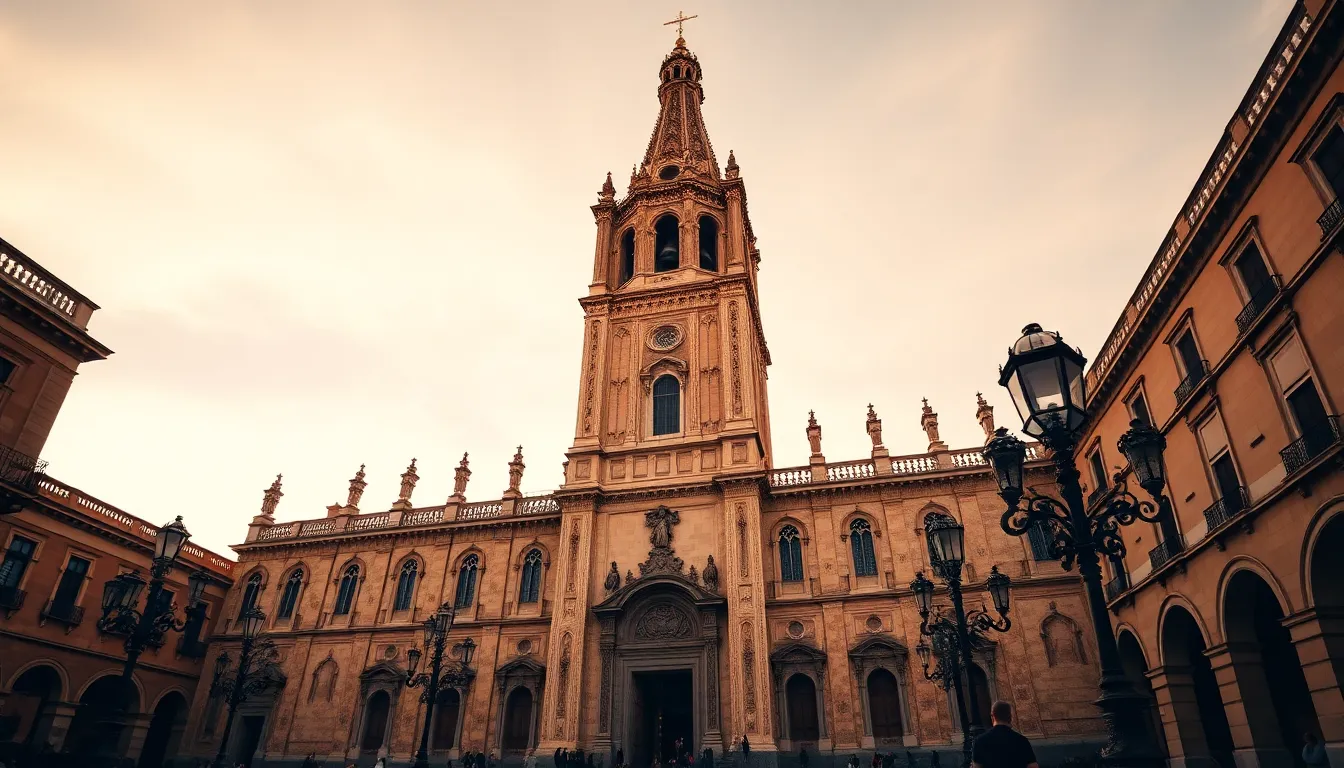
Seville is the city where I have to slow my groups down. People arrive expecting a checklist, the cathedral, the Alcazar, the old quarter, and within an hour they have stopped wanting to rush. The orange trees, the tiled courtyards, the sound of the bells from the Giralda, all of it works on you. I tell every group the same thing on our first morning: Seville is not a city you tick off. It is a city you let in.
I have been leading faith communities through Andalusia for more than twenty years, and Seville is one of the richest stops on any Spain itinerary. Its three heritage layers, Christian, Moorish, and Jewish, are not spread across the city. They overlap, sometimes within the same building, sometimes within the same wall. Let me orient you to each one and to what your group needs to know.
Why Seville Holds So Many Stories at Once
Seville was a major city under Muslim rule, a capital under the Almohads, and then, after Christian forces took it in 1248, one of the most important cities of Catholic Spain. When Spain’s empire crossed the Atlantic, Seville became the gateway port for trade with the Americas, which brought enormous wealth and another wave of building. All of that history sits stacked in the old center.
For a heritage group, Seville matters because it shows the layering of Spain at its most vivid. A mosque becomes a cathedral. A minaret becomes a bell tower. A Moorish palace is expanded by Christian kings who kept the very style of the people they had conquered. And in the shadow of all of it sits the old Jewish quarter. A community can walk through five centuries of Spanish history in a single morning here.
The Christian Layer: The Cathedral and the Giralda
Seville’s cathedral is the headline, and it earns it.
Seville Cathedral
The Cathedral of Seville is the largest Gothic cathedral in the world, built between the 15th and 16th centuries on the site of the city’s great mosque. The scale inside is genuinely hard to take in. The main altarpiece, a vast gilded wall of carved scenes from the life of Christ, took craftsmen the better part of a century to complete. The cathedral also holds what is traditionally identified as the tomb of Christopher Columbus, carried by four figures representing the kingdoms of Spain. For a pastor planning a Christian heritage day, the cathedral alone rewards a long, unhurried visit.
The Giralda
The cathedral’s bell tower, the Giralda, was originally the minaret of the mosque that stood here before. Rather than tear it down, the Christian builders kept it and added a bell stage and a weathervane on top. You climb it not by stairs but by a series of gentle ramps, built wide enough that the muezzin could once ride a horse to the top. From the summit, the whole city opens up below you. The Giralda is, all by itself, a lesson in how Seville layers one faith’s work onto another’s, and groups grasp it instantly when they make the climb.
The Moorish Layer: The Real Alcazar
Across the square from the cathedral stands the Real Alcazar, and for many of my groups it is the emotional high point of Seville.
The Alcazar is a royal palace that began under Muslim rule and was expanded over centuries by Christian kings. The most famous section, the Mudejar palace built for King Pedro in the 14th century, was created by Muslim craftsmen working in their own tradition for a Christian monarch. The result is breathtaking: courtyards with reflecting pools, walls covered in intricate carved plaster and tilework, ceilings of inlaid wood, and gardens that draw directly on the Islamic tradition of the garden as paradise on earth.
I always remind groups that the Alcazar is not a ruin or a museum piece. It is still used as a royal residence, which makes the experience of walking through it feel oddly alive. Standing in the Courtyard of the Maidens, with the light moving on the water, is one of those moments where the whole idea of convivencia, the centuries when three faiths shaped this land together, stops being abstract.
The Jewish Layer: The Barrio de Santa Cruz
Wrapped around the cathedral and the Alcazar is the Barrio de Santa Cruz, today one of the most charming neighborhoods in Seville, with its whitewashed walls, flower-filled balconies, and tiny shaded squares. What many visitors do not realize is that this was once the Juderia, the Jewish quarter of medieval Seville.
Before 1391, Seville had one of the largest Jewish communities in Spain. That year, a wave of anti-Jewish violence swept the city and destroyed much of the community, decades before the 1492 expulsion finished what was left. Because the destruction came early and the neighborhood was rebuilt over the centuries that followed, the physical traces are fainter here than in Toledo or Girona. But they are present if you know where to look, and a good guide can show you the street names, the layout of the lanes, and the small markers that recall what this quarter was.
For a Jewish heritage group, Santa Cruz is a place to reflect on loss in a particular way. Here, beauty grew over a wound. Walking these lovely streets, you are walking ground where a community lived and was driven out, and holding both of those truths at once is part of what makes the visit meaningful.
Planning Your Group’s Visit to Seville
A few practical notes for group leaders.
First, the cathedral, the Giralda, the Alcazar, and Santa Cruz are all within a few minutes’ walk of one another in the old center. That compactness is a gift for group travel. A focused day covers the essentials, though Seville rewards an overnight or two, especially because the city comes alive in the cooler evenings.
Second, book the cathedral and the Alcazar in advance. Both are among the most visited sites in Spain, and timed entry, ideally early in the day, saves your group from long queues in the heat. A local guide who knows how to sequence the day makes a real difference.
Third, take the season seriously. Seville is one of the hottest cities in Europe in summer, regularly above 40 degrees Celsius in July and August. For a mixed-age group, that heat is genuinely difficult and can be dangerous. Spring and autumn are far better. April, with the orange blossom in the air, is especially beautiful, though it is also Seville’s busiest season around its famous spring festivals.
Fourth, Seville pairs naturally with Cordoba and Granada to form a strong Andalusian heritage route. You can see how that itinerary comes together in our wider Spain guide.
A heritage tour is not a standard sightseeing trip, and the right operator makes the difference. At Heritage Tours, we build every itinerary around what matters to your specific community, and with 15 or more participants, the group leader travels free.
If Seville belongs in your community’s journey, I would love to help you shape it. Start with our Spain heritage travel guide, or look at the nearby Cordoba heritage guide and Granada heritage guide to see how an Andalusian route fits together. You can also explore the wider Spain destination and our group heritage tours.
FAQ: Visiting Seville on a Heritage Tour
What are the must-see sites in Seville for a heritage group?
The three essentials sit within a few minutes of each other: the cathedral, the largest Gothic cathedral in the world, with the Giralda bell tower that was once a minaret; the Real Alcazar, a Mudejar royal palace of extraordinary beauty; and the Barrio de Santa Cruz, the old Jewish quarter. Together they tell the layered story of Christian, Moorish, and Jewish Seville.
Was the Barrio de Santa Cruz really the Jewish quarter?
Yes. The charming neighborhood of Santa Cruz, today known for its whitewashed lanes and flowered balconies, was the medieval Juderia. Seville had one of Spain’s largest Jewish communities until the violence of 1391 devastated it, well before the 1492 expulsion. The physical traces are fainter than in Toledo or Girona, but a knowledgeable guide can reveal them.
Why was the Giralda originally a minaret?
The Giralda was built as the minaret of the great mosque that stood on the cathedral site under Muslim rule. When the cathedral was built, the Christian builders kept the minaret and added a bell stage and weathervane rather than demolishing it. Its internal ramps, wide enough for a horse, were designed for the muezzin to ride to the top.
When is the best time of year to visit Seville?
Spring and autumn are best. Seville is one of the hottest cities in Europe in summer, regularly exceeding 40 degrees Celsius in July and August, which is hard and even risky for mixed-age groups. April is beautiful with the orange blossom, though it is also the busiest season. Aim for April, May, October, or early November.
Do group leaders travel free to Seville with Heritage Tours?
Yes. When your group includes 15 or more participants, the group leader travels free on all Heritage Tours itineraries, including any route that features Seville. It is our way of honoring the work spiritual leaders put into bringing their communities together.