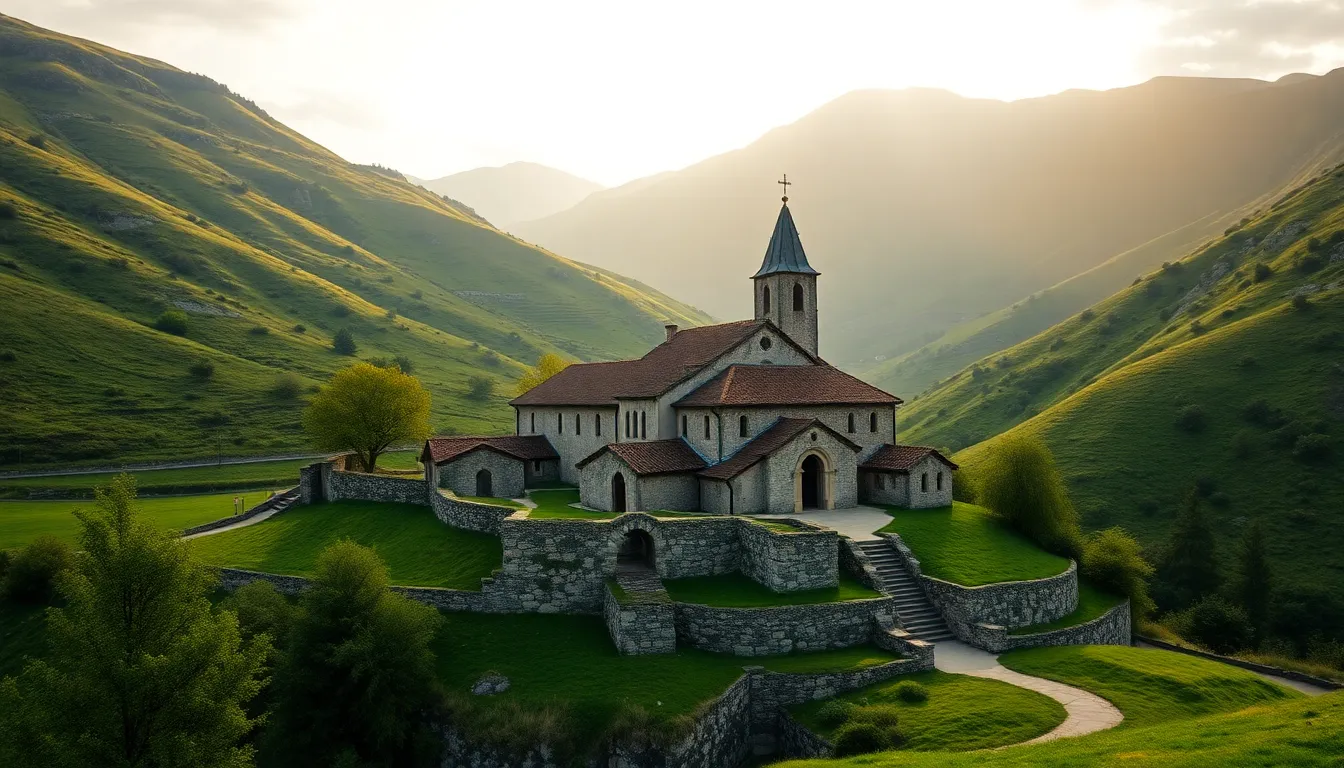
Most group leaders have never heard of Santo Toribio de Liebana, and I understand why. It is tucked into the green folds of the Picos de Europa mountains in Cantabria, far from the famous routes, and it does not have the grandeur of Santiago or the scale of the Pilar. But when I tell a group what this small stone monastery holds, the room goes quiet. Because Santo Toribio claims to hold the largest surviving piece of the True Cross in the world, and it is one of only a handful of places on earth granted the privilege of a perpetual Holy Year. For a faith group, that combination makes the long drive into the mountains entirely worth it.
If you are a pastor or educator considering this shrine, here is the background I share and the reason I think it deserves a place on more itineraries than it gets.
The Lignum Crucis
The relic at the heart of Santo Toribio is called the Lignum Crucis, the wood of the Cross. Tradition holds that it is the largest preserved fragment of the cross on which Christ was crucified, and the piece itself is substantial, formed of two sections joined into the shape of a cross, with a visible nail hole. It is set into an ornate silver-gilt reliquary and kept in a chapel built for it within the monastery church.
The tradition traces the relic back to Saint Toribio, an early bishop associated with bringing relics from the Holy Land, with the wood later finding its home in this Cantabrian monastery. I am always straightforward with groups about relics of the True Cross. There are many such fragments venerated across the Christian world, and their authenticity cannot be established by historical proof. What can be said with confidence is that this relic has drawn pilgrims to this remote valley for many centuries, and that the devotion surrounding it is real and old.
What moves people here is not a debate about authenticity. It is the chance to stand quietly before an object that countless believers have traveled to see, and to reflect on the cross itself. Pilgrims are able to approach the reliquary, and in the traditional gesture many venerate the relic directly. For a Protestant group, I frame this as a window into how medieval and modern Catholic devotion centers on the passion of Christ, which gives everyone a meaningful place to stand whatever their tradition.
A Perpetual Holy Year
Here is what makes Santo Toribio truly unusual. It is one of a small number of sites in the world, alongside Jerusalem, Rome, Santiago de Compostela, and Caravaca de la Cruz, granted the privilege of celebrating a Jubilee or Holy Year. At Santo Toribio, the Holy Year, the Ano Jubilar Lebaniego, occurs whenever the feast of Saint Toribio on April 16 falls on a Sunday.
During a Holy Year, the monastery opens its Door of Forgiveness, the Puerta del Perdon, a special doorway that is sealed shut at all other times. Pilgrims pass through it as part of the Jubilee observance. The tradition of the Jubilee, a designated time of pardon and spiritual renewal, runs deep in Christian history, and Santo Toribio is one of the few places where it is woven into the rhythm of the calendar in this way.
For a group leader, the Holy Year matters for planning. A pilgrimage timed to a Jubilee year at Santo Toribio carries added significance, with the Door of Forgiveness open and the sense of participating in something the wider church recognizes. If your community responds to that frame, it is worth checking which upcoming years qualify and building toward one of them.
The Setting and the History
The monastery sits in the Liebana valley, surrounded by the dramatic limestone peaks of the Picos de Europa, and the setting alone rewards the journey. The current church is largely Gothic, built in the 13th century over a much older monastic foundation that dates back well over a thousand years.
This valley also holds a quiet but important place in Christian intellectual history. In the 8th century, a monk of this monastery named Beatus of Liebana wrote a celebrated commentary on the Book of Revelation. The illuminated manuscripts of his commentary, copied and painted across the following centuries, are among the treasures of medieval art, their vivid imagery of the apocalypse studied by scholars to this day. Pointing this out to a group adds a layer most visitors never learn. This remote monastery was not only a place of relics. It was a place of learning whose influence spread far beyond these hills.
I place Santo Toribio within the wider landscape of Spain’s faith heritage in Spain’s spiritual sites, and it pairs naturally with the great northern pilgrimage tradition.
Fitting It Into a Northern Route
Santo Toribio sits in the green, mountainous north of Spain, the same region the main Camino de Santiago crosses on its way west. That geography is the key to including it well. For groups walking or visiting the Camino, a detour into the Liebana valley is a natural and rewarding addition, and there is even a recognized pilgrimage path, the Camino Lebaniego, that links the northern coast to the monastery.
I usually build Santo Toribio as part of a northern Spain itinerary that includes the Camino, the Cantabrian coast, and the cities of the north rather than as a standalone trip. That way the long mountain drive becomes part of a coherent journey through the cradle of Spanish Christianity. You can see how the Camino and the major shrines fit together in the Marian shrines of Spain heritage guide, and I lay out the full structure in planning a Christian pilgrimage to Spain.
One practical note for the budget conversation with your congregation: with Heritage Tours, group leaders travel free with fifteen or more participants. That threshold is easier to reach when you build your group early, and our group heritage tours page explains how the group leader experience works.
FAQ: Santo Toribio de Liebana
What is the Lignum Crucis at Santo Toribio?
The Lignum Crucis is a relic venerated as the largest surviving fragment of the True Cross, the cross on which Christ was crucified. It is formed of two joined sections in the shape of a cross, with a visible nail hole, kept in a silver-gilt reliquary in the monastery church. As with all relics of the True Cross, its authenticity cannot be proven historically, but it has drawn pilgrims to this Cantabrian valley for many centuries.
What is the Holy Year at Santo Toribio?
Santo Toribio is one of only a few sites in the world, alongside Jerusalem, Rome, Santiago de Compostela, and Caravaca de la Cruz, granted the privilege of a Jubilee or Holy Year. At Santo Toribio it occurs whenever the feast of Saint Toribio on April 16 falls on a Sunday. During a Holy Year the monastery opens its Door of Forgiveness, which is sealed at all other times, and pilgrims pass through it as part of the observance.
Is Santo Toribio suitable for a Protestant group?
Yes, with honest framing. The relic veneration is a Catholic devotion, but the site offers any Christian group a meaningful chance to reflect on the cross and the passion of Christ. The monastery’s role in Christian intellectual history, through Beatus of Liebana’s famous commentary on Revelation, adds depth that speaks across traditions. We present the relic and the devotion clearly so every group member has a place to stand.
How do you reach Santo Toribio?
The monastery lies in the Liebana valley in Cantabria, in the mountains of northern Spain, reached by a drive into the Picos de Europa. It sits in the same northern region the Camino de Santiago crosses, so we usually include it within a broader northern itinerary rather than as a standalone visit. A recognized pilgrimage path, the Camino Lebaniego, links the coast to the monastery for groups who want to walk part of the way.
Should we plan our trip around a Holy Year?
If your community responds to the Jubilee tradition, it is worth it. During a Holy Year the Door of Forgiveness is open and the visit carries the added significance of a recognized church observance. Since the Holy Year only falls when the feast of Saint Toribio lands on a Sunday, it is worth checking which upcoming years qualify and building toward one of them. We can help you identify those dates and plan accordingly.
If Santo Toribio and the Lignum Crucis speak to your community, I would be glad to help you weave this hidden shrine into a northern Spain journey. Reach out whenever you are ready to start planning.