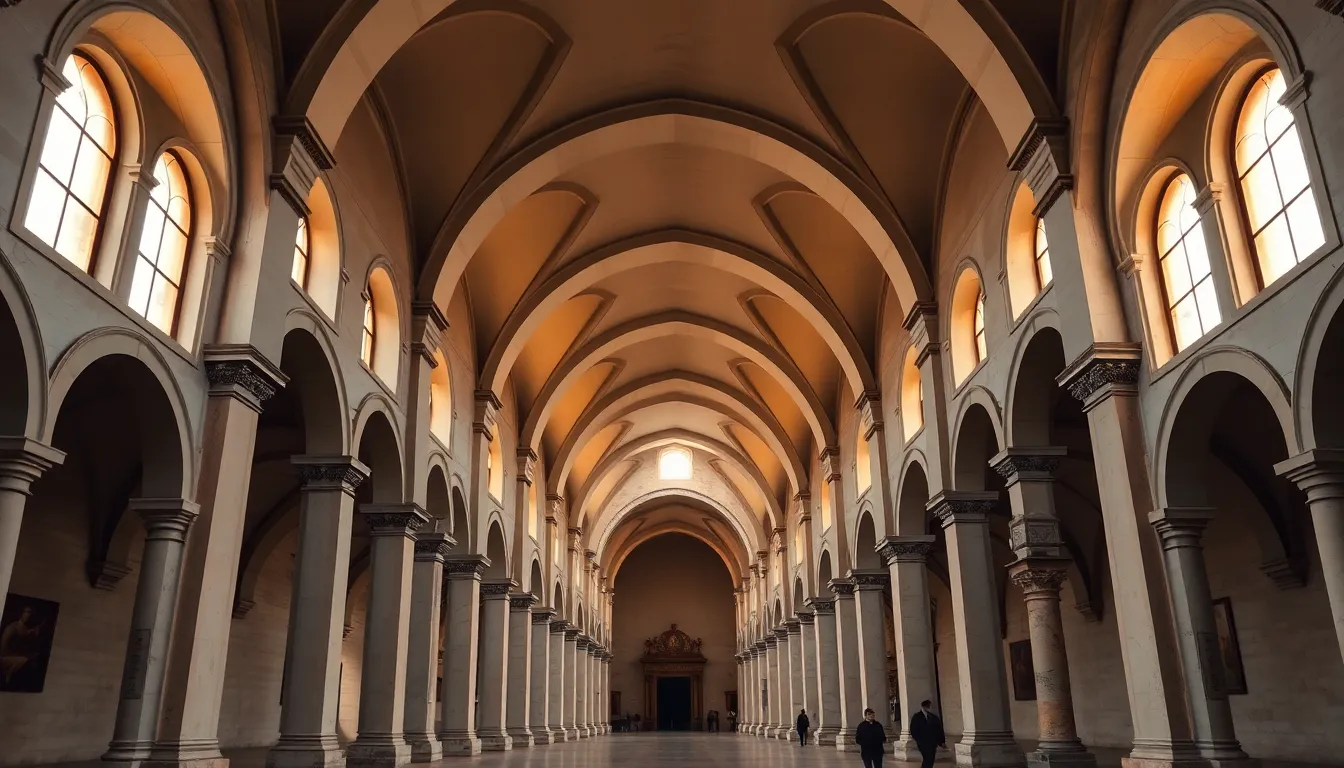
People walk into Santa Maria la Blanca and they almost always say the same thing: it does not look like what they expected. They came to see a synagogue and they are standing in a forest of white horseshoe arches that looks, at first glance, like a mosque. That confusion is the whole point. It is the most honest thing this building can teach a group, and I have learned to let it sit with people before I explain anything.
If you are leading a community to Toledo, Santa Maria la Blanca will be one of the buildings that stays with them. Let me tell you what it is, why its history is complicated, and what your group actually walks into.
The Oldest Standing Synagogue in Toledo
Santa Maria la Blanca was built around 1180, which makes it the oldest of Toledo’s surviving synagogues and one of the oldest synagogue structures still standing in Europe. Its original name was the Ibn Shoshan Synagogue, after the family connected to its founding. It served the Jewish community of Toledo through the height of the city’s medieval Jewish life.
That date, the late 12th century, places it firmly in the world of Al-Andalus and the cultural exchange that shaped it. The building was constructed by Muslim craftsmen, in the Almohad style, for a Jewish congregation, in a city under Christian rule. Like so much of Jewish Spain, it is a building that does not belong to any single tradition cleanly. It belongs to all three at once.
The White Arches: What a Group Sees
Inside, the space is divided into five aisles by rows of pillars, twenty-eight octagonal columns in all, each topped with a carved capital and joined by horseshoe arches. The whole interior is whitewashed, which is where the later name comes from, and the effect of all that white under the light is genuinely striking. The arches march away in every direction. The capitals carry delicate pinecone and scroll patterns. It feels less like a single room than a grove.
Why It Looks Like a Mosque
I always raise this with the group directly, because someone is going to think it. The horseshoe arch, the columned hall, the geometric capitals, these are the visual language of Islamic Spain. The same craftsmen who built mosques built this synagogue, and they built it in the style they knew. To stand here is to see, in stone, that the line between these cultures in medieval Toledo was not a wall. It was a shared workshop.
This is one of the clearest teaching moments on the whole Spain itinerary. A book can tell your group that Jewish, Muslim, and Christian cultures intertwined in Al-Andalus. Standing under these arches, they do not have to take it on faith.
The Complicated Later History
Here is where I slow down, because this building’s story is harder than its beauty suggests, and I do not believe in hiding that from a group.
Santa Maria la Blanca stopped being a synagogue around 1411. The Jewish community of Toledo had been attacked in the wave of violence and forced conversions that swept Castile in 1391, and in the years that followed, this synagogue was taken from the community and converted into a church. That is where the Christian name, Santa Maria la Blanca, comes from. This happened nearly a century before the 1492 expulsion. The loss of this particular building was an early chapter of the larger catastrophe, not its conclusion.
Over the centuries after that it served as a church, a refuge, a storehouse, even a barracks at points. It was never returned to Jewish use. Today it is owned by the Catholic Church and run as a monument, which means your group is visiting a former synagogue, turned church, now preserved as heritage, still under Christian ownership. I tell groups this plainly. It is not a comfortable fact, but it is the true one, and a community that came all this way deserves the truth rather than a tidy version.
Holding That History With Dignity
I do not turn this into a grievance, and I do not turn it into nothing. The way I handle it is to name what happened, give the group room to feel it, and then point to what the building still does. It still stands. The arches the community worshipped under are still here. People still come from all over the world to read this space and remember the congregation that prayed in it. The continuity is in the visitors now, and that is not a small thing.
How a Group Moves Through It
A few practical notes from years of bringing groups here.
The visit itself is short. There is no museum attached, so the building is the whole experience, and a group can take it in within twenty to thirty minutes. That makes it easy to pair with El Transito, the other surviving Toledo synagogue, which is a few minutes’ walk away and includes the Sephardic Museum. I almost always do the two together, and I usually save Santa Maria la Blanca for second, so the group can sit with the contrast.
Both synagogues sit within the old Juderia of Toledo, so the walk between them is itself part of the visit. The lanes are narrow and atmospheric, and I let the group feel the neighborhood rather than hurrying them from door to door.
Modest dress is appropriate. The site charges a small admission. Photography policies shift, so I confirm them fresh for each group rather than promising in advance.
Why This Building Belongs on Your Itinerary
Some group leaders ask whether they really need both Toledo synagogues, or whether one is enough. My answer is that they teach different lessons and you want both.
El Transito teaches you about written Jewish presence, the Hebrew on the walls, the named patron, the museum that tells the full arc. Santa Maria la Blanca teaches you about the shared world that produced it and the early loss that foreshadowed 1492. Together they give your community the height of the Golden Age and the beginning of its unraveling, in two rooms, in one morning. That is a rare thing to be able to offer a group, and Toledo offers it within a few hundred steps.
FAQ: Visiting Santa Maria la Blanca in Toledo
Why is a synagogue called Santa Maria la Blanca?
The name is Christian and came after the building was taken from the Jewish community and converted into a church around 1411. “La Blanca,” the white one, refers to the whitewashed interior and its white arches. Its original name was the Ibn Shoshan Synagogue. We always explain the name to groups, because it carries the building’s whole history.
Is Santa Maria la Blanca still a synagogue?
No. It stopped serving as a synagogue in the early 15th century and was never returned to Jewish use. Today it is preserved as a monument under Catholic Church ownership and visited as a heritage site. Groups come to read the space and remember the congregation that worshipped there, not to attend services.
How is it different from El Transito?
Santa Maria la Blanca is older, built around 1180, and is known for its open hall of white horseshoe arches and octagonal columns. El Transito, from 1357, is denser, covered in Mudejar stucco and Hebrew inscriptions, and houses the Sephardic Museum. The two sit a short walk apart and are usually visited together.
How long does a group need at Santa Maria la Blanca?
Twenty to thirty minutes is usually enough, since there is no museum attached and the building itself is the experience. Most groups pair it with El Transito for a fuller morning in the Juderia.
How do you handle the difficult history with a group?
I name it honestly. This was a synagogue taken from its community and converted, an early chapter of the persecution that led to the 1492 expulsion. I give the group room to feel that, then I point to what endures: the building still stands, and people still come to remember the community that built it. The history is held with dignity, not avoided and not turned into mere grievance.
If Toledo is part of the journey you are imagining for your community, I would welcome the conversation. Heritage Tours builds each Spain itinerary around the history and interests of your group, and with fifteen or more participants the group leader travels free. You can read more about Jewish heritage in Spain or see how we run our group heritage tours.
Contact us whenever you are ready to begin.