Eight Centuries of Jewish Life in Spain
The Jewish presence in Spain lasted roughly eight hundred years. That is not a footnote in history. That is a civilization. Generations of families were born, studied, worshipped, traded, wrote poetry, practiced medicine, and built communities across the Iberian Peninsula. From the earliest settlements in Roman times through the medieval Golden Age and up to the devastating expulsion of 1492, Spain was one of the most important centers of Jewish life the world has ever known.
For a rabbi considering whether to bring a congregation to Spain, this is the context that matters most. You are not visiting a place where Jews once passed through. You are walking through a country where your community’s ancestors lived full, complex lives for longer than most modern nations have existed.
The Golden Age: When Jewish, Muslim, and Christian Scholars Worked Together
The period from roughly the 10th to the 12th century is often called the Golden Age of Spanish Jewry, and the name is not exaggerated. Under certain Muslim rulers in Al-Andalus, Jewish scholars reached extraordinary heights. Maimonides, born in Cordoba in 1138, became one of the most influential Jewish thinkers in history. Judah Halevi, the great poet and philosopher, wrote some of the most important Hebrew poetry ever composed on Spanish soil. Abraham ibn Ezra, born in Tudela, produced biblical commentaries still studied today.
What made this possible was a culture of intellectual exchange that is hard to imagine from our present moment. Jewish, Muslim, and Christian scholars translated Greek texts together, shared advances in mathematics and astronomy, and built libraries that drew thinkers from across the Mediterranean. This was not paradise. There were periods of persecution, and the tolerance was always conditional. But the achievement was real, and the physical evidence of it is still standing in Cordoba, Toledo, and Granada.
Toledo’s Jewish Quarter: El Transito and Santa Maria la Blanca
Toledo is the heart of Jewish Spain. The Jewish quarter here was one of the largest and most significant in the medieval world, and two of Spain’s three surviving medieval synagogues stand within its walls.
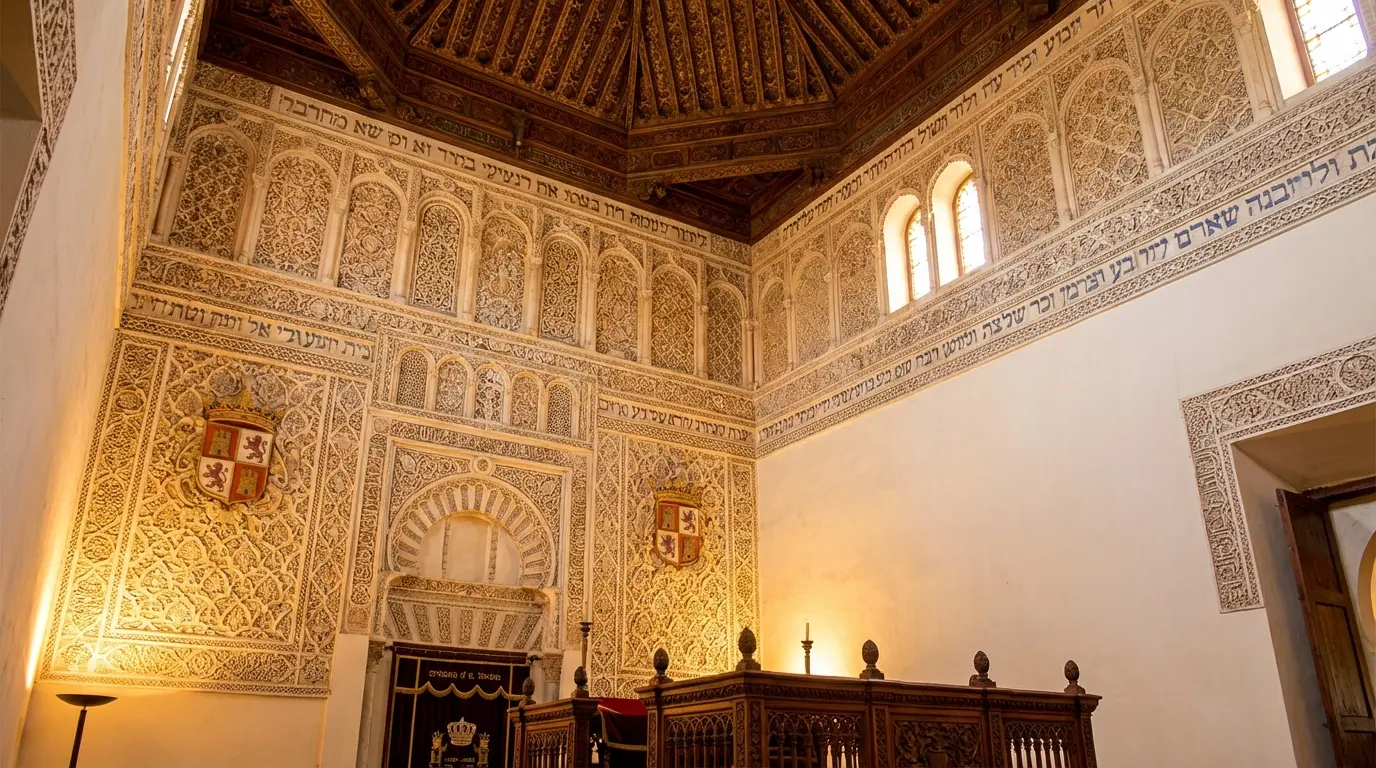
El Transito, built in 1357 by Samuel Halevi, treasurer to King Pedro I, is the more historically significant of the two. The interior walls are covered in elaborate Mudejar stucco work, with Hebrew inscriptions from Psalms carved alongside decorative geometric patterns. After the expulsion, it was converted into a church, then a military barracks, before becoming the Sephardic Museum it is today. The museum does excellent work telling the full story of Sephardic life in Spain.
Santa Maria la Blanca, originally known as the Ibn Shoshan Synagogue, is slightly older and architecturally stunning. The white horseshoe arches and octagonal columns create a space that feels both a mosque and a synagogue, a physical testament to the cultural exchange of Al-Andalus. It was converted into a church in 1405, nearly a century before the expulsion.
When your group stands inside either of these buildings, explain the layers. This is a synagogue that became a church that became a museum. Every conversion tells a chapter of the story.
Cordoba’s Synagogue: One of Only Three That Survived
Cordoba’s synagogue is small. That is the first thing every visitor notices. After the grandeur of El Transito, this single room on a quiet street in the old Jewish quarter can feel almost modest. But its significance is enormous.
Built in 1315, it is one of only three medieval synagogues still standing in all of Spain. The walls still carry Hebrew inscriptions and Mudejar plasterwork. The women’s gallery, accessible by a narrow staircase, is still visible. For a community that once numbered in the tens of thousands across Cordoba alone, this single room is what survived.
The synagogue sits just steps from the Mezquita, Cordoba’s famous mosque-cathedral. Visiting both in the same morning creates a powerful experience for any heritage group, two sacred spaces, two stories of faith, within a few minutes’ walk of each other.
Girona’s Call: A Jewish Quarter That Feels Intact
Girona’s Jewish quarter, known as El Call, is unlike any other in Spain. Where Toledo and Cordoba offer individual buildings of great importance, Girona offers something closer to a complete environment. The narrow medieval lanes, the stone staircases, the doorways that have not been widened or modernized, all of it creates a sense of walking through the neighborhood as it was.
The Jewish community in Girona flourished for over six centuries. The Museum of Jewish History, located in the heart of the Call, traces this entire arc. Its collection includes medieval documents, ritual objects, and archaeological findings from the surrounding area. The museum is small enough for a group to visit together and substantive enough to anchor a meaningful conversation.
For rabbis who have already taken groups to Toledo, Girona is the natural next step. It is quieter, more intimate, and gives your community space to absorb what they are seeing without the crowds that Toledo draws in peak season.
The 1492 Expulsion, and What Happened Next
On March 31, 1492, Ferdinand and Isabella signed the Alhambra Decree, ordering every Jew in Spain to convert to Christianity or leave within four months. The decree was issued the same year they funded Columbus’s voyage to the Americas. While one expedition sailed west toward a new world, an entire people were forced out of the only home they had known for eight centuries.
The numbers are debated by historians, but somewhere between 40,000 and 200,000 Jews left Spain. Many went to Portugal, only to face forced conversion there a few years later. Others scattered across North Africa and Italy. But the largest group found refuge in the Ottoman Empire, where Sultan Bayezid II reportedly said of Ferdinand: “You call this man wise? He has impoverished his own country to enrich mine.”
The Sultan sent ships. Sephardic Jews settled in Istanbul, Thessaloniki, Izmir, and across the Ottoman lands. They brought with them their language, Ladino (a form of medieval Spanish), their music, their cooking, and their traditions. That community is still alive in Istanbul today. When you visit the synagogues of Balat in Istanbul, you are hearing the continuation of a story that began in Toledo.
For a rabbi bringing a congregation to Spain, understanding the expulsion is not just historical context. It is the emotional center of the trip. And knowing that the story did not end in 1492, that it continued across the Mediterranean, gives your group something to carry forward.
What This History Means for a Group Visit Today
Spain’s Jewish heritage sites are not ruins of a forgotten people. They are the physical evidence of a civilization that shaped Jewish thought, literature, philosophy, and religious practice in ways that are still felt today. When your congregation stands in El Transito and reads the Hebrew inscriptions on the walls, they are not looking at artifacts. They are reading the words of their own tradition, carved into stone by people who lived full Jewish lives in this place.
That is what makes Spain different from a textbook. A book can tell you that Maimonides was born in Cordoba. Standing in the square that bears his name, in the city where he studied and prayed, makes that fact feel personal.
If you are considering Spain for your community, I would welcome the chance to talk about what that trip could look like. Heritage Tours builds every itinerary around the specific interests and history of your group. With 15 or more participants, the group leader travels free. Learn more about our Spain heritage tours and let us know when you are ready to start the conversation.
FAQ: Jewish Heritage Travel to Spain
What are the most important Jewish heritage sites in Spain?
Toledo’s El Transito Synagogue and Santa Maria la Blanca are the most significant. Cordoba’s medieval synagogue, one of only three surviving in Spain, is essential. Girona’s Call offers one of Europe’s best-preserved Jewish quarters. Beyond these, Lucena, Besalu, and Segovia hold important Sephardic history that most standard tours overlook.
What happened to Spanish Jews in 1492?
Ferdinand and Isabella signed the Alhambra Decree on March 31, 1492, ordering all Jews to convert or leave Spain within four months. Tens of thousands departed. The largest group was welcomed by the Ottoman Empire, where Sultan Bayezid II sent ships to bring them to safety. Their descendants, known as Sephardic Jews, maintained their language and traditions for centuries.
How many medieval synagogues survive in Spain today?
Three. Two are in Toledo: El Transito (now the Sephardic Museum) and Santa Maria la Blanca. The third is in Cordoba. All three were converted to churches after the expulsion and later preserved as cultural heritage sites. Other communities had synagogues, but they were destroyed or repurposed beyond recognition.
What is the Sephardic citizenship law and who qualifies?
In 2015, Spain passed a law offering citizenship to descendants of Sephardic Jews expelled in 1492. Applicants needed to demonstrate Sephardic ancestry and a connection to Spain. The application window has closed, but the law remains historically significant as an official acknowledgment of the expulsion. Several heritage sites now reference it in their exhibits.
Is Spain’s Jewish heritage suitable for a synagogue group tour?
Very much so. Spain holds some of the most significant Sephardic heritage sites in the world, and the story it tells, from the Golden Age through the expulsion, is deeply relevant to Jewish communities today. A group trip allows your congregation to experience this history together, with the context and discussion that a guided heritage tour provides. The story also connects directly to Turkey, where expelled Sephardic Jews were welcomed by the Ottoman Sultan.