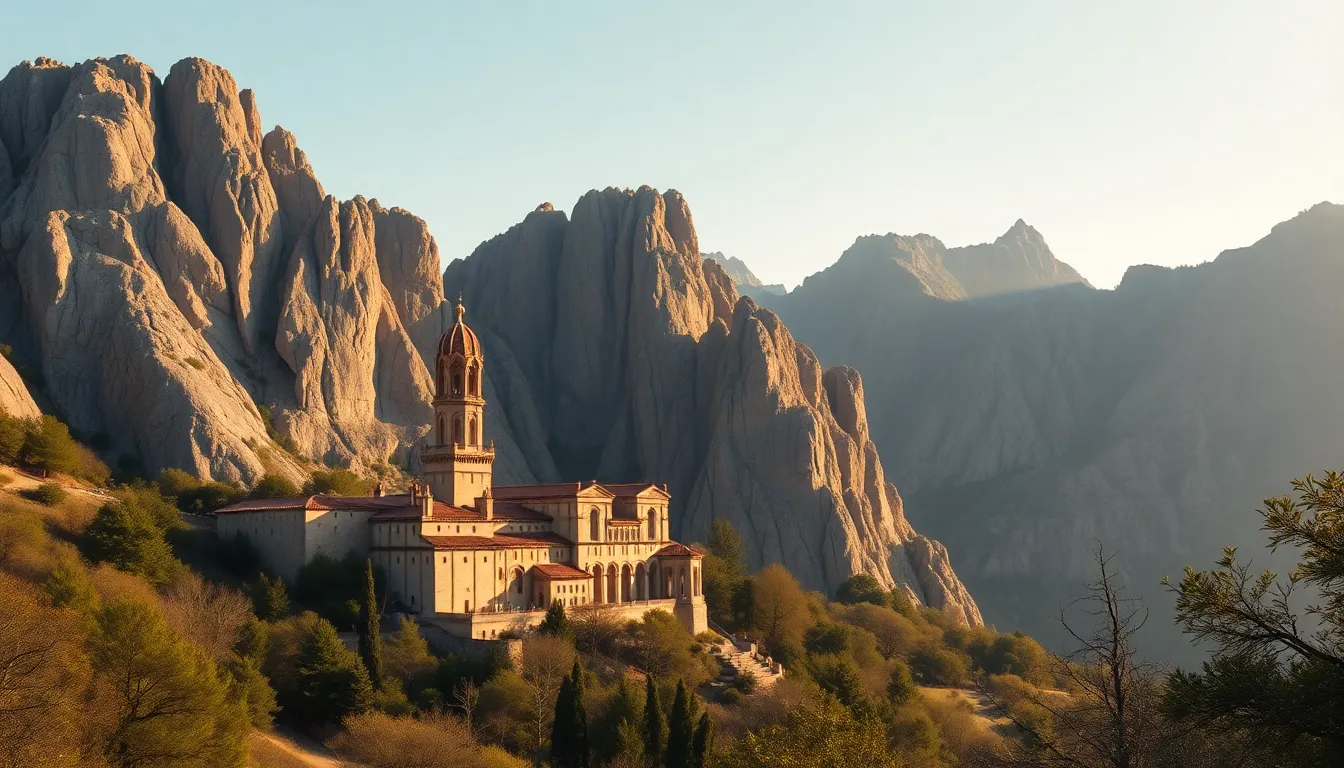
The first time I brought a group up to Montserrat, the coach came around a bend on the road from the valley floor and the whole bus went quiet. That doesn’t happen often. People had been chatting, comparing photos from Barcelona, and then the mountain came into view and the conversation just stopped. You see the rock first, those strange rounded pinnacles standing up out of nowhere, and then, tucked into a ledge halfway up, the monastery. It looks like it grew out of the stone.
I have led groups to a lot of places. Montserrat is one of the few that quiets a room before anyone has said a word about its history. So let me tell you what that history actually is, because the silence on the bus is only the beginning of what a well-prepared group can take from this mountain.
The Mountain That Gave the Place Its Name
Montserrat means “serrated mountain” in Catalan, and the moment you see it the name explains itself. The massif rises sharply to about 1,236 meters, and its summit is a row of rounded rock towers that look like they were cut with a saw. Geologists will tell you it is conglomerate rock, pebbles and sediment compressed and then lifted and eroded over millions of years. The locals had a different explanation for centuries. They said the angels sawed the mountain into that shape to make a worthy throne for the Madonna.
For Catalans, this is not just a beautiful mountain. It is the spiritual heart of the region, the place their identity is rooted. When you understand that, you understand why the monastery sits where it does and why it has survived everything thrown at it.
The Benedictine Abbey: A Thousand Years of Continuous Prayer
The monastery of Santa Maria de Montserrat is Benedictine, which means the community lives by the Rule of Saint Benedict, written in the sixth century. The rule organizes life around prayer, work, and study, summed up in the old phrase “ora et labora,” pray and work. A monastery has stood on this ledge since at least the early eleventh century, founded around 1025 under Abbot Oliba of Ripoll, who established it as a priory.
I want group leaders to sit with that number for a moment. There has been a community praying on this rock, more or less without interruption, for a thousand years. There were monks here when the First Crusade set out. There were monks here when Columbus sailed. The continuity is the point. When you stand in the basilica, you are not looking at a preserved relic of something that ended. You are a visitor in a place that is still doing the exact thing it was built to do.
What Napoleon and Spain Could Not Erase
The monastery has been destroyed and rebuilt more than once. Napoleon’s troops sacked and burned it in 1811 and 1812 during the Peninsular War, and much of the medieval complex was lost. In the nineteenth century the religious orders of Spain were suppressed for a time, and the community was scattered. In the twentieth century, under the Franco dictatorship, Montserrat became a quiet refuge for Catalan language and culture when both were being suppressed. The abbey sheltered people, printed in Catalan, and held services in the language when that was a risk.
I mention this because it changes how a group reads the place. Montserrat is not a museum of medieval piety. It is a community that has repeatedly been a place of resistance and shelter. For a pastor or rabbi leading a group, that is a richer conversation than architecture alone.
La Moreneta: The Black Madonna of Montserrat
The reason most pilgrims have come for nine centuries sits in a small chapel above the main altar. La Moreneta, “the little dark one,” is a wooden statue of the Virgin Mary holding the Christ child. She is a Romanesque carving, generally dated to the late twelfth century, and she is dark. The face and hands are nearly black.
People always ask why. The honest answer is that the wood and the varnish have darkened over eight hundred years, partly through age, partly through centuries of candle smoke and lamp soot in the chapel. Whatever the cause, the darkness became part of her identity, and the legends grew around her. The most repeated story says shepherds found the image in a cave on the mountain in the year 880, guided by lights and music, and that when the bishop tried to move her down to the city she became too heavy to lift, a sign she wished to stay on the mountain. The chapel was built where she would not be moved.
How Groups Visit Her
The statue sits in a niche, and pilgrims file up a side stairway to pass directly in front of her. Through an opening in the protective glass, her right hand, holding an orb, is left exposed, and the tradition is to touch or kiss the orb while praying. The line moves steadily. For a Catholic group this is a genuine devotional moment. For a Protestant group it is worth observing respectfully, and often worth discussing afterward, because Marian devotion is one of the real points of difference between traditions and Montserrat puts it right in front of you.
For a Jewish group, this is plainly a cultural and historical visit rather than a devotional one, and that is entirely fine. The mountain, the thousand-year community, and the story of the abbey as a place of shelter all carry weight that does not depend on shared theology.
The Escolania: One of the Oldest Choirs in Europe
If your timing is right, you will hear the Escolania de Montserrat, the boys’ choir attached to the monastery. It is one of the oldest boys’ choirs in Europe, with roots going back to the thirteenth century, and the boys live and study at a school on the mountain. They typically sing a short program in the basilica around midday and again in the early evening, the most famous moment being the singing of the “Virolai,” the hymn to the Madonna of Montserrat.
I will be plain about this. Hearing those voices fill that stone basilica is one of the experiences my groups talk about for years afterward. It is brief, often little more than ten minutes, so you have to plan the day around it. Confirm the choir’s schedule before you set your itinerary, because the boys are away on school holidays and the schedule changes.
Planning the Visit for a Faith Group
Montserrat sits about an hour northwest of Barcelona, which makes it a natural day trip or half-day visit on a Spain itinerary. Here is what I tell group leaders.
Go early. The mountain fills with general tourists by late morning, and the basilica and the line to see La Moreneta get crowded. An early arrival gives your group the chapel in relative quiet and better light on the mountain.
Build the day around the choir if you can. Check the Escolania schedule first, then work backward.
Leave time to walk. There are paths along the ridge and a funicular up to the Santa Cova, the holy cave where the image was supposedly found, and another up toward Sant Joan with views over the whole massif. Even thirty minutes on the mountain outside the basilica changes the visit. The silence and the scale of the rock are part of the experience.
Mind the practicalities for older travelers. The site is at altitude, there are stairs and slopes, and weather on the mountain can be cooler and windier than in Barcelona. A group with members in their seventies and eighties can absolutely manage Montserrat, but plan the pace.
If you are reading this while shaping a wider trip, Montserrat pairs naturally with the other sites I write about in our guide to spiritual sites in Spain, and it sits well alongside the great cathedral cities. Many of my groups combine it with Toledo Cathedral and the city of three faiths and with the long story of the Reconquista that shaped Catalonia and the rest of the peninsula.
FAQ: Visiting Montserrat Monastery
Why is the Madonna of Montserrat black?
The statue, known as La Moreneta, is a Romanesque wood carving from around the late twelfth century. Its dark color comes mainly from the natural aging and darkening of the varnish and wood over the centuries, accelerated by long exposure to candle and lamp smoke in the chapel. Over time the darkness became part of her identity and devotion, and she is now one of the most venerated Black Madonnas in the world.
Is Montserrat worth visiting for a non-Catholic group?
Yes. The serrated mountain itself is remarkable, the Benedictine community has prayed on this rock for a thousand years, and the abbey’s role as a shelter for Catalan culture under Franco gives it a story that reaches well beyond Catholic devotion. Protestant groups often find the visit sparks good conversation about Marian devotion, and Jewish groups visit it as a cultural and scenic stop. Most leaders who include it report their people found it meaningful regardless of background.
How do I plan the visit around the boys’ choir?
The Escolania de Montserrat usually sings a short program in the basilica around midday and again in the early evening, though the schedule changes and the boys are away during school holidays. Confirm the current schedule before fixing your itinerary, then build the day around it. The choir sings for only about ten minutes, so timing matters.
How long does a group need at Montserrat?
A focused visit covering the basilica, the chapel of La Moreneta, and the choir takes about two to three hours. If you want to add the funiculars up to the Santa Cova or Sant Joan for the walks and views, plan a half day. Going early in the morning is the single best thing you can do to avoid the midday tourist crowds.
How far is Montserrat from Barcelona and how do groups get there?
Montserrat is about an hour northwest of Barcelona by road, which makes it an easy half-day or full-day excursion. Faith groups almost always travel by private coach, which lets you arrive early, control your timing around the choir, and keep an older group comfortable. The final approach up the mountain is part of the experience.
If Montserrat is on your mind for your congregation’s Spain journey, I would be glad to help you fit it into a wider itinerary and time the visit so your group hears the choir and beats the crowds. Start the conversation with us here.