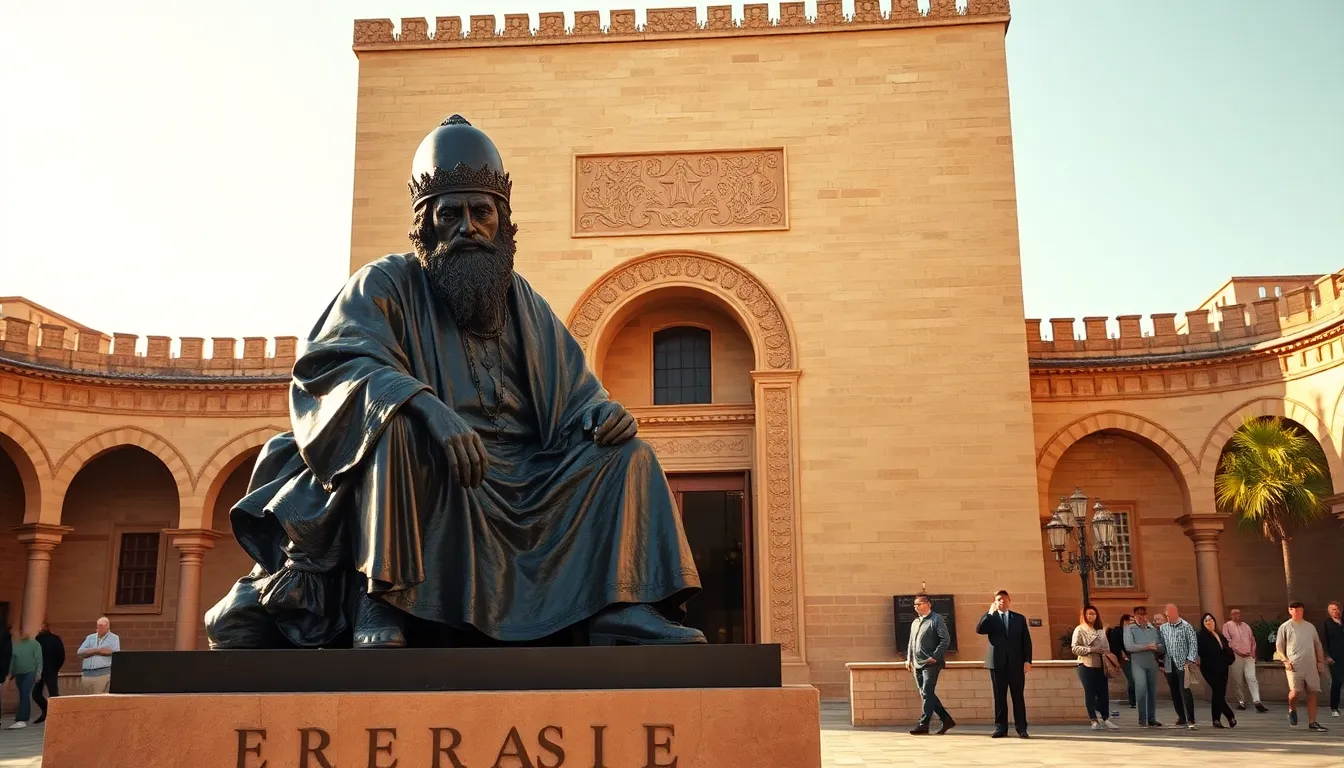
There is a small square in the Juderia of Cordoba where a bronze statue of Maimonides sits, robed and turbaned, a book in his hand, looking out over the lane. Groups gather around him, and I always pause there longer than the size of the square would suggest. Because this is not just a statue. This is the city that produced one of the most consequential minds in Jewish history, and standing in front of him in the place he was born changes how a fact you have known your whole life actually feels.
If you are a rabbi or an educator bringing a community to Spain, the Maimonides connection in Cordoba is one of the moments that turns history into something personal. Let me tell you who he was, what the city holds, and what your group experiences there.
Who Maimonides Was
Moses ben Maimon, known in Hebrew tradition as the Rambam, was born in Cordoba in 1138, during the long twilight of the Golden Age of Spanish Jewry. He became, in a single lifetime, one of the greatest Jewish legal authorities, philosophers, and physicians the tradition has ever produced. There is an old saying, “From Moses to Moses, there was none like Moses,” placing him in the company of Moses himself. That is the regard in which he is held.
His achievements are hard to overstate for a group. He wrote the Mishneh Torah, a comprehensive code of Jewish law still studied in every yeshiva. He wrote the Guide for the Perplexed, a philosophical work that shaped Jewish, and even Christian and Islamic, thought for centuries. He served as a court physician and wrote medical treatises read across the medieval world. He did all of this as a working rabbi, judge, and doctor, not a cloistered scholar. I want groups to feel the full breadth of that before we stand in front of his statue.
Why Cordoba, and Why He Left
Here is a part of the story I never skip, because it connects directly to the themes of the whole Spain journey.
Maimonides was born in Cordoba, but he did not live out his life there. When he was a boy, the Almohads, a more rigid Muslim dynasty, took control of Al-Andalus and ended the relative tolerance that had let Jewish life flourish. His family was forced to leave. They wandered for years, through Spain and North Africa, before he eventually settled in Egypt, in Fustat near Cairo, where he lived most of his adult life and where he is buried, in Tiberias, in the land of Israel.
So the Rambam is, in a real sense, a man shaped by exile. The greatest Jewish mind of his age was born in this Spanish city and driven out of it by persecution. That arc, brilliance born in Spain and forced into exile, is the arc of Sephardic history in miniature, three and a half centuries before the great expulsion of 1492. I make sure groups see that resonance. His story is not separate from the story of the synagogues. It is the same story, lived by one extraordinary person.
The Statue in the Juderia
The Maimonides statue stands in the Plaza de Tiberiades, named for the city where he is buried, in the heart of the Juderia of Cordoba. It is a seated bronze figure, scholarly and calm, and over the years a tradition has grown of visitors touching his foot, which has been worn bright by countless hands.
I tell groups about that worn foot, because it says something. People come from all over the world, of every faith and none, to stand with this man. He belongs to the Jewish tradition first and most deeply, but his influence reached so far that Cordoba claims him as a son of the city itself. Standing there, your community is part of a stream of visitors that has not stopped in centuries.
It is a natural place for a group to gather, for a short teaching, a reading from his work, or simply a moment of reflection on a figure most of them have studied without ever expecting to stand where he was born.
What Else the City Holds
The statue is the focal point, but the Maimonides connection enriches several nearby stops.
A few minutes’ walk away is the Cordoba synagogue, one of only three medieval synagogues left in Spain, built after Maimonides’s time but in the same community that formed him. Near the statue there is also a small interpretive space dedicated to his life and thought. And the whole Juderia, the whitewashed lanes around the square, is the texture of the world he was born into.
I build the morning so the group moves naturally between the synagogue, the statue, and the lanes, treating them as one connected experience rather than separate boxes to tick. Cordoba’s Jewish quarter is compact enough that this flows easily.
How a Group Experiences the Maimonides Square
A few practical notes from leading groups here.
The square itself is small and can get busy in peak season, since it is one of the most photographed spots in the Juderia. I plan our time there with that in mind, often arriving earlier in the morning when the lanes are quieter.
This is, above all, a teaching stop. The visit is less about a building to tour and more about a conversation to have. I encourage group leaders to think in advance about what they want to say here, or what passage of the Rambam they might read aloud. The statue gives the words a setting that a classroom never could.
The lanes around the square are cobbled and narrow but level, so this part of the visit is comfortable for mixed-age groups.
Why He Belongs on Your Itinerary
Some group leaders ask whether a statue really merits a dedicated stop. My answer is that this is not really a stop about a statue. It is a stop about continuity.
Your community studies Maimonides. His rulings shape how they keep halacha, his philosophy shapes how they think about God and reason, his story sits inside the larger Sephardic story your trip is built around. Standing in the square where he was born collapses the distance between the text on the page and the human being who wrote it. That is exactly the kind of moment a heritage journey exists to create, and Cordoba offers it more directly than almost anywhere else.
FAQ: Maimonides in Cordoba
Was Maimonides born in Cordoba?
Yes. Moses ben Maimon, the Rambam, was born in Cordoba in 1138, during the Golden Age of Spanish Jewry. He did not live his whole life there. His family was forced to flee when the Almohads ended the era of tolerance, and he eventually settled in Egypt, where he spent most of his adult life.
Where is the Maimonides statue in Cordoba?
It stands in the Plaza de Tiberiades, in the heart of the Juderia, the old Jewish quarter. It is a seated bronze figure, and visitors traditionally touch his foot, which has been polished bright over the years. It is a few minutes’ walk from the Cordoba synagogue.
Why did Maimonides leave Spain?
When he was young, the Almohad dynasty took control of Al-Andalus and ended the relative tolerance that had allowed Jewish life to flourish. His family was forced into exile, wandering for years before he settled in Egypt. His life is, in many ways, an early echo of the Sephardic experience of exile that the 1492 expulsion would bring on a vast scale.
What did Maimonides write?
His major works include the Mishneh Torah, a comprehensive code of Jewish law, and the Guide for the Perplexed, a foundational work of Jewish philosophy. He also wrote influential medical treatises while serving as a court physician. His writing shaped Jewish, Christian, and Islamic thought for centuries.
Is the Maimonides square worth a group stop?
Very much so, especially as a teaching moment. Standing where the Rambam was born brings the texts your community has studied to life. Many group leaders use the square for a short reading from his work or a reflection on his legacy, with the surrounding Juderia and the synagogue completing the morning.
If Cordoba and the legacy of Maimonides speak to the journey you are planning, I would welcome the conversation. Heritage Tours builds each Spain itinerary around the history and interests of your group, and with fifteen or more participants the group leader travels free. You can read more about Jewish heritage in Spain or see how we run our group heritage tours.
Contact us whenever you are ready to start planning.