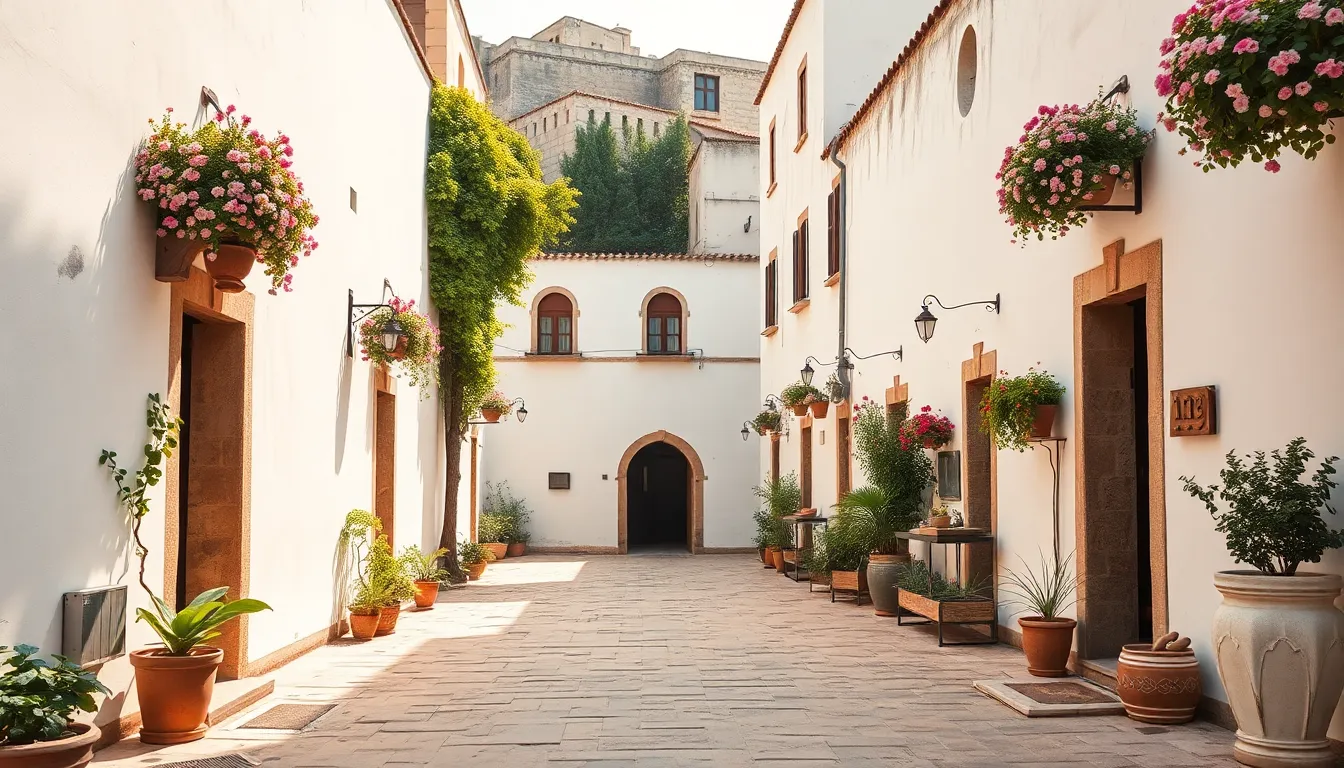
The Juderia of Cordoba is one of those places where I have to remind a group to look up from their cameras. The lanes are so photogenic, whitewashed walls, blue flowerpots, the light bouncing around, that people can spend the whole walk behind a phone screen and miss what they are actually standing in. So I say it early: this beauty is not a backdrop. These are the streets of a Jewish community that lived here for centuries and was driven out. The flowers are lovely. What happened here is more than lovely. Hold both.
If you are a rabbi or an educator planning a Spain journey, the Juderia of Cordoba will be one of its high points. Let me walk you through what it is and what a group visit really involves.
What the Juderia of Cordoba Was
Cordoba was, in the 10th century, one of the largest and most cultured cities in the world, the capital of Al-Andalus, and home to a Jewish community that thrived alongside it. During the Golden Age, Cordoba’s Jews were physicians, scholars, poets, and statesmen. Hasdai ibn Shaprut, the great Jewish courtier and diplomat, served the caliph here. Maimonides, the towering philosopher-physician, was born here in 1138. This was a center of Jewish learning and influence at the very heart of the most sophisticated society in medieval Europe.
The Jewish quarter occupied a network of lanes near the Mezquita, the great mosque. What survives today is a beautifully preserved warren of narrow whitewashed streets, and while much of what your group sees is the living, lived-in old city, the layout and the key sites carry the memory of the community that gave the quarter its name.
I make sure groups understand the height of what Cordoba was before they walk its lanes. The beauty makes more sense, and weighs more, when you know what filled these streets.
The Anchors of the Walk
A few sites give the Juderia its shape for a heritage group, and I plan the walk around them.
The Synagogue
The Cordoba synagogue, built around 1315, is one of only three medieval synagogues left standing in all of Spain. It is small, a single modest prayer hall with Mudejar plasterwork and Hebrew inscriptions on its walls and a women’s gallery upstairs. That smallness is part of its power. Out of a community that once numbered in the thousands, this one room is what survived. It is the spiritual heart of the walk.
The Maimonides Square
A short walk away is the Plaza de Tiberiades, where the bronze statue of Maimonides sits, book in hand. The Rambam was born in this city, and standing in the square named for the place of his burial, in the quarter of his birth, is a moment most groups find quietly powerful. It is a natural place for a short teaching or reading.
The Lanes Themselves
Between these anchors run the lanes that are the experience in their own right. The Calleja de las Flores, the famous flower alley, the narrow passages, the whitewashed walls and the courtyards glimpsed through open doors. This is the texture of the old quarter, and a group should walk it slowly rather than racing between the named sites.
What a Group Sees Walking the Lanes
These are the things I make sure people notice as we go.
The Whitewashed Streets and Courtyards
The signature of Cordoba is white walls and hidden patios, and the Juderia is full of both. Cordoba’s courtyards, the patios, are famous, and even glimpsing one through a doorway gives a group a sense of how life was lived around shaded interior spaces in the heat of Andalusia.
The Mezquita, Steps Away
The Juderia sits right beside the Mezquita, the mosque turned cathedral that is Cordoba’s most famous monument. I point out the closeness deliberately. Within a few hundred steps your group stands near a synagogue, a mosque, and a cathedral, the three faiths of medieval Spain layered into one small district. Few places in the world hold that as compactly.
The Markers and Memory of the Quarter
The city has placed plaques and markers tracing the Jewish history of the quarter, and small interpretive spaces add detail. These traces turn a charming old neighborhood into your community’s specific heritage, and I make sure the group reads them rather than walking past.
How I Structure the Walk
A few practical notes from years of leading groups here.
The Juderia is compact and largely level, which makes it gentler on a mixed-age group than the hills of Toledo. The lanes are cobbled and narrow, and they get crowded in peak season, since this is one of the most visited parts of Cordoba. I tend to start earlier in the morning when the streets are quieter and the light is best.
A full Juderia visit, the synagogue, the Maimonides square, and the lanes around them, runs about two to two and a half hours done properly, and it pairs naturally with the Mezquita next door for a full morning. I leave unstructured time in the lanes rather than booking every minute, because the quarter is best when a group can wander a little and absorb it.
Holding the Story With Dignity
The Juderia of Cordoba is one of the loveliest neighborhoods you will ever walk, and it is also the remnant of a community that was persecuted and expelled. I do not let the charm erase that.
The Jewish community here was diminished by the Almohad persecutions that drove out Maimonides’s family in the 12th century, and the remnant was finally expelled in 1492 with all the Jews of Spain. The whitewashed lanes your group enjoys are quiet today because the people who made this a Jewish quarter were forced to leave it.
But, as with the whole Spain journey, I do not let the visit end in loss. Cordoba’s Jews carried their learning, their language, and their faith across the Mediterranean, and the Sephardic world they seeded kept the memory of cities like this one alive for five hundred years. When your group reads the Hebrew on the synagogue wall and stands at the foot of Maimonides, they are part of that continuity. The community was driven out. The story was not ended. That is the note I want a group to leave on.
FAQ: Visiting the Juderia of Cordoba
What is the Juderia of Cordoba?
It is the historic Jewish quarter of Cordoba, a network of narrow whitewashed lanes near the Mezquita. During the Golden Age, Cordoba was home to a thriving Jewish community of scholars, physicians, and statesmen, and the quarter still holds one of Spain’s three surviving medieval synagogues and the square where Maimonides is honored in the city of his birth.
What are the main sites in the Cordoba Juderia?
The two anchors are the medieval synagogue, one of only three left in Spain, and the Plaza de Tiberiades with its statue of Maimonides. Beyond these, the famous Calleja de las Flores, the whitewashed lanes and courtyards, and the nearby Mezquita complete a group’s experience of the quarter.
How long does it take to walk the Cordoba Juderia?
Done properly, with the synagogue, the Maimonides square, and the surrounding lanes, plan for about two to two and a half hours. It pairs naturally with the Mezquita next door for a full morning. The quarter is compact, so the time goes into walking slowly rather than covering distance.
Is the Juderia accessible for older group members?
It is gentler than Toledo’s Juderia. The Cordoba quarter is compact and largely level, though the lanes are cobbled and narrow and can be crowded in peak season. With a relaxed pace and an earlier morning start, mixed-age groups manage it comfortably.
Why visit the Juderia rather than just reading about it?
Because the place carries what a book cannot. Standing in the synagogue, reading the Hebrew on its walls, gathering at the foot of Maimonides where he was born, walking the same lanes the community walked, turns studied history into shared memory. For a faith community, experiencing it together is the point.
If Cordoba’s Juderia is part of the journey you are imagining, I would welcome the conversation. Heritage Tours builds each Spain itinerary around the history and interests of your group, and with fifteen or more participants the group leader travels free. You can read more about Jewish heritage in Spain or see how we run our group heritage tours.
Contact us whenever you are ready to start planning.